Artificial Intelligence (AI) has changed the way we interact with technology, and at the heart of this revolution are Large Language Models (LLMs).
These powerful AI models can understand, generate, and analyze human-like text to make them perfect for chatbots, coding assistance, and business automation.
Why LLMs Are Essential for AI in 2025?
The demand for AI-powered automation is at an all-time high.
Whether it’s AI models for NLP (Natural Language Processing), customer support chatbots, or AI-driven search engines, the best LLM models of 2025 are offering accuracy & efficiency.
Businesses, developers, and researchers rely on top LLM models 2025 to improve productivity, boost user experience, and generate high-quality content at scale.
Not all large language models are the same. Some are better for text generation, while others excel in coding, automation, or multilingual tasks.
The LLMs market is expected to reach $36.80 billion by 2030.
Wondering which LLM models for AI development are perfect for you?
Don’t worry you are at the right place. Here we tried to explain the best LLM models and do large language comparisons so you can find the right LLM model for your business.
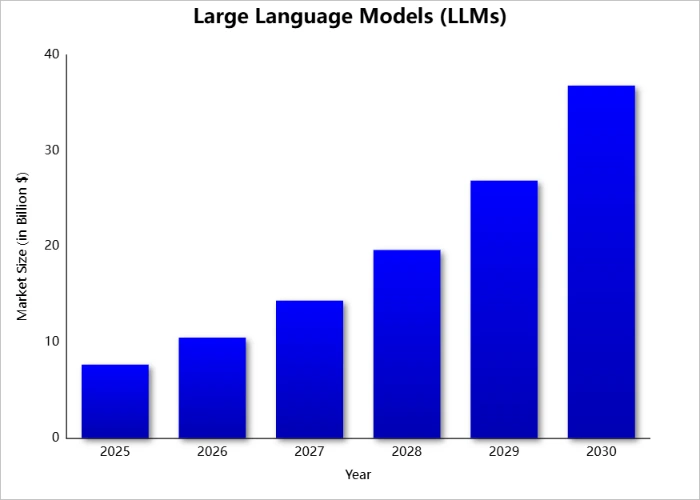
Source: Grand View Research
How LLMs Have Evolved in 2025?
The world of large language models (LLMs) has come a long way in just a few years.
From early models like GPT-3 to the latest top LLM models of 2025, AI has become smarter, faster, and more versatile.
Today’s best LLM models provide better accuracy, real-time responses, and advanced reasoning capabilities to make them necessary for AI-powered applications.
From GPT-3 to GPT-4, Gemini, and Beyond
- The shift from GPT-3 to GPT-4o and Google’s Gemini 2.5 Pro shows a big leap in AI language model performance.
- These new models can handle complex conversations better, generate more accurate responses, and even support multimodal AI.
- They can process not just text but also images, audio, and videos.
- LLM models for AI development now provide deeper contextual understanding to make them ideal for everything from chatbots to enterprise automation.
The Rise of Open-Source LLMs vs. Proprietary Models
- Companies like OpenAI, Google, and Anthropic continue to dominate the large language models in comparison with their proprietary models, and open-source LLMs have gained popularity.
- AI models like LLaMA 3, Mistral, and Falcon offer developers more flexibility, lower costs, and the ability to fine-tune models for specific use cases.
- This shift is changing the way businesses and researchers approach AI-powered automation to build custom solutions without relying on closed-source models.
Major Breakthroughs in AI Language Processing
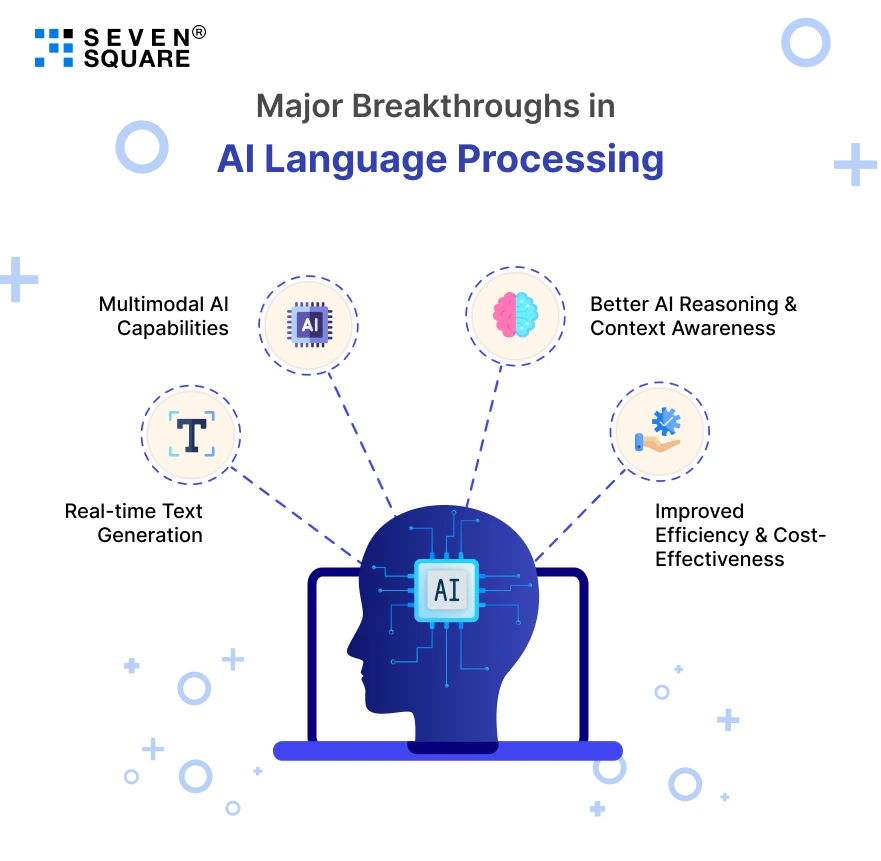
2025 has introduced a few amazing advancements in AI language models:
- Real-time Text Generation: Faster & more natural AI responses with minimal latency.
- Multimodal AI Capabilities: AI that understands and generates text, images, and even video.
- Better AI Reasoning & Context Awareness: LLMs now generate more accurate, fact-based responses.
- Improved Efficiency & Cost-Effectiveness: AI models for NLP and business applications are more scalable than ever.
As AI continues to evolve, the best LLM models of 2025 are going through major changes to make AI-driven applications smarter, more intuitive, and more accessible.
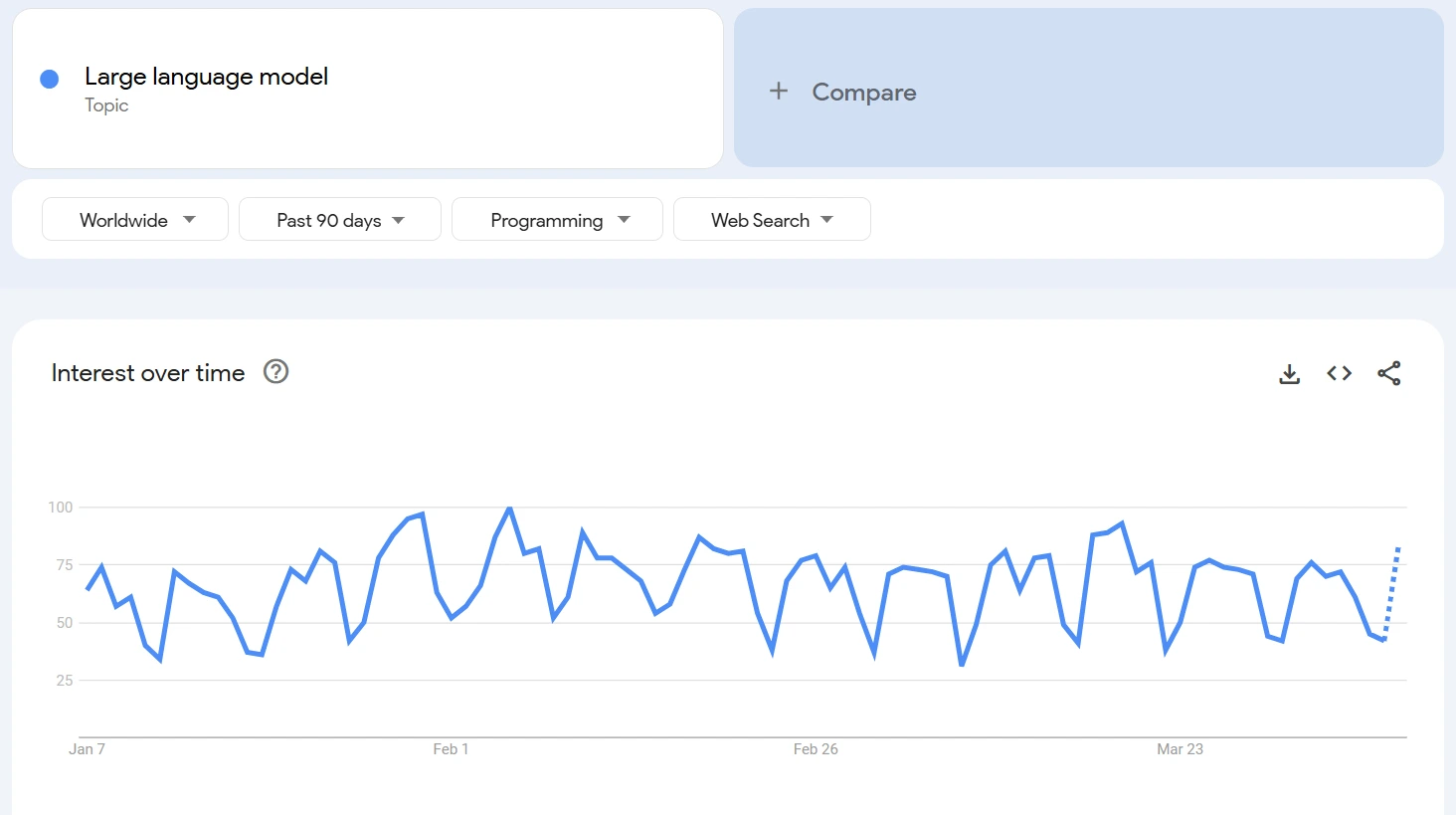
Source: Google Trends
What are the Factors That You Need to Consider While Choosing an LLM?
There are many large language models (LLMs) available in 2025 & choosing the right one can be difficult.
Whether you’re a developer, business owner, or AI researcher, selecting the best model depends on key factors like accuracy, customization, cost, and specific use cases.
Here’s what you need to consider when picking the best LLM models for your needs.
1. Accuracy & Performance
The core of any LLM model for AI development is its ability to generate precise, high-quality responses.
Modern top LLM models 2025 are appraised on benchmarks like MMLU (Massive Multitask Language Understanding) and HELM (Holistic Evaluation of Language Models).
- GPT-4o, Gemini 2.5 Pro, and Claude 3.7 are best for complex reasoning and creative text generation.
- LLaMA 3 and Mistral provide competitive performance among open-source LLMs for NLP tasks.
If your AI application requires deep contextual understanding then go for a model with high accuracy in large language models comparison studies.
2. Customization & Fine-Tuning
Do you need a model that adapts to specific business or research needs? The choice between open-source LLMs and proprietary models matters:
- Open-source LLMs (LLaMA 3.3, Falcon, Mistral):Ideal for fine-tuning and customization without vendor restrictions.
- Proprietary models (GPT-4o, Gemini, Claude): Pre-trained on vast datasets but limited in customization.
For companies developing AI-powered applications with unique requirements & open-source models to provide more control and flexibility.
3. Pricing & Accessibility
AI development costs can add up quickly, so choosing an affordable LLM model is important. Here’s what you need to see:
- Free & Low-Cost LLMs: Open-source models like LLaMA 3.3 and Mistral are budget-friendly options.
- Subscription-Based LLMs: GPT-4o and Claude 3.7 offer API access but come with usage fees.
- Enterprise AI Solutions: Gemini 2.5 Pro and proprietary models provide premium features at higher costs.
If cost is a concern then open-source LLMs offer powerful alternatives without high licensing fees.
4. Best LLMs for Specific Use Cases
Different LLM models for AI development excel in different applications. Here’s a quick guide:
- Coding & Software Development: GPT-4o, Code LLaMA, DeepSeek Coder
- Chatbots & Virtual Assistants: Claude 3.7, Gemini 2.5 Pro, Mistral
- Content Creation & Marketing: GPT-4, LLaMA 3.3, Gemini 2.5 Pro
- AI-Powered Automation: Mistral, Falcon, GPT-4o
Top 10 Large Language Models in 2025 (Ranked & Compared)
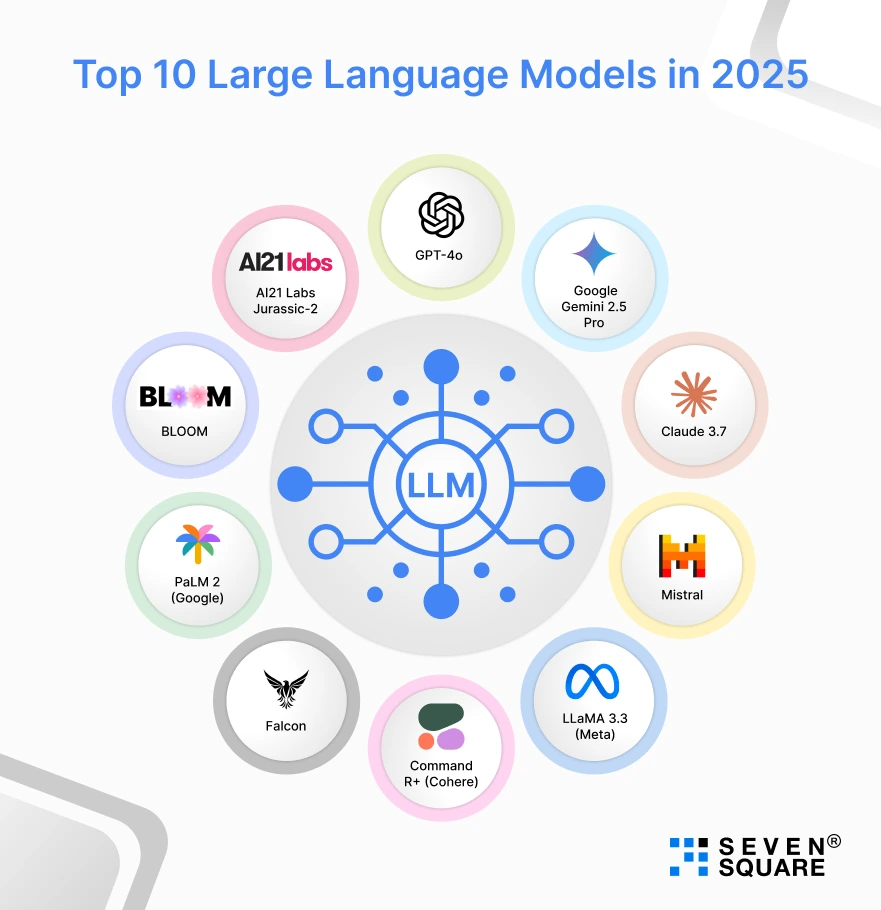
The best LLM models of 2025 are becoming more powerful, efficient, and versatile than ever before.
Whether you’re looking for an LLM model for AI development, chatbot integration, or content creation this list is for you.
Here we compared the top LLM models 2025 based on performance, customization, and real-world applications.
1. GPT-4o (OpenAI) – The Gold Standard
OpenAI’s latest flagship large language model, GPT-4o supports applications like ChatGPT, AI coding assistants, and advanced automation.
Strengths:
- Highly accurate and efficient in generating human-like responses.
- Excels in complex reasoning and problem-solving.
- One of the best AI models for NLP and coding.
Limitations:
- Paid API access with limited free-tier usage.
- Proprietary means no customization like open-source LLMs.
2. Google Gemini 2.5 Pro – Best for Multimodal AI
Google’s AI powerhouse, Gemini 2.5 Pro integrates AI-powered automation into Google Search, Assistant, and enterprise-level applications.
Strengths:
- Advanced multimodal AI (text, image, audio, video processing).
- Strong integration with Google services.
- Efficient in summarization and knowledge retrieval.
Limitations:
- API costs can be high for heavy usage.
- Still improving its factual accuracy.
3. Claude 3.7 (Anthropic) – Ethical & Safer AI
Claude 3.7 is developed by Anthropic and focuses on safe and responsible AI to make it a top choice for businesses and content moderation.
Strengths:
- Best-in-class safety and low-bias AI text generation.
- Perfect for chatbots and customer service applications.
- A strong competitor in large language models comparison.
Limitations:
- May prioritize cautious responses over creativity.
- Limited customization for developers.
4. Mistral – Best Open-Source LLM for AI Development
Mistral is one of the best open-source LLMs that provides businesses and developers with a powerful AI model without high costs.
Strengths:
- Fully open-source that allows for unlimited customization.
- Efficient for AI-powered applications at scale.
- It is a top alternative to proprietary large language models.
Limitations:
- Requires more technical expertise for deployment.
- It doesn’t have extensive training data like GPT-4o.
5. LLaMA 3.3 (Meta) – Open-Source Alternative to GPT-4o
Meta’s LLaMA 3 is a major change in open-source LLMs that provides businesses with a flexible and cost-effective solution.
Strengths:
- Powerful open-source model for AI research and development.
- Best for fine-tuning and customization.
- Strong in LLM models for AI development.
Limitations:
- May require additional training for optimal performance.
- Less optimized for general consumer applications.
6. Command R+ (Cohere) – Best for Enterprise AI
Command R+ is developed by Cohere which is optimized for business applications, content automation, and AI-powered automation tools.
Strengths:
- Perfect for enterprise-level AI applications.
- Provides robust API access for businesses.
- Optimized for document processing and analytics.
Limitations:
- Not widely available for personal use.
- It doesn’t have strong multimodal capabilities.
7. Falcon – Fastest Open-Source AI Model for NLP
Falcon is an open-source AI model designed for NLP applications that offers high-speed performance and lightweight deployment.
Strengths:
- Extremely fast in real-time text generation.
- Best for chatbots and AI-driven automation.
- Open-source with flexible customization.
Limitations:
- Less powerful than proprietary LLMs like GPT-4o.
- It requires additional optimization for specialized use cases.
8. PaLM 2 (Google) – Best for NLP Research & AI Assistants
PaLM 2 is another Google AI model that focuses on natural language processing (NLP) and AI-powered search capabilities but recently it merged into Gemini.
Strengths:
- Strong in AI research and academic applications.
- Best for AI-based assistants and chatbots.
- Supports multiple languages.
Limitations:
9. BLOOM – Large Open-Source AI for Multilingual Use
BLOOM is a multilingual large language model that provides an open-source alternative for global AI applications.
Strengths:
- Supports over 40 languages.
- Best for translation, localization, and AI-powered automation.
- Fully open-source for unrestricted development.
Limitations:
- Requires high computational power.
- Not as refined for conversational AI as GPT-4o.
10. AI21 Labs Jurassic-2 – Best for Long-Form AI Content
Jurassic-2 by AI21 Labs specializes in long-form AI-generated content to make it ideal for marketing, blogging, and document automation.
Strengths:
- Generates detailed and high-quality long-form text.
- Ideal for content creation and AI-powered automation.
- Strong performance in large language models comparison for writing tasks.
Limitations:
- Not optimized for real-time chatbot responses.
- Less known than major competitors like GPT-4o and Claude 3.7.
Whether you’re looking for the most accurate LLM model for AI development, a top open-source LLM, or an AI model for NLP applications this list gives you a complete large language models comparison to help you decide.
From Confusion to Integration: Your LLM Experts Are Here
Whether you’re a startup, enterprise, or research team, our experts specialize in LLM model integration, custom AI development, and scalable deployment.
Learn about top AI chatbots for eCommerce.
We work with both open-source LLMs like LLaMA 3.3, Mistral, and BLOOM, and top proprietary LLM models such as GPT-4o, Claude 3.7, and Gemini 2.5.
- LLM Model Selection: We help you compare and choose from the top LLM models of 2025 for your specific use case.
- Quick Integration: We handle end-to-end LLM integration with your app, platform, or workflow.
- Customization & Fine-Tuning: Want a tailored solution? We fine-tune large language models to match your industry and voice.
- Enterprise-Grade AI: Whether it’s content creation, customer support, or AI-powered automation, we make sure it scales.
- Security & Compliance: Data privacy is a priority, especially with open-source LLMs and cloud-hosted models.
Get in touch today to bring smart & scalable AI into your product!
What are the Best Use Cases for LLMs in 2025?
In 2025, Large Language Models (LLMs) are changing the way we work, build, and connect with technology.
From virtual assistants to advanced coding tools, the best LLM models are offering smart automation in various industries.
Here’s how different sectors are using these top LLM models in 2025 to reach new levels of productivity and innovation.
AI Chatbots & Virtual Assistants
LLMs are the brains behind modern AI chatbots and virtual assistants that understand context, intent, and tone perfectly.
- Best LLMs for businesses: GPT-4o, Claude 3.7, and Command R+.
- They handle customer queries, automate support, and even act as personal assistants.
- These models improve user engagement and save hours of manual work.
Tip: If you’re building a business chatbot then choose an LLM with strong dialogue memory and safety features.
Automated Content Creation
Creating blogs, emails, product descriptions, or reports? LLM models for AI development are now the go-to tools for fast, high-quality content.
- Best AI models for text generation: Jurassic-2, GPT-4o, and Claude 3.7.
- Perfect for marketers, content creators, and social media teams.
- They ensure consistency, creativity, and tone of voice across content.
Tip: For long-form or branded writing, look for LLMs with customizable outputs and fine-tuning capabilities.
Code Generation & Debugging
Programmers are using large language models to write, optimize, and debug code in multiple languages.
- Best LLM models for coders:GPT-4o, Mistral, and LLaMA 3.3.
- Save time by generating clean code, fixing bugs, and explaining complex functions.
- Perfect for both junior developers and experienced engineers.
Tip: Open-source LLMs like Mistral are great for integrating into custom dev workflows.
Search & Information Retrieval
Search engines and internal knowledge bases now use LLMs to give better & more relevant answers.
- LLMs for search engines: Gemini 2.5 Pro, PaLM 2, and Falcon.
- These models go beyond keyword matching as they understand queries and fetch contextual answers.
- Used in corporate intranets, e-learning platforms, and smart search tools.
Tip: Multimodal and multilingual LLMs help to improve user experience for global user bases.
Whether you are building a smart assistant or a tool for content automation then choosing the best LLM model for your use case can improve results.
Open-Source vs. Proprietary LLMs: Which One Should You Choose?
While choosing the right Large Language Model (LLM) in 2025, you may feel whether you should go for Open-source or proprietary.
Both have their strengths, and your decision depends on your goals, whether it’s AI development, research, or building business tools.
Let’s compare the two using key examples and help you pick the best LLM model for your needs.
| Features | Open-Source LLMs | Proprietary LLMs |
|---|---|---|
| Top Examples | LLAMA 3.3, Mistral, BLOOM. | GPT-4o, Gemini 2.5, Claude 3.7. |
| Best For | AI development, customization, academic research. | Business applications, content automation, enterprise tools. |
| Cost | Free to use and modify. | Paid plans & usage-based pricing. |
| Customization | High & fully modifiable. | Limited & depends on the provider. |
| Ease of Use | Requires technical expertise. | Beginner-friendly interfaces and APIs. |
| Performance | Changes and depends upon tuning and setup. | Consistently optimized and scalable. |
| Privacy & Hosting | Can be self-hosted for full data control. | Hosted by provider (cloud-based). |
Which is the Best LLM for NLP & AI Research in 2025?
If you’re doing natural language processing (NLP) or AI research then you should consider:
- Open-source pick: LLaMA 3.3 or BLOOM are perfect for academic use and model training.
- Proprietary pick: PaLM 2 or Claude 3.7 are great for advanced language tasks, ethics research, and safety evaluation.
Which LLM Is Best for Your Needs?
There are so many advanced large language models out there & choosing the right one depends on what you’re building:
- Want full control and customization? Go with an open-source LLM like Mistral or LLaMA 3.3.
- Need high performance and ease of use? Pick a proprietary model like GPT-4o or Claude 3.7.
- Working on AI-powered automation, chatbots, or content creation? Focus on models designed for specific tasks like Command R+ or Command R+.
FAQs
- A Large Language Model (LLM) is a type of artificial intelligence that understands and generates human-like text.
- It is trained on large datasets and is used in chatbots, content creation, search engines, coding tools, etc.
- The best LLM models in 2025 are GPT-4o, Google Gemini 2.5, Claude 3.7, LLaMA 3.3, and Mistral.
- These models are ranked based on performance, customization, affordability, and use cases like AI development and automation.
- Yes, Mistral, LLaMA 3.3, and Falcon are affordable & open-source LLM models that offer excellent performance and are great for AI development on a budget.
- GPT-4o and Command R+ are among the best LLM models for code generation, debugging, and software automation tasks.
- Yes, you can choose from open-source LLMs for custom solutions or proprietary models for plug-and-play features. Our team can help with smooth integration.