React Native lets you reuse your existing web app’s backend, APIs, and business logic while building a dedicated mobile experience for iOS and Android. This makes web-to-mobile conversion faster and more cost-efficient than building separate native apps from scratch.
Why Convert Web App to Mobile App Now
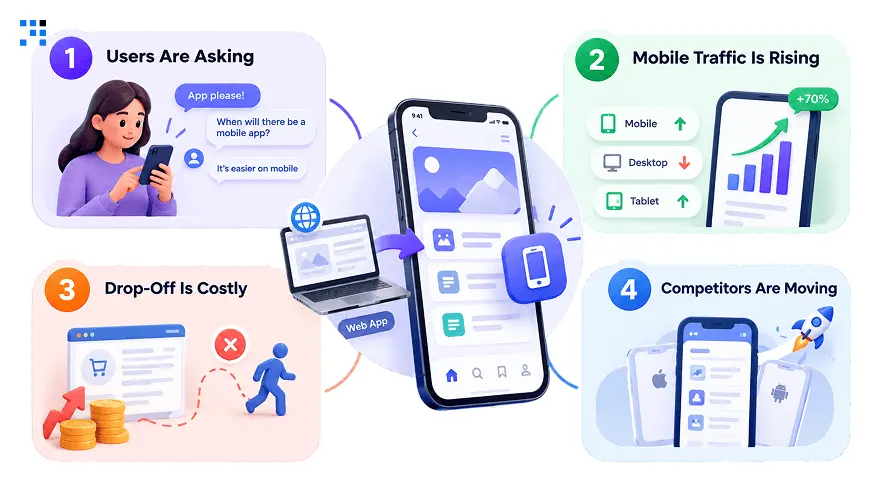
1. Users Are Asking
When customers repeatedly request a mobile app, that’s a clear market signal.
Ignoring it risks losing them to a competitor.
Every unanswered request chips away at customer loyalty.
Acting on this feedback early protects long-term retention.
2. Mobile Traffic Is Rising
Mobile now outpaces desktop traffic for most digital products today.
A web-only experience increasingly feels incomplete to modern users.
This gap widens further every year as habits shift.
Businesses that ignore this trend falls behind.
3. Drop-Off Is Costly
High mobile drop-off on a web app directly hurts conversion rates.
Every lost session represents lost revenue that’s hard to recover.
A native app experience removes this friction almost immediately.
Fixing this early protects your bottom line.
4. Competitors Are Moving
Competitors launching mobile-first features raise expectations across your entire market.
Falling behind here becomes harder to recover from over time.
Users compare experiences constantly, even without realizing it.
Staying ahead means acting before it’s urgent.
Where React Native Fits When You Convert Web App to Mobile App
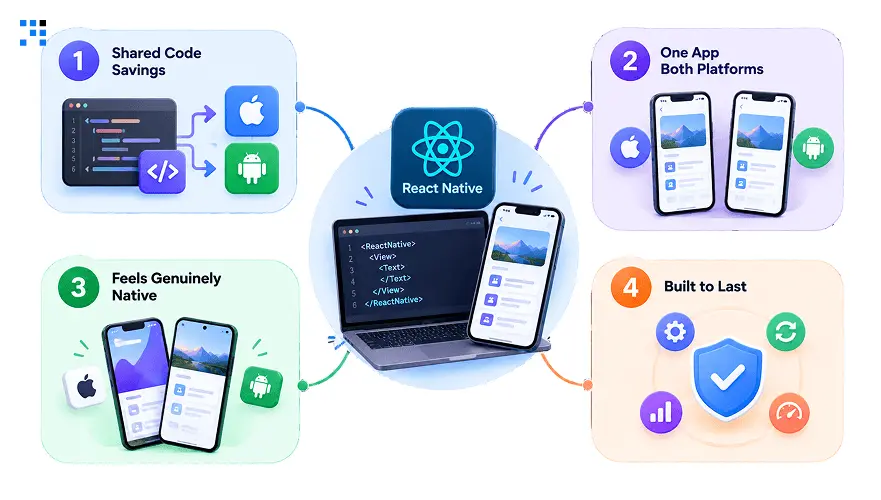
1. Shared Code Savings
Reusing existing business logic and components cuts development time significantly.
This keeps the mobile build affordable for growing businesses.
Less duplicate work means your budget stretches considerably further.
Savings here often fund additional features instead.
2. One App Both Platforms
A single codebase delivers apps for both iOS and Android simultaneously.
This avoids the cost of hiring two separate development teams.
Maintenance also becomes simpler since updates happen in one place.
Businesses save both time and ongoing overhead this way.
3. Feels Genuinely Native
Users get smooth, native-feeling performance rather than a web wrapper.
That difference directly affects app store ratings and reviews.
A sluggish, web-like feel often leads to quick uninstalls.
Native performance keeps users engaged and returning regularly.
4. Built to Last
Backed by Meta and used by platforms like Instagram, it’s proven at scale.
This isn’t a short-term or experimental technology bet.
Regular updates and a large community ensure long-term support.
Businesses can build confidently without fearing obsolescence.
How We Convert Web App to Mobile App Step by Step
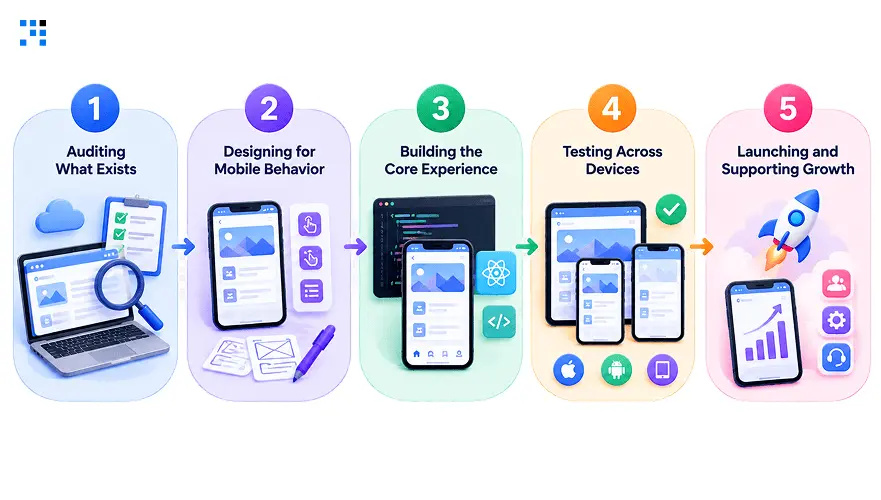
1. Auditing What Exists
Reviewing the current web app reveals what logic and components can be reused.
This step avoids unnecessary rebuilding from scratch entirely.
It also uncovers hidden risks or outdated dependencies early.
A thorough audit saves both time and money later.
2. Designing for Mobile Behavior
Mobile users tap, swipe, and expect features like push notifications regularly.
The app gets redesigned around these real, tested usage patterns.
This isn’t a shrunken desktop layout pasted onto a phone.
Thoughtful design here directly improves user satisfaction and retention.
3. Building the Core Experience
Shared logic gets translated into functional mobile screens and navigation flows.
This is where the actual mobile product starts taking real shape.
Platform-specific details for Android and iOS get handled carefully throughout.
The result feels intentional, not like an afterthought.
4. Testing Across Devices
Real device testing catches issues before users ever encounter them.
This protects the app’s crucial first impression at launch.
Automated and manual testing together improve overall reliability significantly.
Fewer bugs at launch means fewer frustrated early users.
5. Launching and Supporting Growth
After publishing to app stores, performance and feedback get tracked closely.
Ongoing support keeps the app improving steadily after launch.
This includes handling OS updates, crash reports, and new feature requests.
Growth continues well beyond the initial release date.
Mistakes to Avoid When You Convert Web App to Mobile App
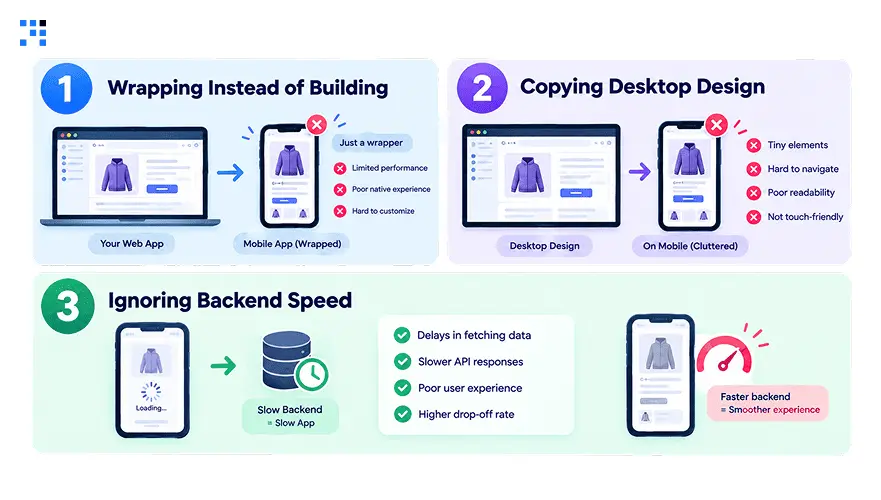
1. Wrapping Instead of Building
Simply wrapping a web app in a browser shell creates a frustrating experience.
Users notice the lag and unnatural feel almost immediately.
Poor performance here often leads directly to quick uninstalls.
A true native build avoids this trap entirely.
2. Copying Desktop Design
Desktop layouts rarely translate well to smaller touchscreens and gestures.
Mobile interfaces need their own dedicated design thinking from scratch.
Buttons, spacing, and navigation all behave differently on mobile devices.
Ignoring this creates a clumsy, unintuitive user experience.
3. Ignoring Backend Speed
A backend built for web traffic often struggles under mobile usage patterns.
Mobile networks demand faster APIs and smarter caching strategies.
Skipping this optimization leads to slow, frustrating app performance.
Addressing it early prevents costly performance issues later.
What It Costs to Convert Web App to Mobile App
1. MVP Range
A simple mobile version typically costs between $15,000 – $30,000.
This works well for testing mobile demand before scaling further.
It includes core screens, basic navigation, and essential features only.
Businesses use this stage to validate real user interest first.
2. Mid-Complexity Range
A mobile app with custom UI typically costs between $30,000 and $60,000.
This includes role-based access, moderate backend logic, and multiple integrations.
It suits growing businesses ready to move past a basic MVP.
Pricing here reflects a more polished, feature-rich product.
3. Full-Scale Range
A complete, feature-rich mobile app usually costs between $80,000 – $150,000+
This includes advanced features like push notifications, offline mode, and deeper integrations.
It suits businesses ready to fully commit to their mobile strategy.
Pricing here reflects a production-ready, scalable product.
Why Businesses Trust Us to Convert Web App to Mobile App
1. Real Product Thinking
Every project starts with understanding your users, not just your codebase.
Decisions get made around real business outcomes, not just specs.
This keeps the final product genuinely useful, not just technically correct.
Clients get a partner focused on outcomes.
2. Speed Without Shortcuts
Fast delivery never comes at the cost of long-term stability.
The app is built to scale, not just launch quickly.
Rushed work often creates expensive problems months down the line.
Doing it right the first time saves money overall.
3. True Cross-Platform Quality
Apps are built to feel genuinely native on both iOS and Android.
Users shouldn’t be able to tell it started as web.
This level of polish directly impacts app store reviews and retention.
Quality here reflects directly on your brand’s reputation.
4. Support Beyond Launch
Involvement continues well after the app goes live publicly.
Performance, updates, and user feedback all get tracked closely.
Issues get resolved quickly, before they affect a large user base.
This ongoing partnership protects your investment long-term.
FAQs
If your web app is built with React.js, a large portion of the business logic and components can often carry over directly. We assess this during an early audit so you know real cost savings before committing to the project.
Yes, when done correctly, users typically can’t tell the app started as a web product. We prioritize native navigation, gestures, and performance so the experience feels fully built for mobile.
Timelines depend on app complexity, but reusing existing code significantly shortens development compared to building from scratch. We focus on getting a solid MVP live quickly, then improving from there.
No, one React Native codebase can power both platforms simultaneously. This keeps your team smaller and your maintenance costs considerably lower long-term.
Launch isn’t the finish line. We continue tracking performance, fixing issues, and helping the app evolve as your user base and needs grow.
