A Transport Management System helps freight companies plan, execute, and track shipments in a structured way by automating transporter assignment, route planning, pricing, and shipment visibility with a connected operational workflow.
Does your freight operation run on a defined system
or on whoever starts coordinating first?

Freight companies are not losing business because of bad transporters.
They are losing it because the process behind every shipment is slower than the market they are competing.
In 2025, supply chain disruptions cost businesses nearly $184 billion globally.
Manual coordination simply became too expensive to ignore.
The question is not whether your operation needs a system.
It is how much the current process has already cost you.
Manual Freight Operations Are No Longer Sustainable
1. Losses Are Hiding Inside Daily Operations
Mid-sized freight operations lose nearly $1.8 million annually to operational inefficiencies.
Most losses do not arrive as obvious financial damage.
They hide inside delays, errors, and disconnected workflows.
2. Growth Starts Exposing the Process Gaps
Shipment delays increase 20–30% during peak periods.
As volume grows, coordination gaps become harder to control.
Eventually, the slowdown becomes part of the operation itself.
3. The TMS Market Is Accelerating in 2026
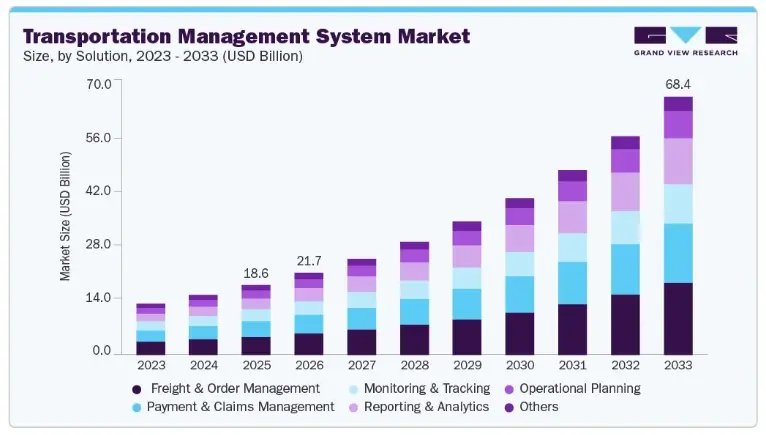
The global TMS market reached $21 billion in 2026.
It is projected to reach $68.4 billion by 2033 at 18.4% CAGR.
That growth is not a feature demand.
It is operational pressure.
How Manual Processes Create Delays Across Freight Operations
The system isn’t slow at doing work.
It becomes slow when it has to reach the people decisions depend on.
1. Shipment Allocation Is Still Based on Response Time
Assignments happen without pricing, routing, or vehicle validation.
Whoever picks up the phone first gets the job.
Availability beats suitability every single time.
2. Requirements Arrive Incomplete Every Time
Transporter shows up with the wrong vehicle, wrong capacity and zero context.
That is not a transporter problem.
That is a data problem.
3. Cargo Visibility Depends on Follow-Ups
Once goods leave the facility, the team operates on faith.
They rely on calls, messages, and drivers to track cargo.
Most escalations happen before accurate status updates arrive.
4. Reports Take Days to Assemble
They are made by pulling data from spreadsheets, call logs, and memory.
It takes days to compile what should already exist in the system.
Decisions get made on last month’s numbers in a business that moves daily.
How Transport Management System Fixes Broken Freight Flow
1. Booking Becomes Structured From the Start
Every requirement enters the system with all shipment details.
Transporter filtered by vehicle type, capacity, and route fit.
Instant quote replaces per-booking negotiation.
Confirmation happens in minutes, compared to an industry average of hours.
2. Invisible Errors Become Preventable
Double-entry errors appear only at reconciliation, not at entry.
The system captures data once and carries it through booking, invoicing, and reporting.
Carriers using TMS see 15–25% lower operational costs through optimized routing and reduced overhead.
3. Shipment Status Moves Without Manual Requests
The system pushes status updates automatically as movement happens.
Shippers and operations teams stay updated without asking.
If someone has to ask, the system has already failed.
4. Fleet Stops Running Empty
Empty return trips are a major cost leak in freight operations.
The matching logic connects available capacity to open requirements automatically.
Fleet utilisation improves 20–25% when load matching is no longer manual.
5. Reporting Becomes a Byproduct
Every booking, assignment, and milestone creates a record in real time.
Nothing is assembled at month end.
Management gets live data whenever they need it.
Not a version someone made three days ago from memory.
Already considering a standard Transport Management System?
Every freight business does at some point.
But a platform built for everyone is optimized for no one.
Which is exactly what the next section breaks down.
Standard TMS Vs Custom TMS | What the Difference Actually Costs You
| Capability | Standard TMS | Custom TMS |
|---|---|---|
| Transporter Bidding | Not available | Built around your matching workflow |
| Quote Calculation | Fixed rate cards | Calculated from your route and load variables |
| Role-Based Dashboards | Same view for everyone | Separate experience for shipper, transporter, driver, and admin |
| Shipment Tracking | Basic status updates | Milestone tracking with custom alerts |
| Route and Load History | Limited reporting | Tied to transporter and route records |
| Escalation Logic | Template-based rules | Built around your actual business structure |
| Tool Integration | Paid add-ons | Designed into the system from day one |
| Scalability | Caps at volume | Built for the load you are heading toward |
Every row in that table shows where a standard TMS stops working.
Your operation starts paying for it there.
The fix is to build your system through custom software development.
Which is based on the way your freight business actually runs.
How Loginex Cut Booking Time From 4 Hours to 15 Minutes
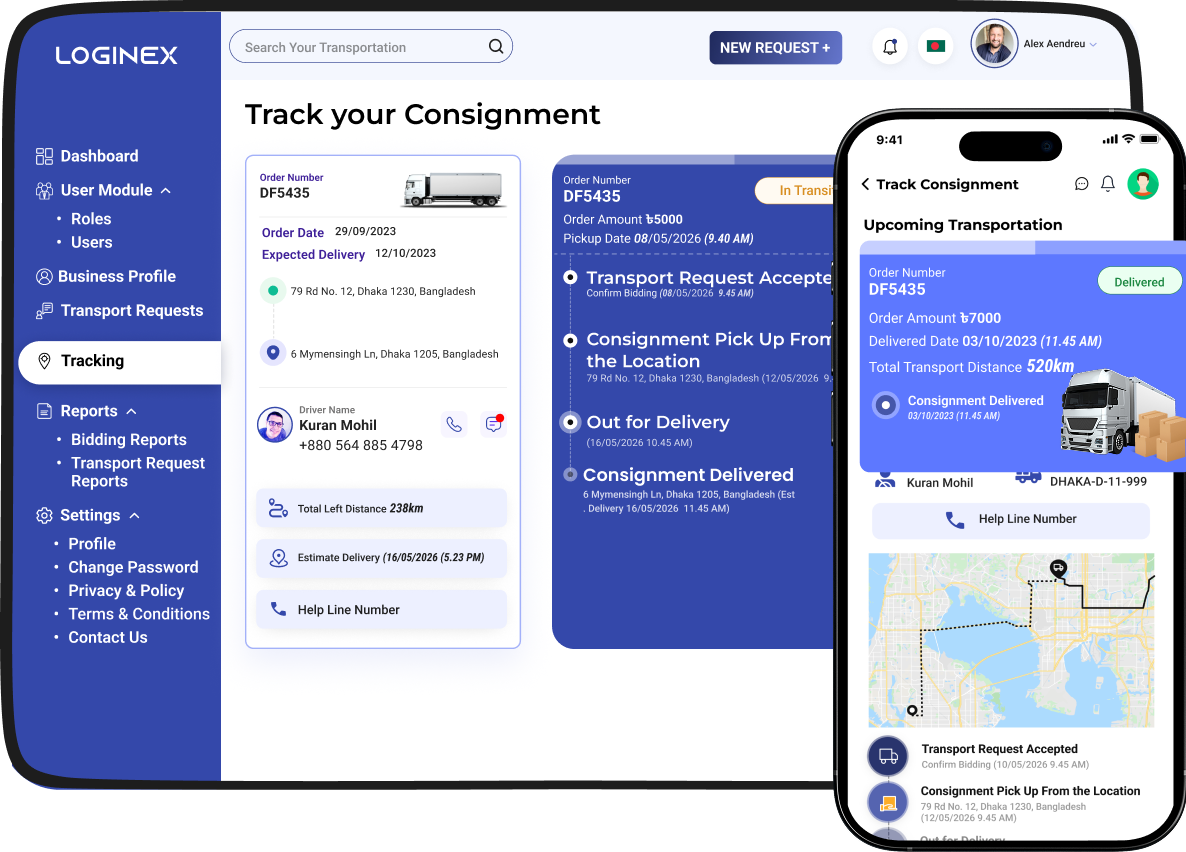
Loginex operates B2B and B2C freight marketplace across India.
Shipment volumes were growing, and the system wasn’t keeping up with them.
In operations, requirements were shared informally with no booking structure.
Delivery tracking depended on calls, creating blind spots across shipments.
How We Structured Operations Into One System
We built a freight management platform around their actual workflow.
From booking creation to transporter assignment, pricing, and delivery tracking.
Connected the entire freight process into a single system.
Impact on Day-to-Day Operations
| Metric | Result |
|---|---|
| Booking Confirmation Time | 4 hours → 15 minutes |
| Accounting Errors | Reduced by 30–40% |
| Fleet Utilisation | Improved by 20–25% |
| Operational Growth | 15% without adding headcount |
The operations did not change.
The structure underneath it did.
And that structure is now what the business scales on.
Want to see how we fixed the transporter assignment?
Ain’t You Done Losing Revenue to Broken Freight Operations?
1. Cost Already Exists Inside Your Process
In follow-ups, empty kilometres, and operational work that should already be automated.
The question is no longer whether the system is needed.
It is how long the current process keeps draining revenue
2. Our First Conversation Will Never Be About Software
We’ll start with how bookings move through your operation.
Coordination gaps reveal where decisions start slowing down.
This tells us where the system needs to take over.
3. You Will Get a Walkthrough of Your Own Operation
Most software companies show you a product.
We show you your own workflow mapped into a working prototype.
That is the only way to know if the system will actually work for your business.
4. Launch Day Means Zero Coordination Breaks
There is no phase where the system settles in.
Every handoff, dependency, and decision path is accounted for before rollout.
The operation runs on a connected system from day one.

Freight companies delaying this decision aren’t saving money.
Calculate what it has cost you since you started reading this.
FAQs
Standard TMSs are built for the average freight operation. Your transporter relationships, route structures, and escalation logic are not average. We build around how your operation actually works, not how a system assumes it does. That is the difference between a tool your team tolerates and one they actually use.
Your route history, transporter records, and shipment data are mapped into the new system during the build phase. Your team has full context from the moment they log in.
Rate structures, route variables, and transporter hierarchies are built into the matching logic. The right transporter gets the right load automatically without your operations team sitting in the middle of it.
A custom TMS is built for the load you are heading toward, not the load you have today. Transporter matching and load allocation scale with volume automatically.
The system is designed for where your operation is heading, not just where it is today. New routes, new transporters, and higher volumes are accounted for from the start. You will not hit a limit the way you do with a standard platform.