Logistics management software for trucking covers dispatch, GPS fleet tracking, route optimization, driver allocation, LR generation, and real-time delivery visibility, improving efficiency and operational control.
Would your fleet operate efficiently
if your dispatcher took a week off?
Most trucking operations are not failing because of bad drivers or wrong routes.
They fail because critical decisions depend on one person.
When that person is unavailable, the operation loses momentum.
And that is a systems issue, not a staffing issue.
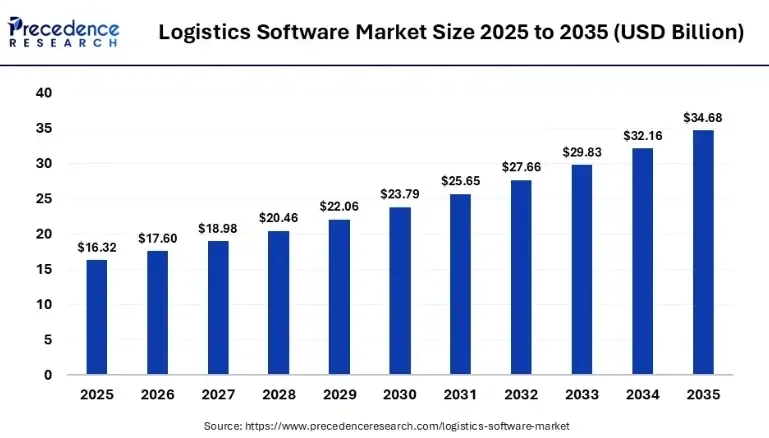
The logistics software market is growing from
$17.60 billion in 2026 to $34.68 billion by 2035 is not a trend.
It is operators realizing the cost of running without one.
What Running Without a System Actually Costs You

1. Idle Trucks Drain Revenue
Every idle vehicle costs between $448 and $760 per day.
Across a fleet, those losses add up quickly.
No utilization tracking means no visibility into which trucks earn and which ones drain.
2. Fuel Costs Rise When Fleets Run Blind
A truck idling 2 hours daily burns 600 to 1,600 gallons per year.
A 50-truck fleet burns up to 80,000 gallons annually from idling alone.
At $3.50 per gallon, that is $280,000 wasted on trucks sitting still.
Route optimization delivers 5 to 8% fuel reduction.
On a $1.7 million fuel budget, that is $136,000 back in weeks.
3. Spreadsheets Carry a Monthly Invoice
A 30-truck fleet on spreadsheets loses $9,000 to $15,000 every month.
Unbilled loads, billing errors, compliance fines, and wasted admin hours.
These are not minor inefficiencies.
They are direct hits to profitability.
4. Non-Fuel Costs Are At an All-Time High
ATRI’s 2025 report places non-fuel operating costs at $1.779 per mile.
Highest ever recorded.
Every manual inefficiency in dispatch and tracking makes that number worse.
5. The Driver Performance Gap Nobody Measures
Two drivers can run the same route and deliver very different results.
Idle time, fuel usage, detention, and driving habits all impact profitability.
Without performance tracking, those gaps stay hidden.
Driver dashboards expose the patterns and help fleets improve efficiency.
What a Logistics Management Software Controls
| Stage | What the System Does |
|---|---|
| Inquiry Management | Captures pickup, destination, material, vehicle type, and schedule |
| Rate Calculation | Calculates rates based on distance, weight, route, and fuel cost |
| Quotation Generation | Generates and sends quotes via email, WhatsApp, or portal |
| Order Confirmation | Confirms bookings digitally with no paperwork |
| Vehicle & Driver Allocation | Assigns vehicles and drivers based on route, load, and availability |
| LR Generation | Generates lorry receipts with shipment and consignee details |
| eWay Bill Integration | Creates compliant eWay bills through GST integration |
| Real-Time Tracking | Tracks shipment status, location, and ETA |
| Automated Alerts | Sends updates for dispatch, delays, documents, and delivery completion |
The value is not in any single feature.
It comes from connecting every stage of the transport lifecycle in one platform.
Standard Vs Custom: What Actually Fits Your Fleet?
44% of fleet operators struggle with integration.
Standard platforms are built for the average operation.
Your pricing matrix, driver structure, and compliance requirements are not average.
| Capability | Standard Platform | Custom System |
|---|---|---|
| Rate Calculation | Fixed templates | Built around your pricing matrix |
| Dispatch Logic | Generic assignment rules | Mirrors your actual decision flow |
| Driver App | Single interface for all | Designed for your field conditions |
| Scalability | Caps at volume | Built for where you are heading |
| Analytics | Pre-built reports | Focused on your key metrics |
| LR and eWay Bill | Manual or paid add-on | Integrated from day one |
Every gap in that standard column is where your operation absorbs the cost.
That is why many trucking companies invest in custom software development.
How Moncrief Ranch Achieved 82% Route Optimization
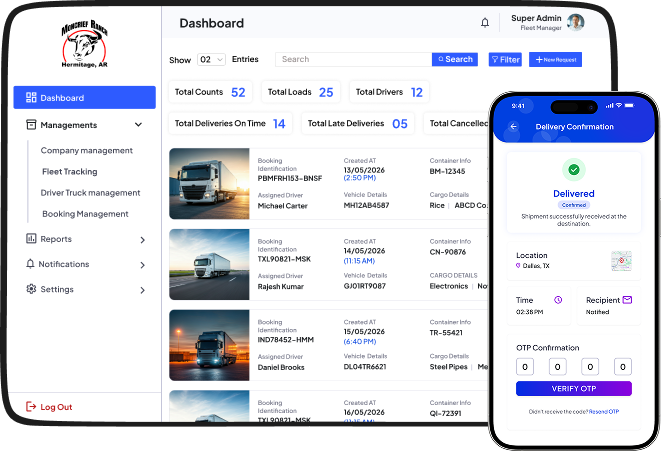
Moncrief Ranch runs agricultural transport across the United States.
Trucks were moving. Nobody knew where they were.
Every delivery update required a driver call.
Route decision was left to the driver’s judgment.
Booking lived on paper until something went wrong.
How We Built One Connected Transport System
We built it around how ranch logistics actually runs.
One system connecting three roles across every movement point.
Admin booking → Driver assignment → Live GPS tracking → Delivery confirmation
Impact on Transport Operations
| Execution Metric | Outcome |
|---|---|
| Route Optimization | 82% improvement in route efficiency |
| Operational Visibility | 90% increase in fleet visibility |
| Dispatch Coordination | 75% faster driver assignment |
| Manual Process Reduction | 68% fewer manual tasks |
The trucks stayed the same.
What changed was how they are booked, tracked, and managed.
That is what now powers fleet operations for Moncrief Ranch.
Want to see how we solved the dispatch coordination gap?
How Long Will You Tolerate the Same Freight Leaks?
1. Every Fleet Has a Different Breaking Point
We sit with fleet coordinators, drivers, and operations managers separately.
Trace how a booking moves. Where it slows. Where it disappears.
Those insights become the system design.
2. Stopping Revenue Leaks
Dispatch logic, tracking gaps, and billing delays are addressed.
You get a clear view of where revenue leaks and what is causing it.
3. System Is Tested by the People Who Use It
Dispatchers, drivers, and operations teams review the workflow before launch.
Every friction point gets identified early.
That means fewer surprises and faster adoption.
4. We Build for the Fleet You Are Growing Into
System is designed to support more trucks, routes, and bookings from the start.
Growth should increase revenue, not operational complexity.
That means no costly rebuilds when the business expands.
5. Go-Live Without Operational Issues
Roles, workflows, and approvals are configured before launch.
So the operation keeps moving from day one.
Trucking companies are not losing money because they lack effort.
They are losing it through operational gaps that systems should already control.

We’ll map your worst revenue leak and deliver a clear action plan within 24 hours.
FAQs
GPS shows location but it does not connect to dispatch optimize routes or capture delivery proof tracking without operational logic is just visibility without control we build the layer where every data point drives a decision.
Every fleet runs differently, rate structures LR format eWay bill rules and dispatch flow vary across businesses. Standard platforms force fixed workflows they don’t match how your operation actually runs, which is why systems are designed around your actual process.
Fuel savings and dispatch efficiency show up in the first month. Billing accuracy follows within weeks of digital POD going live. Most operations hit ROI within 3 to 6 months.
We audit your current data structure during discovery. Transporter records, route history, and booking data migrate before the first user logs in. Nothing starts from zero.
Yes. We account for future growth during planning, not after launch. More trucks, drivers, routes, and bookings are considered before development begins, so the platform can support expansion without costly rebuilds later.