A portfolio website helps architecture firms win more projects by proving their expertise before the first conversation. It showcases relevant projects, explains capabilities, demonstrates technical expertise, and gives clients a clear path to inquire.
If a client Googled your firm today,
does your portfolio show enough expertise to earn an inquiry?

A real estate developer needs an architecture firm.
He asks for recommendations from his industry network.
One recommended firm has no portfolio website.
He cannot review its previous hospitality projects easily.
He cannot see its design or technical capabilities.
Another firm has a clear portfolio website.
It showcases similar projects through detailed case studies.
The developer quickly understands what the firm delivers.
He contacts that firm to discuss the project.
The first firm may have stronger architecture expertise.
But that expertise remains difficult to verify online.
Without a portfolio, great work can stay invisible.
Why Buyers Eliminate Architecture Firms Before Contact

1. Website Visit Precedes Every Inquiry
Hinge Research found that over 80% of buyers check firm websites first.
That evaluation happens before any call or email.
It runs quietly, with no warning and no way to control it.
Your website runs the interview before you know it started.
2. Referrals Get Firms Considered
Clutch’s 2025 survey found firms without a website rely on referrals for 40% of leads.
Firms with websites generate most leads through search instead.
A referral gets you considered, but it rarely gets you selected.
Reputation earns the shortlist.
Your website earns the selection.
3. No Website Means No Shortlist
The same study found 17% of small businesses still operate without a website,
and most cite relevance, not cost, as the reason.
Architecture firms fall into the same trap, assuming reputation alone will carry inquiries.
A missing website is a missed shortlist every single time.
How Weak Portfolios Lose Architecture Leads

1. Unsorted Galleries Kill Conversion Rate
Most architecture portfolios show work.
They rarely prove fit.
Buyers scan for their project type, not general talent.
A gallery without structure loses buyers fast.
Sorted, story-driven portfolios convert far more visitors.
2. Mobile Load Speed Failure
Google found 53% of mobile visitors abandon slow-loading sites.
Architecture sites are especially exposed, since galleries run heavy.
Your best renderings are worthless if they never load.
3. No Process Page For Buyer Education
Buyers want timeline and fee clarity before they ever call.
A dedicated process page answers those questions upfront,
before an inquiry is even submitted.
Educated prospects arrive convinced, not curious, and closer to signing.
What Architectural Firm Website Development Must Include
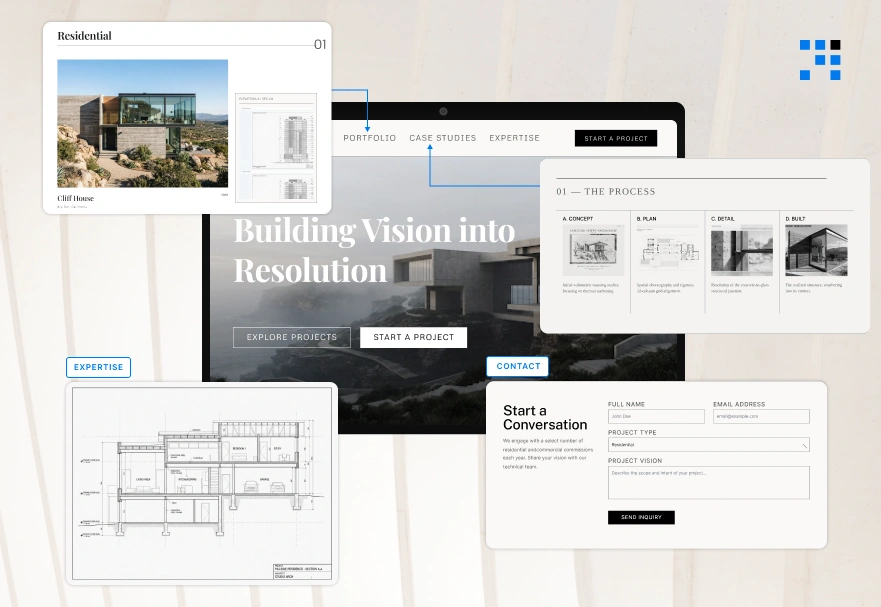
1. Structured Portfolio By Project Typology
Buyers search for firms who’ve built their exact project type.
Unsorted galleries force buyers to guess your specialization.
Clear categorization removes that guesswork and speeds up shortlisting.
2. Case Study Pages
Photo-only portfolios show finished work but explain no process.
CMI’s 2025 B2B report found 75% of marketers use case studies.
They rank among the most trusted content types.
Structure, not polish, earns buyer confidence here.
3. Technical Drawings Alongside Renderings
Renderings show design intent but not construction capability.
Buyers evaluating execution look for plans, sections, and drawings.
This addition signals real authorship, not just visualization skill.
4. Inquiry Funnel Built Into Every Project Page
A visitor impressed by your work still needs a clear next step.
Every project page should end with a way to reach out, not a dead end.
The stronger the case study, the more that page deserves its own path to inquiry.
Where Architecture Services Firms Must Invest Now
1. One Project Recovers Full Website Cost
Professional architectural firm website development is a real investment,
not a minor line item.
A single additional project at your typical fee levels can cover that investment outright.
Every project the site brings in after that is pure return.
2. Organic Leads Cost Less Than Paid Ads
Website and SEO leads cost around $1,000 to $6,000 per client.
Paid advertising leads cost $2,800 to $14,000 per client.
That makes organic website traffic three to five times more efficient.
A strong portfolio keeps generating leads long after launch, at falling cost.
3. Specialization Signals Drive Relevant Inquiries
Buyers gauge confidence by how clearly your site states what you do.
Vague, generic positioning gets buyers scrolling past fast.
Clear specialization drives stronger, more relevant inquiry volume.
How an Architecture Firm Increased Business Inquiries by 25%
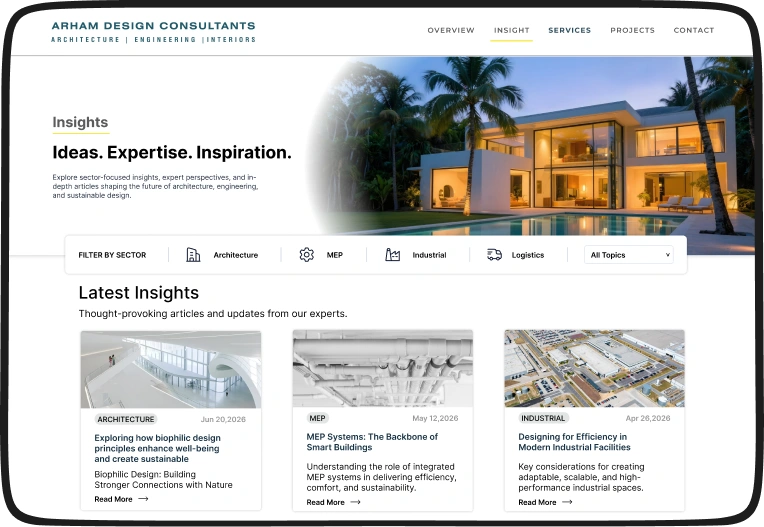
Arham Design Consultants had 20+ years of multidisciplinary expertise.
None of it had a digital platform to support it.
In a firm where MEP and interior design work existed.
But service positioning across disciplines stayed underrepresented online.
Leads had no digital channel to reach ADC at all.
How We Turned Projects Into Proof
We structured the portfolio around industry sector, not project feed.
Every project page carried a direct inquiry flow.
No page ended as a dead-end gallery.
What The Website Delivered
| Area | Business Impact |
|---|---|
| SEO-ready portfolio | 25% More Inquiries |
| Industry-based projects pages | 24% Faster Qualification |
| Mobile-first website | 40% Higher Engagement |
| Expertise-led content | 1.5X Stronger Visibility |
This isn’t just about a prettier portfolio website.
These numbers come from organizing 20+ years of expertise.
Sorted by sector, not chronology.
Want to see how we mapped the sector-based portfolio?
How We Build Architectural Firm Websites That Convert
1. Audit Where Your Portfolio Loses Buyers
We review your current site against what buyers actually evaluate.
Every weak CTA and disorganized gallery gets flagged directly.
Missing trust signals and unclear positioning get documented too.
That audit becomes the exact blueprint for your rebuild.
2. Structuring Case Studies Around Buyer Questions
Every project page is built to answer three buyer questions.
Can you execute this? | Can I trust you? | Will this work?
We map the project brief, process, and outcome to match that logic.
Nothing goes live without answering what buyers are actually asking.
3. Build For Mobile And Speed First
Your renderings load fast, and your galleries stay sharp on any screen.
Every build gets tested on real devices before launch.
Core Web Vitals and load speed are validated, not assumed.
Speed and clarity ship together, not as a later fix.

Competitors’ websites are winning bids yours should win.
Stop losing work to a better portfolio.
You handle the design.
We handle the proof.
FAQs
Referrals aren’t going anywhere, that part doesn’t change. What changes is what happens after someone hears your name. Prospects still check you out online, and if there’s nothing there to confirm it, some quietly move on. A website doesn’t replace referrals, it backs them up.
It typically takes 8 to 12 weeks, depending on how many projects need structuring. Inquiries tend to pick up once the site is indexed and case studies go live, not on launch day. It compounds and keeps working every month without another referral to trigger it.
Nothing gets discarded without review first. Your photography, drawings, and notes get audited project by project, and whatever’s reusable gets restructured into the new case study format.
No. Case studies get drafted from existing project files, with a short interview filling in process and outcome details. Everything gets reviewed and approved before it goes live.
We recommend 12 to 25 curated projects, not your full archive. Quality and typology spread matter more than raw project count. We help you select projects mapped to your target client types.