AI voice agents handle most routine support calls, faster and cheaper than humans. They still fall short on complaints, disputes, and anything emotionally charged. The best setups in 2026 use both and split by what each one’s actually good at.
Is your support team solving problems,
or repeating answers?

Picture a growing D2C brand.
A customer calls at 6 PM about a delayed package.
The agent pulls up the tracking number.
Reads it out. Call over in 90 seconds.
Four calls later, another customer calls in.
He’s been charged twice for one order.
Same agent, same queue, same three-minute average.
He waits behind two tracking calls first.
By the time he connects, he’s already annoyed.
Nobody on that team did anything wrong.
The queue just can’t tell the two calls apart.
That’s not an agent problem.
That’s a routing problem.
When Manual Customer Support Becomes Expensive

1. Routine Calls Consume Your Support Team
Reps spending all day on order status aren’t a support team.
They’re an expensive FAQ page with a payroll attached.
That’s time your team could spend on the calls that actually need judgment.
2. Manual Support Breaks as Volume Grows
Many growing businesses route customer issues through WhatsApp.
It works fine at low volume.
Once volume doubles, threads pile up and nothing gets tracked.
Issues start slipping through with no record anyone handled them.
3. Hiring Doesn’t Scale Like Volume Does
Hiring adds capacity in fixed steps, one rep at a time.
Call volume moves in spikes, not steps.
Every spike means overstaffing or dropped calls.
Help desk automation absorbs that spike without a hiring cycle behind it.
Where the AI vs Human Debate Gets It Wrong

1. Call Volume Outgrows Headcount
Inbound support volume keeps climbing every quarter.
Hiring cycles don’t move at the same speed.
By the time a new rep is trained, volume has already shifted again.
That gap is exactly what voice AI platforms were built to close.
2. Containment Isn’t Resolution
Most AI voice vendors report “containment rate.”
The percentage of calls that never reached a human.
A call can be contained and still unresolved.
Automated resolution benchmarks show the two numbers rarely match.
The customer who gets contained today calls back tomorrow.
3. The 60–70 Rule
Across live deployments, AI resolves 60-70% of inbound volume.
Status checks, bookings, FAQs, simple account actions.
That ceiling shows up across industry benchmarks, not one vendor’s claim.
Past that line, resolution rates drop fast.
4. Customer Support Automation Isn’t All-or-Nothing
Automation works in layers, not one switch.
Front-line triage. Data capture. Selective resolution.
Each layer needs a different design decision.
AI Support Market Data for 2026
1. Cost Per Call Isn’t Subtle
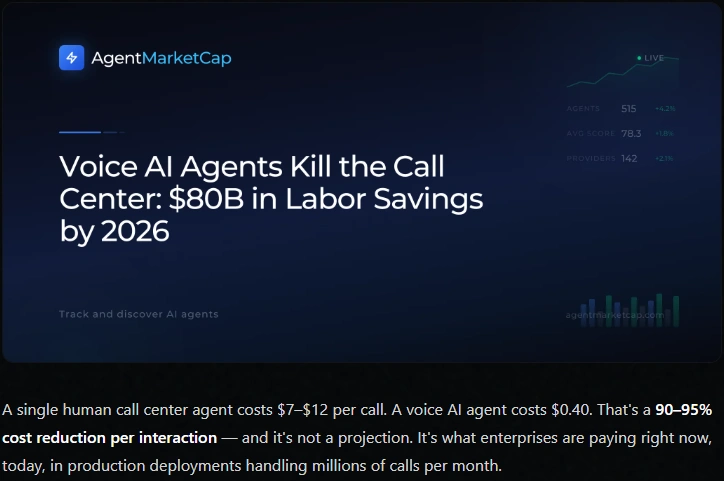
A human voice interaction runs $7–$12 per call.
Salary, training, and overhead included.
Voice AI resolution runs closer to $1.18 at enterprise scale.
That’s an 85–90% cost drop.
On every routine call you stop routing manually.
2. Speed and Availability Aren’t Close

AI doesn’t take breaks.
It doesn’t queue callers during spikes.
The AI customer service market hits $15.12 billion in 2026.
Growing at 25.8% a year.
That money is chasing the availability gap.
3. Adoption Outran Integration
88% of contact centers use some AI.
Only 25% have it fully integrated.
That gap is where most projects stall.
Usually because nobody designed the handoff.
| Dimension | AI Voice Agent | Human Support Team |
|---|---|---|
| Disputes | Needs escalation | Handles well |
| Emotional nuance | Limited | Strong |
| Complaint handling | Weak without a human lane | Strong |
One company has already tested this at enterprise scale.
Klarna’s AI rollout proved that automation can deliver major savings,
but it also exposed the limits of removing humans from complex customer conversations.
What Klarna Revealed About AI Customer Support
1. AI Delivered the Efficiency Everyone Expected
In 2024, Klarna automated two-thirds of customer chats.
Equal to 700 full-time agents.
>Resolution time dropped from 11 minutes.
Down to under two minutes.
Estimated savings hit $40 million a year.
2. Complex Conversations Exposed the Limits
Cracks showed up in disputes and refunds.
The emotionally loaded, high-stakes conversations.
AI wasn’t built to carry those alone.
Customers wanted a human option.
Increasingly, they couldn’t reach one.
3. Klarna Rebuilt the Human Lane
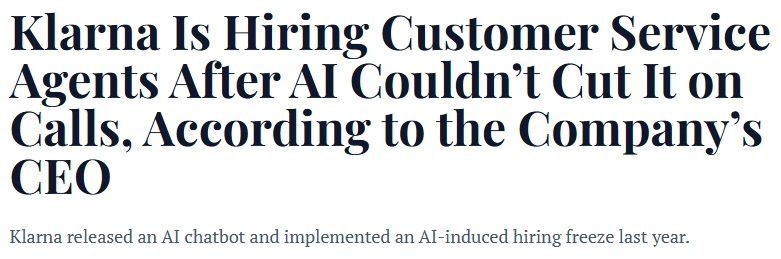
By May 2025, the CEO admitted the cost.
Automation had produced lower-quality service.
Klarna started rehiring humans for complex cases.
They proved that proved AI needs a deliberate human lane.
The savings were real.
So did the impact on customer trust and satisfaction.
That’s the case for hybrid design from day one.
How AI Solutions Fit Into Your Customer Support Stack

1. Connects to Your Existing Systems
A voice agent isn’t a standalone bot.
It needs to read your CRM.
It needs live order and account data.
Without that connection, it’s just a scripted voicebot.
2. AI Is Only as Good as Your Data
Outdated FAQs cause the system to guess
Guessing shows up as hallucinated answers on the call.
Clean, current knowledge bases fix that first.
This is the unglamorous work most vendors skip.
3. Smart Escalation Is the Real Design Work
The bot itself isn’t the hard part.
Deciding when it hands off is.
Complaints, disputes, and safety issues route to humans.
Every other case needs a clear rule built in.
4. Frees Up Human Expertise for What Matters
Done right, this becomes the first layer of support.
Routine requests get resolved without a human touch.
Complex issues reach the right person with full context attached.
Your team spends its time on judgment, not repetition.
That’s how the right AI solutions improve customer experience without replacing your team.
If You’re Serious About Fixing This Here’s How We Work
1. Start With Your Support Data
No build starts with a tool decision.
It starts with your last 90 days of calls.
We tag what’s repetitive and what needs judgment.
That split tells us where automation actually pays off.
2. Design the Human Handoff
Most failed deployments skip this step entirely.
We define exactly which cases go straight to a human.
Complaints, disputes, anything with financial or legal weight.
Everything else gets a scripted, testable resolution path.
3. Connect AI to What You Already Run
No new dashboard for your team to check daily.
The agent reads and writes directly to your CRM
Your reps see the same tools, with less noise in the queue.

Most support teams don’t lose to competitors overnight.
They lose a little ground on every unhandled spike.
The gap closes only once the routing is actually built.
FAQs
No. Removing the human option entirely damages trust and resolution quality. We build AI to absorb repetitive volume and design the handoff so your team handles judgment, not the whole queue.
Routine calls run $1–2.50 through AI versus $7–12 through a human agent. We start by mapping your call volume so you know the real number before anything gets built.
It escalates immediately with full context attached. We design that handoff logic upfront so nothing reaches your team blind and no customer repeats themselves.
No. Smaller teams often benefit more since they can’t staff 24/7 with headcount alone. We scale the architecture to your call volume, not the other way around.
Start with your call data, not the technology. Find out what percentage of your volume is genuinely repetitive, and that number tells you exactly how much of your support load is ready to move to AI today.