A logistics management system replaces calls and paperwork by connecting booking, dispatch, tracking, and delivery proof on one platform. Owners get a live view of every truck, load, and document, without chasing drivers for updates.
How many of your trucks could you locate right now,
without calling anyone?
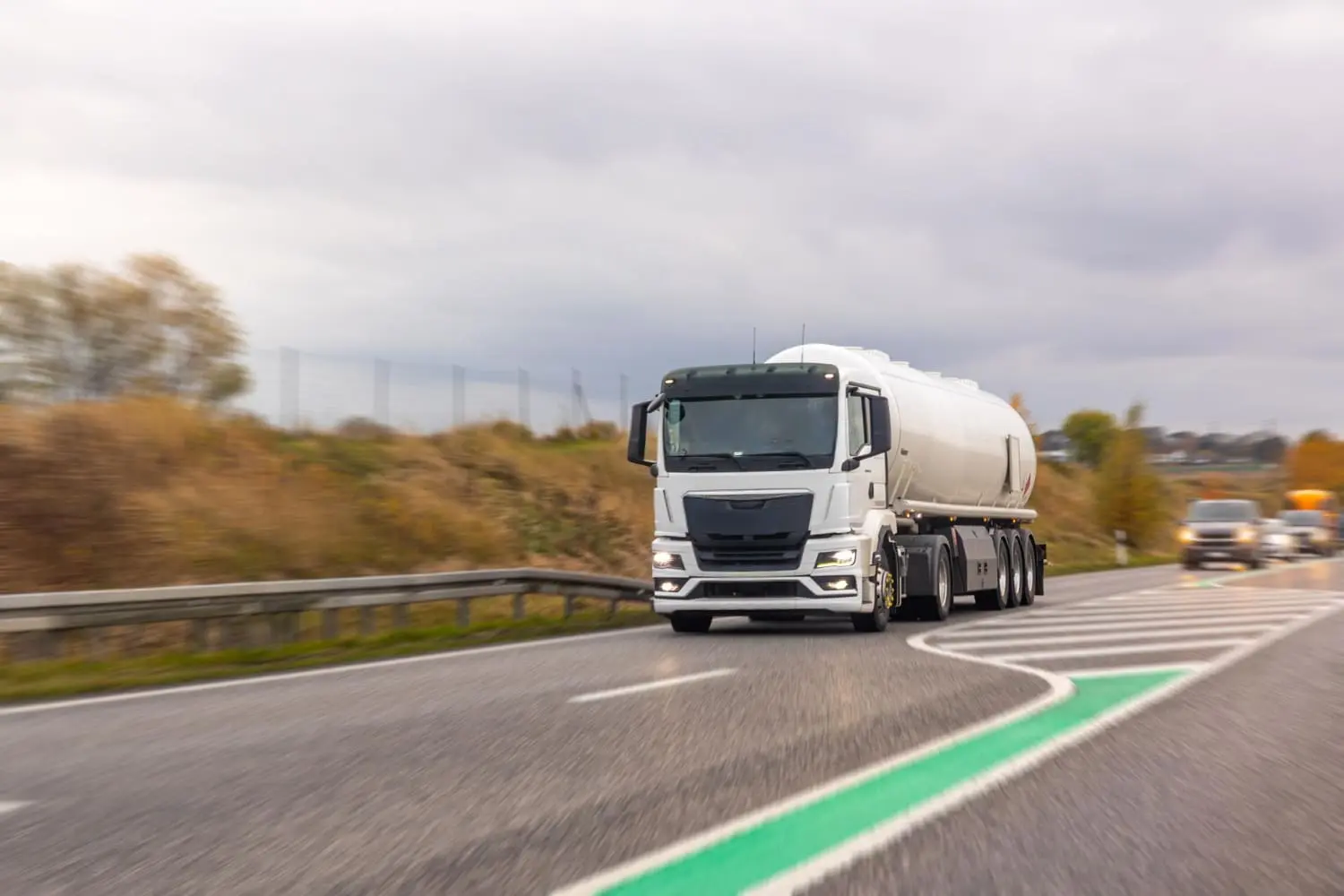
A truck picks up 10 tons of cement.
The lorry receipt gets written by hand in the cabin.
Midway through the trip, the driver takes a shortcut.
Dispatch has no way to check the route.
The truck breaks down for two hours, unnoticed.
The client calls twice asking about the shipment.
Nobody has an answer, because nobody is tracking it.
Delivery lands six hours late.
The lorry receipt gets misplaced before billing starts.
The invoice goes out three weeks late.
Payment gets delayed because the paper trail broke.
One missed call did not cause this.
A business built entirely on calls did.
What Skipping a Logistics Management System Costs You
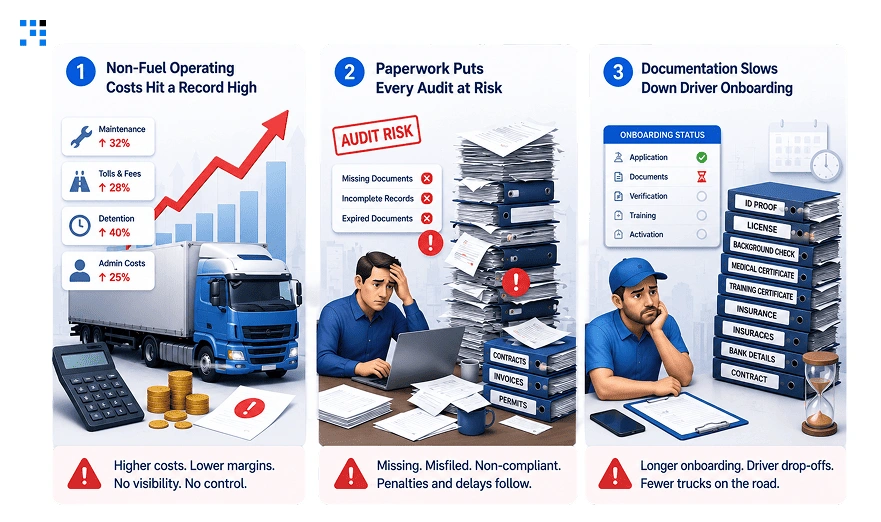
1. Non-Fuel Operating Costs Hit a Record High
ATRI data shows non-fuel costs hit $1.779 per mile.
That’s the highest figure ever recorded industry-wide.
Manual dispatch steps keep pushing that number higher.
A connected system removes steps instead of adding them.
2. Paperwork Puts Every Audit at Risk
Compliance documents sit scattered across drivers and file folders.
Nobody knows what’s missing until an audit shows up.
By then it’s too late to fix it.
A logistics management system keeps every document in one place.
3. Documentation Slows Down Driver Onboarding
New drivers wait on background checks and document collection.
Files get chased down over calls and messages.
That delay keeps a driver off the road longer.
A single digital flow moves onboarding documentation start to finish.
How a Logistics Management System Runs the Operation
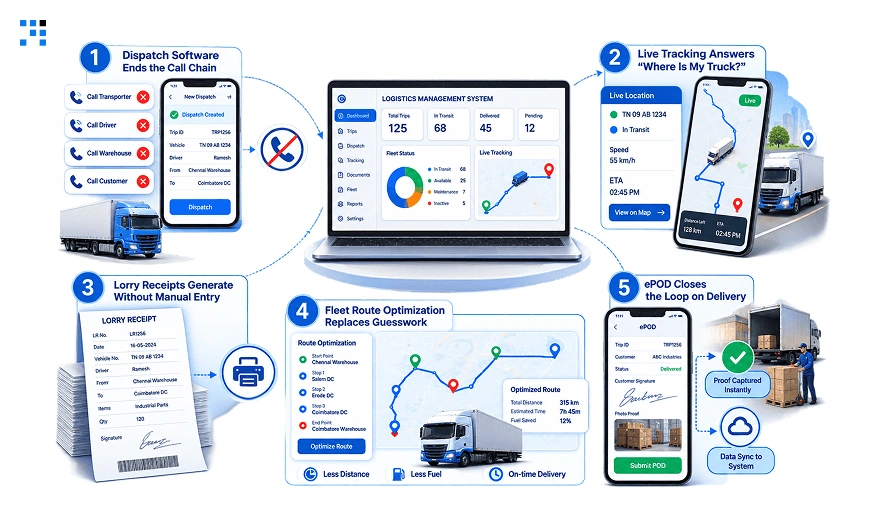
1. Dispatch Software Ends the Call Chain
A dispatcher used to call three drivers per truck.
Dispatch software shows every truck on one screen.
Assignment now takes a tap, not a call.
The whole team sees the same live status.
2. Live Tracking Answers “Where Is My Truck?”
Customers kept calling dispatch just to check status.
Live tracking shows location and ETA on its own.
They can check it themselves, anytime they want.
Your team stops fielding the same question all day.
3. Lorry Receipts Generate Without Manual Entry
Handwritten receipts often didn’t match the actual booking.
Now shipment and consignee details pull in automatically.
Nobody’s copying numbers from one paper to another.
The record stays accurate from the first entry.
4. Fleet Route Optimization Replaces Guesswork
Drivers once picked routes based on gut feel.
That habit quietly added miles and fuel costs.
The system now maps the most efficient path.
Delivery windows get tighter without anyone trying harder.
5. ePOD Closes the Loop on Delivery
A missing paper POD used to stall billing for days.
Now a signature or photo confirms delivery on the spot.
That proof lands in the system immediately, not later.
Invoicing can start the same day the load arrives.
What a Logistics Management System Handles Every Day
| Day-to-Day Task | System Handling | Business Impact |
|---|---|---|
| New booking inquiry arrives | Captured digitally with full details | Nothing gets missed |
| Rate quote needs sending | Generated instantly from trip data | Faster quotes win bookings |
| Driver performance under review | Tracked automatically across every run | Decisions backed by data |
| Vehicle due for servicing | Flagged based on usage patterns | Fewer breakdowns, less downtime |
| Fuel and toll spend piling | Logged against each trip | Clear view of real cost |
| Month-end reporting time | Pulled straight from live data | Reports ready in minutes |
| Customer requesting status update | Pushed at each delivery milestone | Fewer complaints, more trust |
| Trip closed, payment pending | Linked to confirmed proof of delivery | Faster payment cycle |
Every task on this list used to depend on someone remembering to do it.
Custom software development builds that memory into the system itself.
That is how a transport business runs on data, not on follow-ups.
How a Logistics Management System Helped Moncrief Ranch
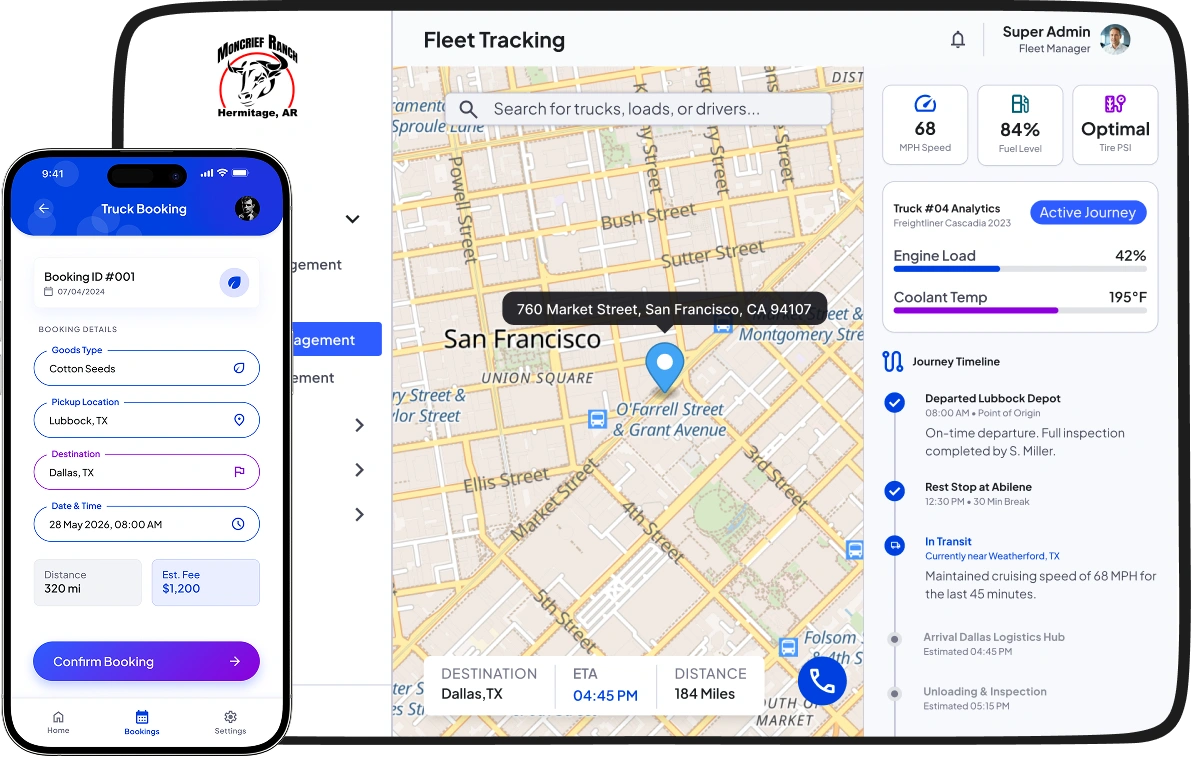
Moncrief Ranch runs agricultural transport across the US.
Trucks moved, but nobody tracked their location.
Every delivery update required a phone call from the driver.
Drivers picked routes based on their own judgment.
Bookings lived on paper until problems surfaced.
One Connected System Built Around Ranch Logistics
We built the platform around how ranch transport actually runs.
One system now connects admin, drivers, and dispatch.
Booking, assignment, tracking, and delivery flow through a single path.
What Changed for Moncrief Ranch After Going Live
| Area | Result |
|---|---|
| Route Optimization | 82% improvement in route efficiency |
| Operational Visibility | 90% increase in fleet visibility |
| Dispatch Coordination | 75% faster driver assignment |
| Manual Process Reduction | 68% fewer manual tasks |
This wasn’t just about adding GPS tracking.
It created one connected system for the ranch.
Calls and paperwork stopped running the operation.
The system now runs it instead.
Want to see how we solved the dispatch coordination gap?
How We Build Your Logistics Management System
1. Mapping How Your Trucks Move
Dispatchers, drivers, and admin get interviewed separately.
Every booking gets traced from pickup to delivery.
Slowdowns and workarounds get written down, not smoothed over.
That map becomes the system’s blueprint. .
2. Every Role Gets Its Own Screen
Admin, dispatch, and drivers each get their own screen.
No one adapts to someone else’s dashboard.
Each role sees only what it needs.
That keeps the system fast to use daily.
3. Documentation Gets Built In From Day One
Lorry receipts, bills of lading, and invoices get built in early.
Paperwork isn’t bolted on after launch.
It sits inside the booking flow itself.
That’s what actually removes it from your team.
4. Your Team Tests It Before You Do
Dispatchers and drivers walk through the workflow first.
Friction gets caught before real bookings run.
That cuts down on surprises once it’s live.
Adoption moves faster because the system already fits.

The next fleet running on calls and paper is losing time right now.
Fixing that starts with one conversation, not a full overhaul.
FAQ’s
That’s exactly what we plan for before writing a line of code. We audit your existing records first and map them into the new system. Your team keeps working with current data while migration happens in the background. Nothing starts from zero, and nothing gets lost in the switch.
No, and we design it that way on purpose. We build the tracking layer into a standard mobile app, so drivers use phones they already carry instead of new hardware to manage. That keeps rollout fast and adoption simple across your fleet.
We build for this exact gap, not just the ideal case. The system stores the last known location automatically when offline and syncs the moment signal returns. Dispatch sees a flagged gap, never a blank screen.
Yes, because we build rate logic around your actual pricing, not a fixed template. Flatbeds, tankers, and containers can each carry their own rate rules, since we map your real pricing matrix during discovery, before development starts. Your rates stay yours, the system just calculates them faster.
We track this closely with you, not just at handoff. Most fleets see call volume drop within two to three weeks, and we stay involved through the paperwork transition too, covering LR, ePOD, and invoicing. Full elimination typically lands within 60 to 90 days of real usage.
We plan for this before your first truck goes live. The architecture is built to support growth from day one, so adding trucks, drivers, or routes later needs no rebuild. That’s the difference between a system built for you and a template.