React.js and JavaScript both matter, but they solve different problems. JavaScript powers the basics, while React.js handles complex, fast-changing interfaces more efficiently. For most product-focused apps in 2026, React.js is the stronger pick, though JavaScript still has its place for simpler builds.
Still building your product’s frontend from scratch in plain JavaScript?

Here’s what actually separates React.js from JavaScript in 2026, and
why that choice affects how fast you ship and how much it costs to maintain later.
What Is React JS and Why Teams Are Switching to It?
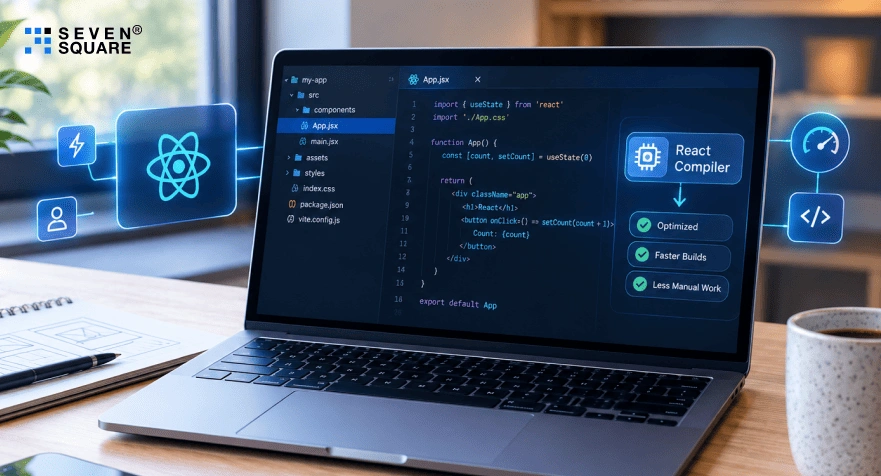
ReactJS is a JavaScript library built specifically for building interfaces, especially ones where the screen updates constantly based on user input or data
In 2026, React JS ships with the React Compiler, which automatically handles a lot of the manual performance tuning developers used to do by hand.
This means faster apps with less engineering effort.
Why Growing Enterprises Prefer React JS
We recommend React.js once a product needs to scale past its first version.
It’s built for reusable components, so features get added without rebuilding the whole interface each time.
This matters most for founders planning to keep iterating. React.js makes each new feature cheaper to build than the one before it.
What is JavaScript & Why is It Used for Web Development?

JavaScript is the language every website runs on. It powers everything from simple animations to full backend logic when paired with Node.js
Its biggest strength is flexibility. Founders often start here because it lets a small team ship a working prototype fast, without extra setup or structure to learn first
When JavaScript Is Still the Smartest Choice
We recommend plain JavaScript when the product is small, simple, or still being validated.
A landing page, a basic script, or a lightweight internal tool rarely needs anything more.
Speed beats structure here. If the goal is to test an idea fast, JavaScript gets you there with the least setup.
React JS vs. JavaScript: Which One Fits Your Use Case?
1. Building a Landing Page
JavaScript alone is enough here.
There’s no need for components or state management for a page that mostly just displays content.
2. Powering a Product Dashboard
React JS is the right call.
Dashboards update constantly with live data, and its component structure keeps that manageable as it grows.
3. Launching an MVP
JavaScript gets an MVP live fastest.
Once the idea is validated and features are added weekly, moving to React.js saves time later.
4. Scaling a Customer-Facing App
React JS wins here.
Reusable components mean a login screen, profile screen, and settings screen can share logic instead of repeating code three times.
React JS vs. JavaScript: A Side-by-Side Comparison for Founders
Here’s how the two stack up on what actually matters for your product..
| Factors | React JS | JavaScript |
|---|---|---|
| Ideal Use Case | Products meant to grow and scale | Simple sites, early MVPs, quick launches |
| Time to Launch | Slightly longer setup, pays off later | Faster for small builds |
| Cost to Add Features | Stays predictable as features are added | Rises as the app grows |
| Hiring Developers | It is a general-purpose programming language. | It is a specialized library. |
| Usage | Larger talent pool, faster onboarding | Harder to find and onboard on custom code |
| App Speed & Performance | Optimized automatically as it scales | Needs manual tuning as it grows |
| Future-Proofing | Built to grow with the product | Often needs a rebuild as the product grows |
Still not sure which one fits your product?
How Do We Build Your Application With the Right Technology?
1. Start With the Product Goal
The real question isn’t which framework to use, it’s what the app needs to do today and where it’s headed next.
That decision comes first, followed by picking the right technology around it. Skipping this step is how teams end up with the wrong foundation before they’ve even started.
2. Build Fast for Speed
For MVPs and early validation, the priority is getting something real in front of users.
The build stays lightweight, skipping unnecessary structure or setup time.
Speed matters more here than long-term architecture, because the goal is learning, not scaling yet.
3. Scaling for Growth
Once a product has direction and is meant to grow, React.js becomes the stronger foundation to build on.
New features get added on top of existing components instead of rebuilding screens from scratch. This is what keeps development fast even as the product gets more complex.
4. Avoid Costly Rewrites Later
Early technology choices shape how expensive every future change becomes.
Planning a year ahead, not just for today’s launch, keeps small shortcuts from turning into full rebuilds down the line.
A little more thought now saves a lot of rework later.
5. Technology Evolves With Your Product
No single setup fits a product at every stage of its life.
What works for an MVP won’t be enough once real users and complexity show up.
The right approach keeps adjusting as the product grows, instead of locking in one decision forever.
FAQs
You can start with plain JavaScript if you’re just validating an idea. Once you’re adding features regularly and the interface is getting complex, moving to React JS saves time and cost.
It depends on how the original app was built. If it was built cleanly, key logic can often be reused, but the interface itself usually needs to be rebuilt in React JS’s component structure.
Not necessarily. React JS can cost more upfront due to setup, but it usually costs less over time because new features build on existing components instead of starting from scratch.
Somewhat. React.js has a larger developer pool, so hiring and scaling a team tends to be easier and faster with React JS than with a custom JavaScript build.
It comes down to how complex your interface will get and how fast you plan to grow. We help founders make this call early so they don’t end up rebuilding later.