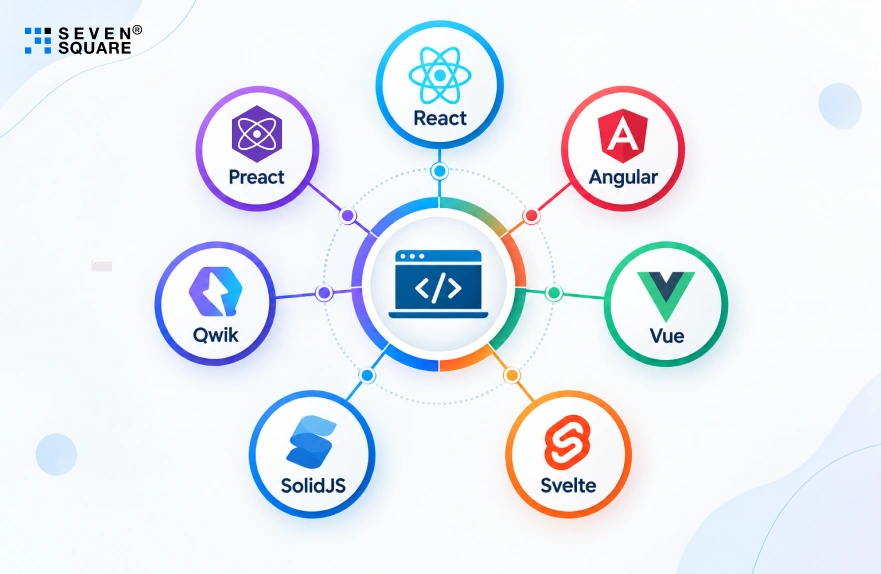
The top single-page application frameworks in 2026 are React, Angular, Vue.js, Svelte, SolidJS, Qwik, and Preact. Each one differs in performance, learning curve, and how much control it gives over rendering.
Is your web app framework built for scale, or just easy to start with?
Startups burn weeks debating frameworks instead of shipping product.
This blog breaks down which SPA framework actually fits your build, your team, and your timeline.
Top 7 Single-Page Application Frameworks
Here is a table of the best single-page application frameworks with each tool’s core information.
| Sr. No. | Framework | Language | Examples | GitHub Stars |
|---|---|---|---|---|
| 1 |
 React React |
JavaScript | Facebook, Instagram, Airbnb |  230k+ 230k+ |
| 2 |
 Angular Angular |
TypeScript, JavaScript | Gmail, PayPal, Forbes | 95k+ |
| 3 |
 Vue Vue |
JavaScript | Alibaba, Xiaomi, GitLab | 210k+ |
| 4 |
 Svelte Svelte |
JavaScript | The New York Times, Spotify (internal tools) | 80k+ |
| 5 |
 SolidJS SolidJS |
JavaScript | PlayStation, internal tooling at scale-ups | 33k+ |
| 6 |
 Qwik Qwik |
JavaScript | Builder.io, early-stage SEO-heavy apps | 21k+ |
| 7 |
 Preact Preact |
JavaScript | Uber, developer.chrome.com | 36k+ |
Framework choice doesn’t fix data flow, architecture does.
Custom software development builds the sync and integration layer no table can show you.
Skip it now, and you’ll rebuild it after the first real slowdown.
A Detailed Look at the Top 7 SPA Frameworks in 2026
1. React (Meta) – The Industry Standard
React is a JavaScript library maintained by Meta, focused on the view layer. It remains the most widely adopted framework for building fast, scalable SPAs in 2026.
Strengths:
- Virtual DOM updates only what changes, not the full page.
- Component-based structure makes code reusable across the app.
- Hooks handle state without needing class components.
Limitations:
- Massive ecosystem can mean too many ways to do the same thing.
- Requires extra libraries for routing and state at scale.
2. Angular (Google) – Built for Enterprise Structure
Angular is Google’s full-featured framework for building large, structured web applications. It suits teams that want strong conventions built in from day one.
Strengths:
- Two-way data binding keeps model and view in sync automatically.
- Built-in dependency injection improves testability.
- Written in TypeScript for stronger type safety.
Limitations:
- Steeper learning curve than most other frameworks on this list.
- Heavier setup for small or simple projects.
3. Vue – Easy To Learn Fast
Vue.js is a flexible, approachable framework known for its gentle learning curve. It fits teams that want power without heavy setup.
Strengths:
- Reactive data binding updates the UI automatically.
- Vue CLI handles project setup and build tooling.
- Pinia manages state in a predictable, centralized way.
Limitations:
- Smaller job market and hiring pool than React or Angular.
- Fewer enterprise-scale case studies to reference.
4. Svelte – Best for Speed and Bundle Size
Svelte compiles your code at build time instead of shipping a runtime framework to the browser. This makes it one of the fastest, lightest options available in 2026.
Strengths:
- No virtual DOM, so updates are extremely fast.
- Smaller bundle sizes than most other frameworks.
- SvelteKit adds routing and full app structure.
Limitations:
- Smaller ecosystem compared to React or Angular.
- Fewer third-party component libraries available.
5. SolidJS – Reactivity Without Compromise
SolidJS combines React-like syntax with true fine-grained reactivity. It’s built for teams that want top-tier performance without giving up familiar patterns.
Strengths:
- Fine-grained reactivity updates only what actually changed.
- No virtual DOM overhead at runtime.
- Consistently benchmarks among the fastest frameworks available.
Limitations:
- Smaller community than React makes finding help harder.
- Ecosystem maturity still lags more established frameworks.
6. Qwik – Instant Load Speed
Qwik is built around instant loading through a technique called resumability. It’s gaining traction fast for content-heavy, performance-critical apps.
Strengths:
- Resumability skips re-executing JavaScript on page load.
- Near-instant startup time, even on large apps.
- Strong fit for SEO-sensitive, content-heavy products.
Limitations:
- Newer framework with a smaller talent pool.
- Adoption still depends heavily on the Builder.io ecosystem.
7. Preact – Best for Lightweight React Alternative
Preact is a lightweight alternative to React with a nearly identical API. It fits teams that want React’s patterns in a much smaller package.
Strengths:
- Roughly 4KB in size, far smaller than React.
- Compatible with most React libraries and patterns.
- Fast rendering with minimal overhead.
Limitations:
- Not every React library works without compatibility layers.
- Smaller community means fewer dedicated resources.
How We Build The Right SPA Framework For Your Web Application
1. Framework Matched To Product
Every decision starts with your product’s actual complexity and data flow.
Team skillset and long-term maintenance get factored in early. This audit prevents a costly framework switch mid-build.
2. Performance Built From Day One
Fast rendering and real-time data sync shape the architecture from the start.
No generic template gets forced onto your product. The structure matches how your users actually interact with it
3. Every Interaction Gets Tested First
Components get tested against real user flows, not just unit tests.
Performance, responsiveness, and edge cases get caught early. Nothing ships without being stress-tested first.
4. Launch-Ready At Scale
Monitoring, security, and performance come baked in at launch.
Ongoing support stays available as your product grows. What you get is a system built to scale, not a one-time build.
FAQs
React has the largest hiring pool and library ecosystem, making it the lowest-risk pick. Faster options like Svelte only pay off if your team already knows them. We help founders weigh this trade-off before committing.
Svelte and Qwik ship far less JavaScript than React or Angular. Qwik is built specifically for near-instant loading. We’ve built SPAs on both when speed and search visibility mattered most.
Angular’s learning curve and setup overhead can slow small teams down. Vue.js offers similar power with far less setup. We map your team’s bandwidth against the framework before you commit.
Possibly, since both have far smaller hiring pools than React. That trade-off is worth weighing against the performance gains. We factor in your hiring plans, not just benchmarks, when recommending a stack.
You can, but it usually means re-architecting core parts of the app. This is why matching complexity and skillset upfront matters more than chasing trends. This is exactly the audit we run before writing any code.