Everything around us is getting smarter, from our homes and offices to factories and cities.
This change is happening because of IoT app development, which allows smart devices to connect, communicate, and work together as connected systems.
So, what makes devices “smart” today?
Sensors, internet connectivity, and intelligent software. These elements help devices collect data, send it to the cloud, and respond in real time.
From smart lights that adjust automatically to machines that predict failures before they happen, IoT-powered apps are changing how we live and work.
Businesses are investing heavily in IoT applications because they deliver real value: Better automation, real-time monitoring, lower operational costs, & smarter decision-making.
We help businesses turn everyday devices into intelligent, data-driven solutions using scalable and secure IoT app development.
In this blog, we’ll explain how IoT app development works for smart devices and connected systems, step by step.
You’ll learn how devices communicate, how data flows, and how businesses can build powerful IoT apps.
What Is IoT App Development?
IoT application development is the process of building software that allows physical devices to connect to the internet, collect data, & interact with users or other systems.
The Internet of Things (IoT) turns normal devices into smart ones. They also communicate with hardware, sensors, cloud platforms, and other connected systems.
While a regular app waits for user input, an IoT app constantly listens, analyzes data, and reacts automatically.
- In smart homes, IoT apps control lights, thermostats, and security systems.
- In wearables, IoT apps track health data like heart rate and activity.
- In industrial IoT, apps monitor machines, predict maintenance needs, and improve efficiency.
We design custom IoT app development solutions that connect devices, data, and users smoothly to create smarter experiences.
How Do Smart Devices and Connected Systems Work Together?
For smart devices, IoT apps to work smoothly, every part of the system must communicate clearly. This is where connected systems come into play.
- Sensors and devices collect real-world data like temperature, motion, speed, or health metrics.
- Gateways securely send this data over the internet using Wi-Fi, Bluetooth, or cellular networks.
- Servers and cloud platforms process, store, and analyze the data.
- IoT applications display insights on dashboards or trigger automated actions.
Two-way communication is what makes IoT systems powerful. Real-time communication is important. Delays can cause safety issues, data loss, or poor user experience.
We focus on building reliable, real-time IoT app development solutions that keep smart devices and connected systems working together without interruptions.
Step-by-Step IoT App Development Process for Smart Devices
Our focus is on solving real business problems through smart IoT design and development.
1. Understanding Business Goals & IoT Use Cases
- Every successful IoT project starts with clarity.
- Before writing a single line of code, we first understand your business goals and identify the right IoT use cases.
- Whether it’s smart homes, smart industry, healthcare, or logistics, each IoT solution has a different purpose.
- We analyze how IoT can improve automation, reduce costs, or enable real-time insights. This step ensures the IoT app delivers value.
- Aligning technology with business goals helps us design IoT apps that are practical, measurable, and future-ready.
2. Choosing the Right Hardware & Sensors
- The performance of an IoT app depends heavily on hardware.
- Selecting the right devices, sensors, and controllers is critical for accurate data collection and long-term reliability.
- Our team focuses on smooth IoT hardware integration, ensuring sensors work smoothly with the software and cloud systems.
- From temperature and motion sensors to industrial machines and wearables, we choose hardware that fits the use case and budget.
- This approach helps reduce failures, improve accuracy, and ensure stable IoT app development.
3. Selecting Connectivity Technologies
- Connectivity is what keeps smart devices and connected systems talking to each other.
- Choosing the right IoT connectivity technologies depends on speed, range, power usage, and security needs.
- Wi-Fi for high-speed local connectivity.
- Bluetooth for short-range and low-power communication.
- 5G for ultra-fast, large-scale IoT deployments.
- We select the best connectivity option to ensure reliable communication and real-time performance.
4. Designing IoT App Architecture
- A strong foundation is important for any IoT solution. We carefully design the IoT application architecture before development begins.
- Device and sensor layers.
- Network and communication layers.
- Cloud and data layers.
- Application and user interface layers.
- This structured approach ensures the IoT app is secure, flexible, and easy to scale as more devices and data are added.
5. Backend, Cloud & Data Processing Setup
- IoT apps generate massive amounts of data. Managing this data efficiently is crucial.
- We build robust backend systems focused on IoT data processing and cloud scalability.
- Secure data storage.
- Real-time data analytics.
- Automated alerts and workflows.
- Smooth integration with other systems.
- Our cloud-first approach ensures fast performance and long-term reliability.
6. Frontend & Dashboard Development
- Data is only valuable when it’s easy to understand. That’s why we create clean and user-friendly IoT app interfaces.
- Real-time monitoring of devices and systems.
- Visual charts and analytics.
- Alerts and control actions.
- Mobile and web access.
- We design interfaces that help users make faster and smarter decisions without technical complexity.
7. Testing, Deployment & Scaling
- Before launch, every IoT app goes through rigorous testing to ensure performance, security, and stability.
- We test devices, connectivity, cloud systems, and user interfaces under real-world conditions.
- Once deployed, we focus on building scalable IoT solutions that grow with your business.
- Whether you’re adding more devices, users, or locations, our IoT apps are designed to scale smoothly without performance issues.
What Is IoT App Architecture?
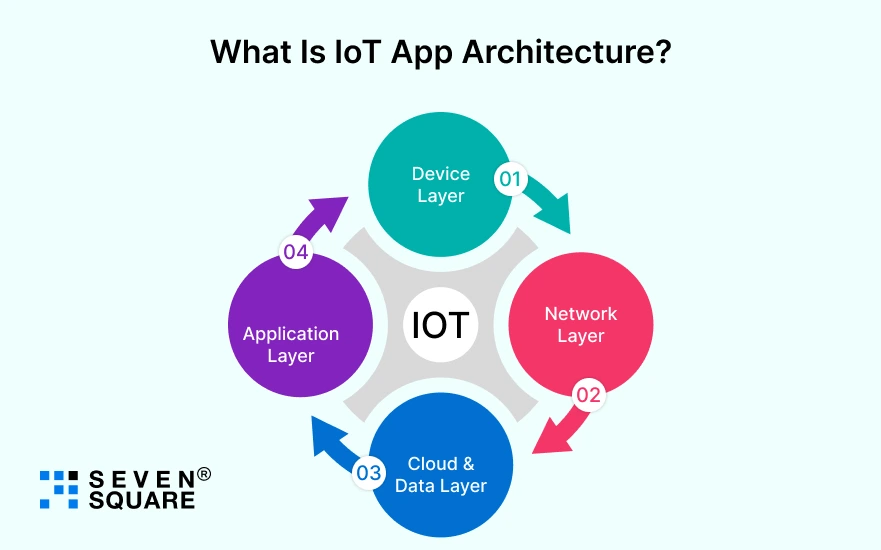
Let’s break down the IoT app development architecture & learn how we design architecture that is easy to understand, secure, and scalable from day one.
1. Device Layer
- The device layer includes sensors, smart devices, machines, & wearables that collect real-world data like temperature, motion, health stats, or machine status.
2. Network Layer
- The network layer transfers data from devices to the cloud using internet connectivity.
- This layer ensures smooth and secure communication between smart devices and connected systems.
3. Cloud & Data Layer
- The cloud and data layer processes, stores, and analyzes incoming data.
- This is where automation rules, alerts, and analytics are handled using cloud services.
4. Application Layer
- The application layer is what users interact with.
- It includes mobile apps, web dashboards, and admin panels that show insights and allow real-time control.
How Data Flows End-to-End?
Data flows from Devices → Network → Cloud → Application, and back again.
This two-way flow allows real-time actions, automation, and intelligent decision-making, which is the core of successful IoT app development.
What Technologies & Tools Do We Use in IoT App Development?
Building reliable IoT solutions requires the right combination of IoT platforms and tools along with modern IoT frameworks.
Programming Languages Used in IoT
We use languages like Python, Java, JavaScript, C/C++, and Node.js, depending on the device and system needs.
Popular IoT Platforms
We work with leading platforms such as:
- AWS IoT
- Azure IoT
- Google Cloud IoT
These platforms help with device management, security, and scalable cloud integration.
Databases & Analytics Tools
IoT apps rely on real-time data, so we use scalable databases and analytics tools that support fast IoT data processing and insights.
Mobile & Web Technologies for IoT Dashboards
For dashboards, we use modern mobile and web technologies that enable clean UI, smooth performance, and real-time monitoring.
How Do We Build Scalable & Secure IoT Applications?
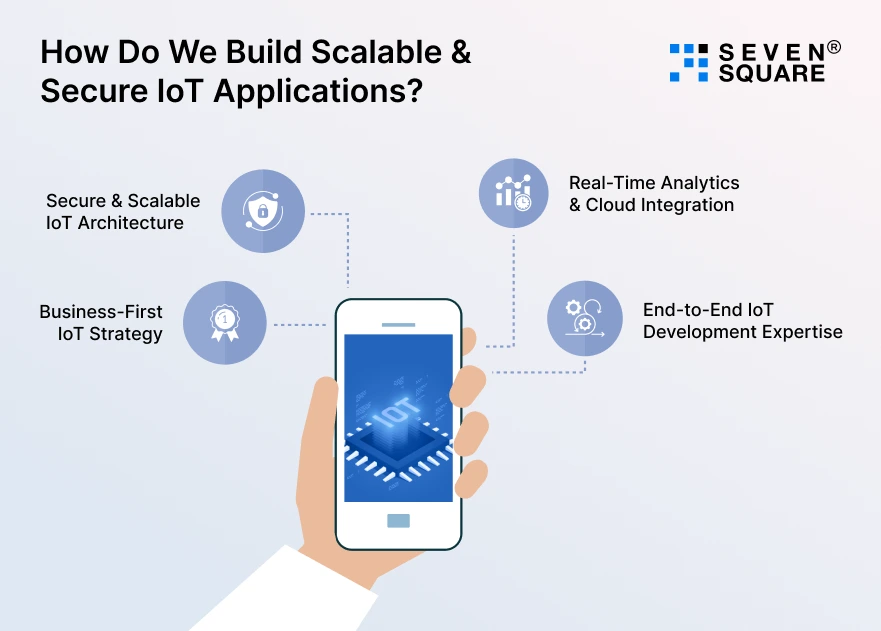
We specialize in custom IoT app development according to business needs.
- Business-First IoT Strategy : We focus on solving real problems, not just adding technology. Every IoT app starts with a clear business goal.
- Secure & Scalable IoT Architecture : Security and scalability are built into the architecture to protect data and support growth.
- Real-Time Analytics & Cloud Integration : Our solutions provide real-time analytics with seamless cloud integration for faster decision-making.
- End-to-End IoT Development Expertise : From idea and design to deployment and scaling, we handle the complete IoT development lifecycle.
Want IoT App Development Services? Contact Us Now!
What Are the Future Trends in IoT App Development You Should Know?
The future of IoT app development is evolving fast, and businesses must stay ahead.
- AI + IoT Integration : AI helps IoT systems learn from data and make smarter decisions automatically.
- Edge Computing : Processing data closer to devices reduces latency and improves real-time performance.
- Smarter Automation & Predictive Analytics : IoT systems are becoming more proactive, predicting issues before they occur.
Is IoT App Development Right for Your Business?
IoT app development for business is ideal when you want better automation, real-time visibility, and data-driven decisions. You should invest in IoT if:
- You manage devices, machines, or assets.
- Real-time data can improve operations.
- You want scalable, future-ready systems.
FAQs
- It connects smart devices to cloud systems to collect, process, and act on data in real time.
- IoT apps use sensors, cloud platforms, connectivity technologies, databases, and mobile or web apps.
- Yes, when built correctly with encryption, authentication, and a secure cloud infrastructure.
- Timelines vary based on complexity, but most IoT apps take a few weeks from planning to launch.