You moved your application to the cloud expecting lower costs, better performance, and easy scaling. But instead, something feels off.
Your cloud bills keep increasing every month.
Your application still feels slow and unreliable.
And when traffic spikes, your system struggles to scale, even on powerful cloud infrastructure.
So the big question is: “We moved to the cloud, then why are our costs still increasing?”
The uncomfortable truth? The cloud is not the problem. The real issue is legacy systems running inside modern cloud environments.
Most companies migrate their applications to AWS, Azure, or GCP without fixing the legacy architecture underneath.
As a result, outdated systems continue to consume excessive resources, cause performance bottlenecks, and block effective cloud cost optimization.
We work closely with fast-growing companies facing exactly this challenge.
We help them modernize legacy systems so they can reduce cloud costs, eliminate legacy system performance issues, & get the results they expected from the cloud.
In this blog, you’ll learn how legacy system modernization fixes these problems without breaking your business.
If your cloud feels expensive, slow, or unpredictable, this blog is for you.
What Are Legacy Systems in the Cloud Age? (And Why They Still Exist?)
Legacy systems are older software applications or architectures that were built years ago using outdated technologies, frameworks, or design patterns.
These include legacy applications that were originally designed for on-premise servers, not for modern cloud environments.
So if legacy systems cause so many problems, why do companies still use them? The answer is simple.
- First, many legacy systems contain business-critical logic that has evolved over the years. Rewriting or replacing them feels risky.
- Second, teams fear downtime and data loss. Even a small mistake can impact customers, revenue, or compliance.
- Third, modernization feels expensive upfront. The legacy system maintenance costs are visible & predictable, while refactoring seems complex and uncertain.
Legacy architecture is fundamentally different from cloud-native architecture.
- Legacy systems are static, tightly coupled, and resource-heavy.
- Cloud-native systems are dynamic, scalable, and cost-efficient.
Learn Why Your App Isn’t Scaling Even After Cloud Migration.
Why Legacy Systems Increase Cloud Costs? (The Hidden Cost Traps)
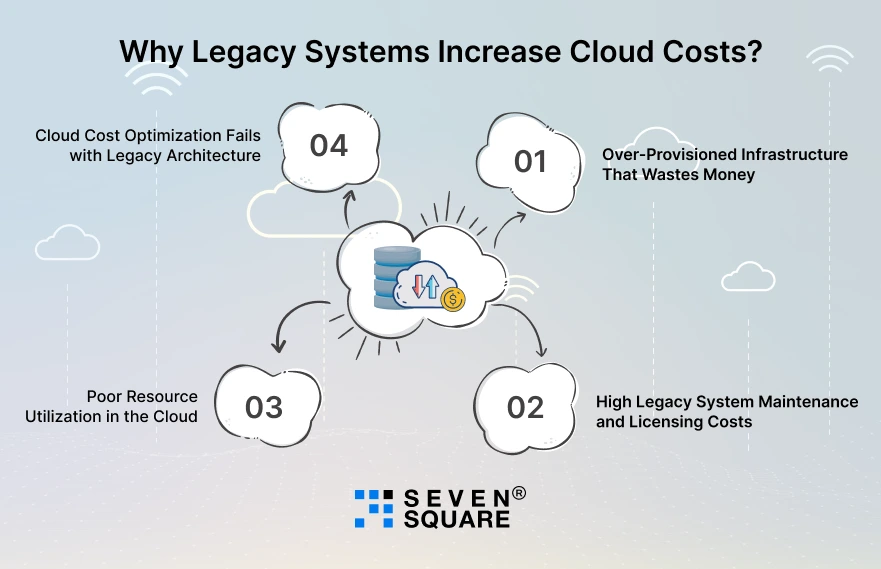
Cloud bills increase month after month, and legacy systems are usually the reason. Here’s how legacy systems silently increase cloud costs:
1. Over-Provisioned Infrastructure That Wastes Money
Legacy applications are not built to scale dynamically. They can’t adjust resources based on real usage.
To avoid crashes, teams over-provision:
- Larger servers.
- Extra storage.
- Always-on environments.
This means you pay for resources even when they are not being used. Cloud-native apps scale up and down automatically.
Legacy systems don’t, which breaks effective cloud cost optimization.
2. Legacy systems don’t, which breaks effective cloud cost optimization.
Many legacy systems depend on:
- Expensive commercial databases.
- Old middleware licenses.
- Proprietary tools with fixed pricing.
Even after moving to the cloud, these legacy system maintenance costs remain and often increase due to cloud hosting fees added on top.
You end up paying:
- Vendor license costs.
- Cloud infrastructure costs.
- Support and patching costs.
All at the same time.
3. Poor Resource Utilization in the Cloud
Legacy applications are usually designed to run 24/7, even when traffic is low. This leads to:
- Always-on servers.
- No serverless usage.
- No container optimization.
As a result, cloud resources stay idle but still generate bills. This is one of the highest hidden costs of maintaining legacy systems in the cloud.
4. Cloud Cost Optimization Fails with Legacy Architecture
Cloud platforms offer powerful cost-saving tools:
- Auto-scaling.
- Spot instances.
- Serverless services.
But legacy architecture cannot fully use them.
Without legacy system modernization, cloud cost optimization becomes manual, slow, and ineffective, causing long-term financial drain.
Explore the Most Common Cloud Migration Mistakes.
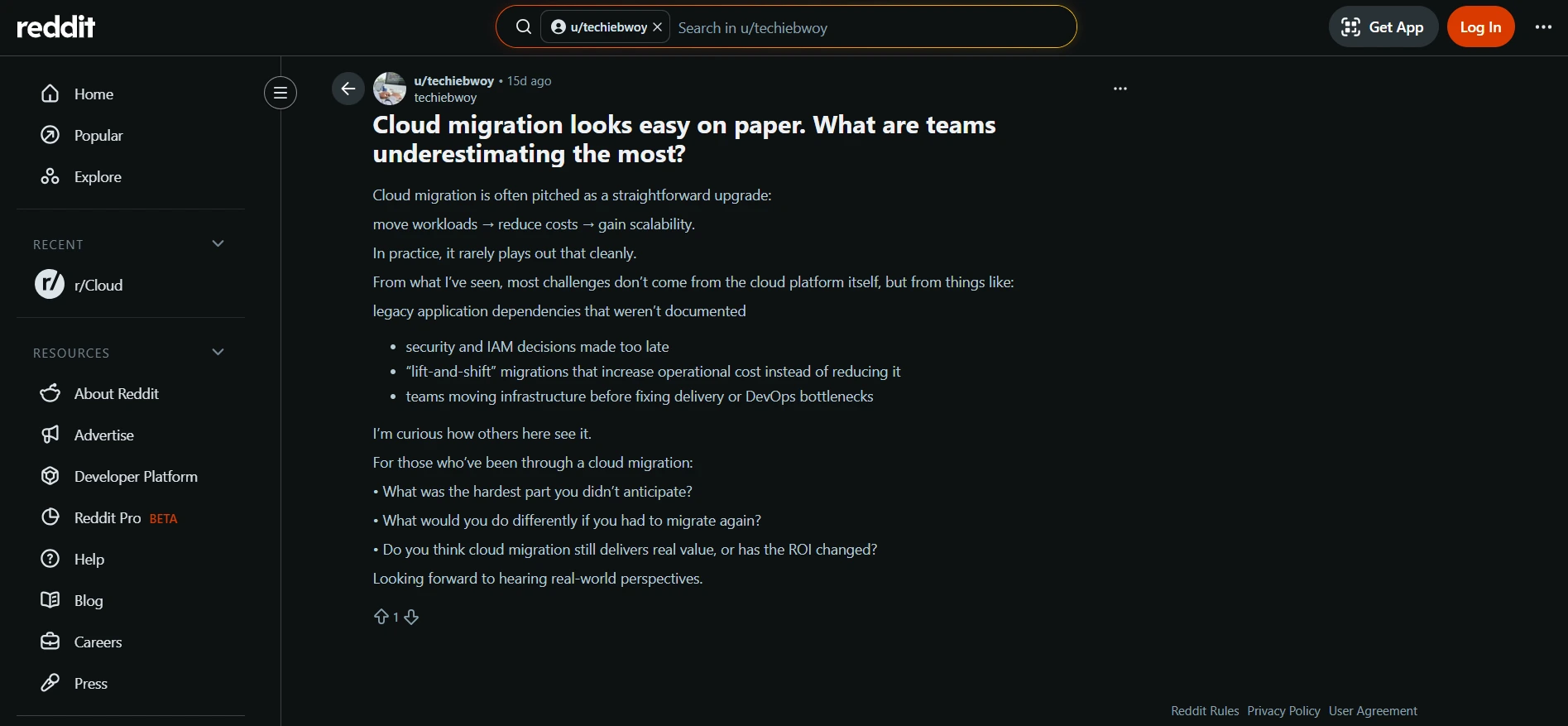
What People On Reddit Are Saying About Legacy System Migration?
In this Reddit thread, cloud engineers describe exactly what many companies discover post-migration:
Source: Reddit
This exactly highlights how legacy system performance issues and poor architecture can turn an expected cost reduction into a painful cloud bill.
Why Legacy Systems Reduce Cloud Performance? (Even on Powerful Infrastructure)
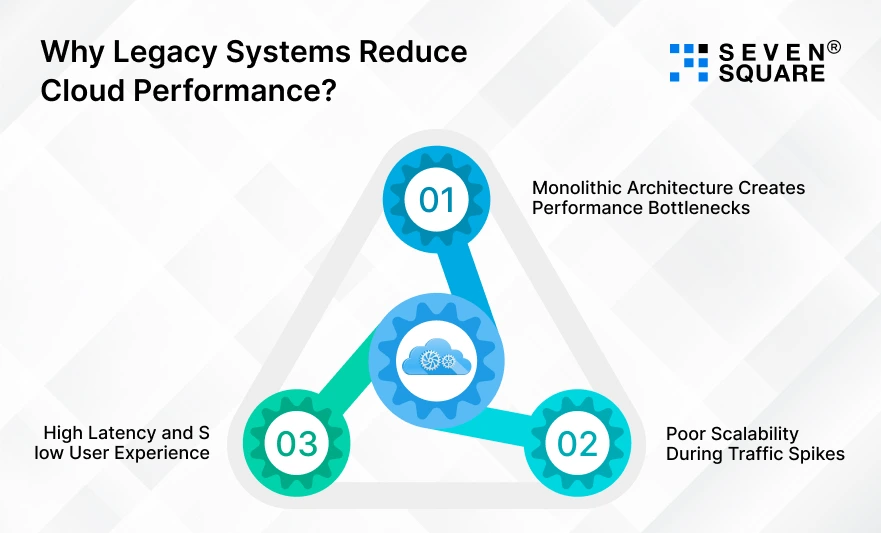
Many teams think that moving to better servers will fix performance issues. But performance problems caused by legacy systems don’t disappear in the cloud; they often get worse.
Here’s why legacy system performance issues persist:
1. Monolithic Architecture Creates Performance Bottlenecks
Most legacy systems are built as large monolithic applications. This means:
- One slow component affects the entire system.
- A single failure can bring everything down.
- Scaling one feature requires scaling the whole app.
These performance bottlenecks caused by legacy systems make applications slow, unstable, and expensive to run.
2. Poor Scalability During Traffic Spikes
Cloud infrastructure can scale instantly, but legacy systems cannot. During peak traffic:
- Response times increase.
- Errors spike.
- Users experience downtime.
This mismatch directly impacts cloud scalability and customer experience.
3. High Latency and Slow User Experience
Legacy systems depend upon:
- Old communication protocols.
- Synchronous processing.
- Tightly coupled services.
In the cloud, this leads to:
- High latency.
- Slow API responses.
- Poor application performance.
Even powerful cloud environments can’t fix architecture-level issues.
How We Solved This Legacy System Modernization Problem?
We’ve helped multiple companies fix rising cloud costs and poor performance caused by legacy systems.
A growing SaaS company approached us after migrating its core application to the cloud. Their situation looked like this:
- Cloud costs were increasing every month.
- Application performance was inconsistent.
- Scaling during peak usage caused failures.
The Results: Cost Savings + Performance Gains
After modernization:
- 35 to 45% reduction in cloud costs.
- 2.5x faster application performance during peak traffic.
- 60% faster deployment cycles.
- 99.9% uptime achieved.
- Scalability improved by 3x.
This is the real value of legacy application modernization, which makes the cloud efficient, scalable, and cost-effective for your business.
How Do We Help You Reduce Cloud Costs & Improve Performance?
We help you modernize step by step, with a clear focus on cost reduction, performance improvement, and business continuity. Here’s how we help:
- Legacy system and cloud cost assessment to identify waste.
- Modernization roadmap aligned with your business goals.
- Incremental modernization without disrupting users.
- Cloud-native optimization for performance and scalability.
Want to Get Legacy System Modernization Services? Contact Us Now!
How Legacy System Modernization Fixes Cost & Performance Issues?
What Is Legacy System Modernization?
Legacy system modernization is the process of improving or transforming old applications so that they work efficiently with modern cloud infrastructure. It focuses on:
- Removing architectural bottlenecks.
- Reducing technical debt.
- Aligning systems with cloud-native capabilities.
Why Legacy System Modernization Is Important for Cloud Cost Optimization?
Without modernization, cloud environments amplify inefficiencies. Modernization helps because it:
- Enables auto-scaling instead of over-provisioning.
- Reduces idle infrastructure costs.
- Eliminates unnecessary licenses and dependencies.
- Improves monitoring and cost visibility.
This is how real cloud cost optimization becomes possible.
How Modernization Improves Cloud Performance?
When legacy systems are modernized:
- Monoliths are broken into scalable components.
- Services scale independently based on demand.
- Latency is reduced through better communication patterns.
- Deployments become faster and more reliable.
The result is a system that performs better, costs less, and scales with confidence.
FAQs
- Legacy systems are not designed for cloud environments.
- They often require over-provisioned infrastructure, stay running 24/7, and can’t use auto-scaling effectively, leading to higher cloud bills.
- Cloud migration alone does not fix architectural problems.
- Legacy system performance issues, such as monolithic design and tight coupling, continue to cause latency, downtime, and slow scaling.
- Modernization can be expensive if done incorrectly.
- Phased legacy system modernization often reduces long-term cloud costs and delivers strong ROI by improving performance and efficiency.
- Modernized systems support auto-scaling, containers, and serverless services.
- This allows businesses to pay only for what they use and achieve real cloud cost optimization.