What is the real cost of mobile app development?
For most growing businesses, it’s far higher than what appears in the initial estimate.
At first, everything looks manageable. You approve the budget, hire a mobile team, and start building. But a few months later, reality hits.
Costs start increasing quietly, deadlines move, and suddenly your mobile app becomes one of the biggest expenses in your business.
The biggest reason?
You’re paying twice. Most companies still build separate apps for iOS and Android.
That means two development teams, two codebases, two testing cycles, & double the long-term maintenance.
This approach increases mobile app development cost, especially for startups and growing businesses. Then come the hidden losses:
- Delayed launches mean lost market share.
- Features take longer, so competitors move faster.
- Maintenance costs increase every quarter without warning.
- Startups burn the runway before reaching product-market fit.
Businesses fail because the cost of building and maintaining the app becomes unsustainable.
We’ve audited 30+ mobile solutions in the last 3 months, and over 70% were overspending because of poor tech stack decisions.
The good news? This problem is solvable.
With the right approach to Flutter app development, reducing mobile development costs by up to 35% is realistic & we’ve already done it for growing businesses like yours.
What Is Flutter App Development & Why Businesses Are Switching in 2026?
Flutter app development is one of the best approaches to building mobile apps using a single codebase that runs on both iOS and Android.
Instead of maintaining two separate apps, businesses build once and deploy everywhere.
Flutter is backed by Google and uses the Dart programming language, which is optimized for fast UI rendering and smooth performance.
The result is apps that feel close to native without the cost of native development. Here’s why businesses are switching to Flutter mobile app development in 2026:
- One codebase for iOS and Android.
- Faster development cycles and quicker releases.
- Near-native performance with smooth UI
- Lower development and long-term maintenance costs.
From a business point of view, Flutter cross-platform development is a financial decision. That’s why more businesses now see Flutter as a cost-efficient mobile strategy.
Why Traditional Mobile Development Increases Costs? (The 5 Hidden Cost Traps)
Native development was never designed to be cost-efficient for growing businesses. It was built for performance first.
Here are the five hidden cost traps that make native app development 30 to 50% more expensive than it should be:
- Separate iOS & Android Teams: You need different developers, different skill sets, & different timelines. Salaries can double your cost before the app launches.
- Duplicate QA & Testing Cycles: Every feature must be tested twice, once for iOS and once for Android. This slows releases and increases QA expenses.
- Slower Time-to-Market: Two platforms mean slower launches. While you’re still building, competitors using cross-platform app development are already live.
- Double Maintenance Costs: Bug fixes, updates, OS changes, everything happens twice. Maintenance quietly becomes a long-term financial drain.
- Scaling Features Costs 2x: Adding new features or experimenting with growth ideas costs double, making innovation expensive and risky.
This is why many businesses start looking for mobile development cost reduction strategies once it’s already too late. And here’s the hard truth:
Your competitor isn’t building faster; they’re just paying less.
This is where the Flutter vs native app development cost difference becomes impossible to ignore & why Flutter has become the smarter choice for cost-conscious, growth-focused companies.
How Flutter App Development Saved Costs? (People Say on Reddit)
Here’s what the community openly shares about how Flutter mobile app development impacts costs and timelines.
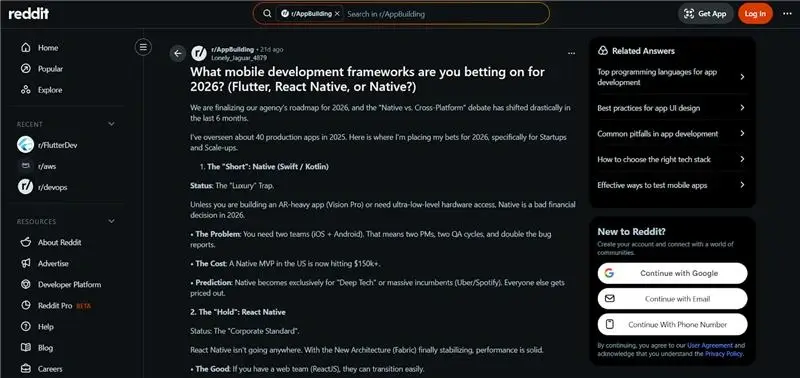
Source: Reddit
What You Should Learn From It?
- Flutter lets you build many features with one development effort instead of two separate native builds.
- Developers often estimate time and cost based on feature complexity, because Flutter already handles both platforms with one codebase.
- By reducing duplicated effort (coding, testing, debugging), businesses can save significant time and money, especially for mid-size to complex apps.
It shows that Flutter cross-platform development can save 30 to 40% or more in development and maintenance costs.
How Flutter App Development Reduces Mobile Development Costs by 35%? (Full Breakdown)
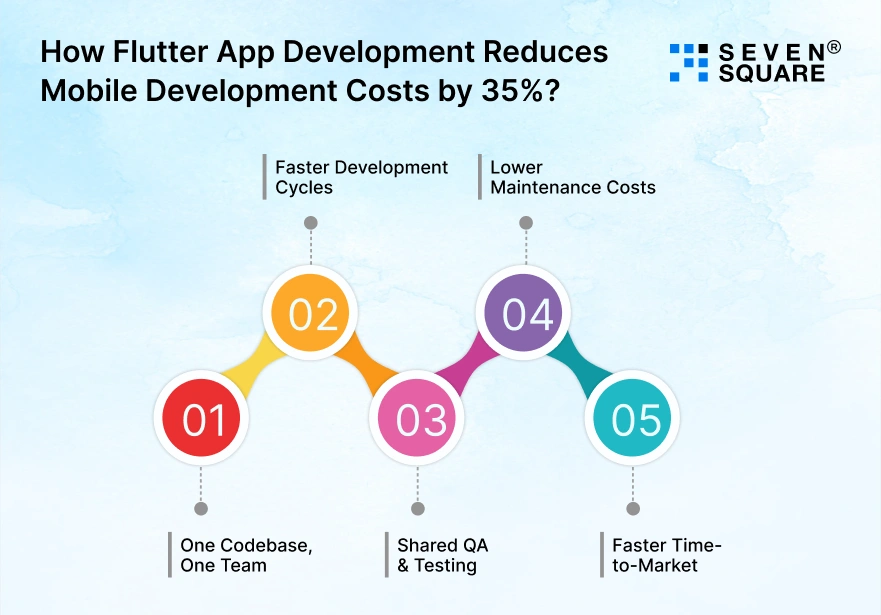
Here’s how Flutter app development reduces mobile app development cost in real projects:
1. One Codebase, One Team
- With Flutter, you don’t build separate apps for iOS and Android.
- One team writes one codebase that runs on both platforms. This reduces development effort by 30 to 40%.
2. Faster Development Cycles
- Flutter’s hot reload allows developers to see changes instantly.
- This speeds up UI changes, bug fixes, and feature iterations to reduce billable hours.
3. Shared QA & Testing
- Testing happens once instead of twice.
- Less QA time means fewer delays and lower costs during every release cycle.
4. Lower Maintenance Costs
- Bug fixes, OS updates, and feature upgrades are done in one place.
- Over time, this significantly reduces long-term maintenance expenses.
5. Faster Time-to-Market
Launching faster means:
- Earlier user feedback.
- Faster revenue generation.
- Less money wasted waiting for releases.
This is why businesses using Flutter cross-platform development consistently report lower development and scaling costs compared to native apps.
How We Reduced Mobile App Costs by 38% Using Flutter?
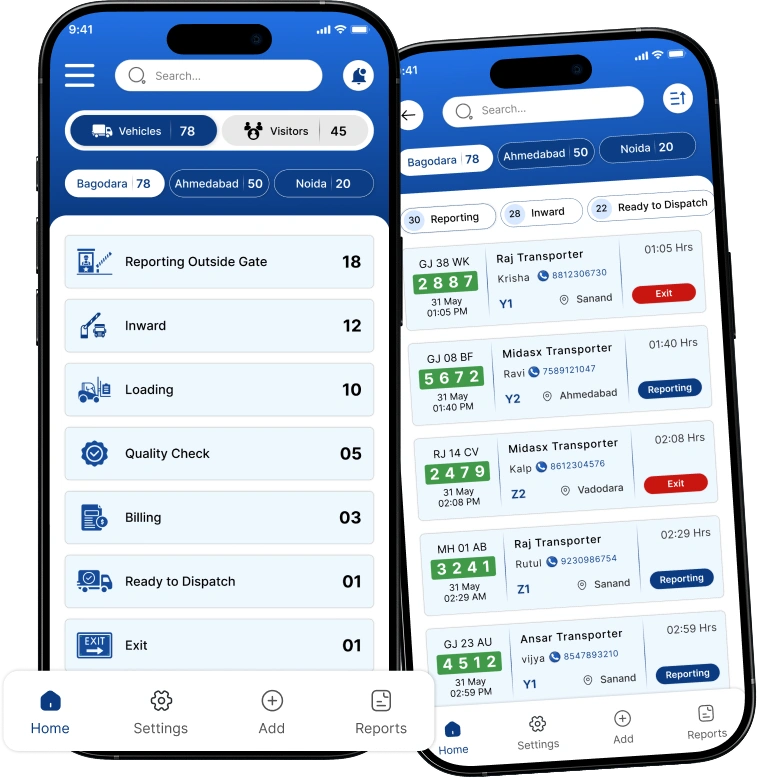
A growing logistics-focused business called Vehicle Monitoring came to us with a clear problem: Their mobile app was becoming too expensive to build and maintain.
They wanted to have separate native iOS and Android apps, which meant higher development cost, slow feature releases, & rising maintenance expenses every quarter.
We recommended Flutter app development to simplify everything into a single, scalable solution.
Using Flutter, we rebuilt the app with a shared codebase, reusable UI components, and an optimized backend integration.
The Results:
- 38% reduction in total development cost.
- Faster releases by nearly 40%.
- One development team instead of two.
- Lower maintenance effort quarter after quarter.
What’s Our Proven Approach to Building Cost-Efficient Flutter Apps?
We build cost-effective Flutter apps that can scale. Here’s how our Flutter approach is different:
- Architecture-first planning to avoid expensive rework later.
- Reusable components to reduce future feature costs.
- Performance optimization to avoid native rewrites.
- CI/CD automation to reduce release overhead.
- Post-launch cost monitoring to keep budgets predictable.
Want Custom Flutter App Development Services? Contact Us Now!
Is Flutter App Development Right for Your Business?

It’s perfect for businesses that want speed, control, and cost efficiency. Flutter is a great fit if you:
- Are you a startup or a growing business.
- Want to reduce mobile app development costs.
- Need fast time-to-market.
- Plan frequent updates and experiments.
- Want one team instead of two.
If your goal is growth without burning cash, Flutter app development is often the smartest choice.
FAQs
- The cost depends on features, but Flutter apps are usually 30 to 40% cheaper than native apps.
- Yes. Flutter reduces cost by using one codebase instead of two separate native apps.
- No. Flutter delivers near-native performance for most business and consumer apps.
- Flutter often offers better performance consistency and UI control, reducing long-term rework costs.
- Yes. Flutter is already used in large-scale apps by global companies.