Most enterprise apps don’t fail because they are expensive to build. They fail because they become expensive to maintain.
In the US, enterprise mobile app maintenance costs are increasing faster than most teams expect.
What starts as a manageable post-launch budget slowly turns into a constant drain on engineering time, money, and focus.
By the second or third year, many companies realize they’re spending more on maintenance than on innovation. Hidden costs increase slowly:
- Every iOS and Android OS update breaks something.
- Small bug fixes turn into long QA cycles.
- New features must be built twice to keep both platforms in sync.
- Team changes create knowledge gaps & make updates slower and riskier.
Over time, this creates a long-term app maintenance strategy that is reactive instead of planned. Teams spend weeks fixing old issues instead of building new value.
Leaders start asking the same question: How do we reduce app maintenance expenses without sacrificing quality & scale?
This is where many enterprises begin exploring Flutter Enterprise App Development as a long-term cost control strategy designed to reduce maintenance after launch.
Why Are Enterprises Actively Reconsidering Native Apps in 2026?
Five years ago, native development felt like the safest choice. Many enterprises are realizing it’s also one of the most expensive long-term decisions.
Here’s why this problem matters now. Apple and Google are releasing platform updates more frequently than ever.
Each update increases maintenance workload, not just once, but every year. With native apps, teams must:
- Update iOS code separately.
- Update Android code separately.
- Test both versions independently.
- Fix platform-specific bugs repeatedly.
This means two teams, two codebases, and double the effort.
As enterprise apps scale across regions, departments, and user roles, this duplication becomes harder to manage. Feature parity starts slipping. Releases slow down. Maintenance costs increase quietly but consistently.
That’s why CTOs and product leaders are looking for:
- Better Flutter vs native app cost comparison insights.
- Proven ways to achieve enterprise app development cost reduction.
- Technologies that scale without multiplying maintenance complexity.
The conversation is not about how fast we can build. It’s about how long we can afford to maintain what we build.
What Makes Flutter a Maintenance-First Framework for Enterprise Apps?
Flutter is often described as a cross-platform framework. For enterprises, its real value lies somewhere else: maintenance efficiency.
Flutter is designed to reduce long-term operational effort, not just initial development time. That’s what makes it a strong fit for enterprise apps with long lifecycles.
1. What Does a Single Codebase Really Mean for Enterprise Maintenance?
With Flutter, teams maintain one shared codebase for iOS and Android. This directly converts into lower maintenance effort.
- One update instead of two.
- One bug fix instead of two.
- One QA cycle instead of two.
These Flutter single codebase maintenance cost benefits compound over time. As the app grows, maintenance complexity grows linearly, not exponentially.
2. Why Flutter Reduces Regression Bugs and QA Cycles?
Native apps often introduce bugs when fixing platform-specific issues. Flutter minimizes this by:
- Using consistent UI rendering across platforms.
- Reducing platform-dependent logic.
- Allowing faster, more predictable testing cycles.
Fewer regressions mean less rework, less firefighting, and lower long-term costs.
3. How Flutter Simplifies Long-Term Support and Upgrades?
Enterprise apps live for years. Flutter simplifies that lifecycle by:
- Making upgrades easier with centralized changes.
- Reducing dependency on platform-specific expertise.
- Allowing smoother onboarding when team members change.
This lowers the risk and cost of long-term support & a major factor in enterprise maintenance budgets.
4. Total Cost of Ownership: Flutter vs Native Apps
When enterprises compare frameworks, the real metric is total cost of ownership. Native apps may look stable upfront, but over time:
- Maintenance costs rise.
- Release cycles slow down.
- Technical debt increases.
A Flutter enterprise app, on the other hand, keeps maintenance predictable and scalable.
That’s why many organizations see measurable reductions in ongoing costs, often close to 30% over the app’s lifecycle.
What People Are Saying About Maintenance Cost & Flutter?
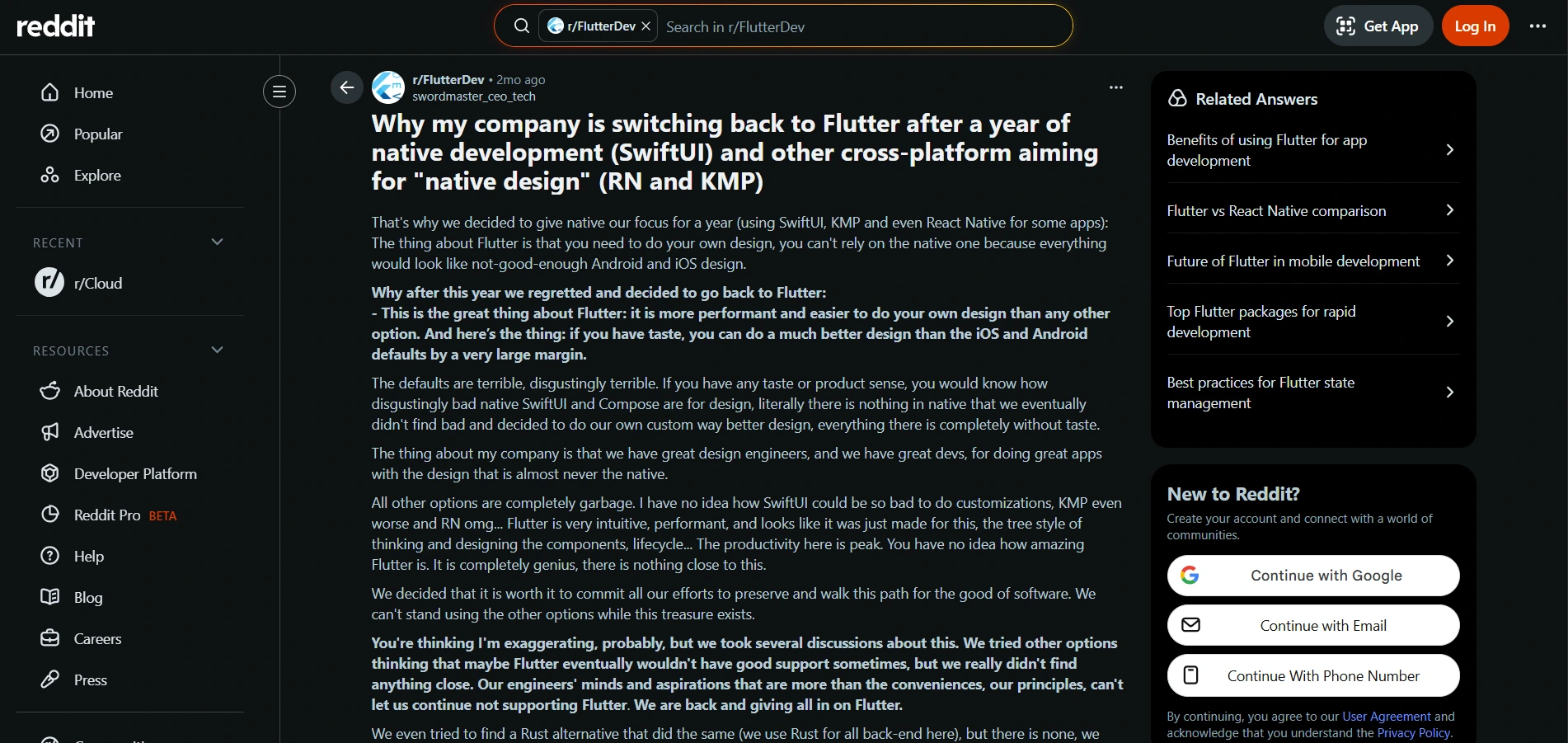
Here you can see why many businesses are switching to Flutter to reduce long-term maintenance costs.
Source: Reddit
What You Can Understand From It?
- You can design and update the UI once for both iOS and Android.
- Maintenance and iteration become simpler and faster.
- Teams enjoy a unified development experience that reduces long-term coordination headaches.
How Do We Approach Flutter Enterprise App Development Differently?
Many companies build Flutter apps. Very few build them with long-term maintenance in mind. We don’t treat Flutter as just a faster way to launch.
We treat Flutter Enterprise App Development as a strategy to reduce future cost, risk, and complexity. From day one, our focus is on:
- Keeping the codebase easy to maintain for years.
- Making updates predictable, not painful.
- Ensuring new developers can onboard without breaking things.
- Designing systems that scale without increasing maintenance effort.
We’ve worked with enterprise clients who came to us after their maintenance costs started increasing.
That experience has changed how we architect Flutter apps, not just for today, but for what happens 2 to 5 years after launch.
Learn How Flutter App Development Helps to Reduce Development Costs.
How Did We Reduce Maintenance Costs for an Enterprise App?
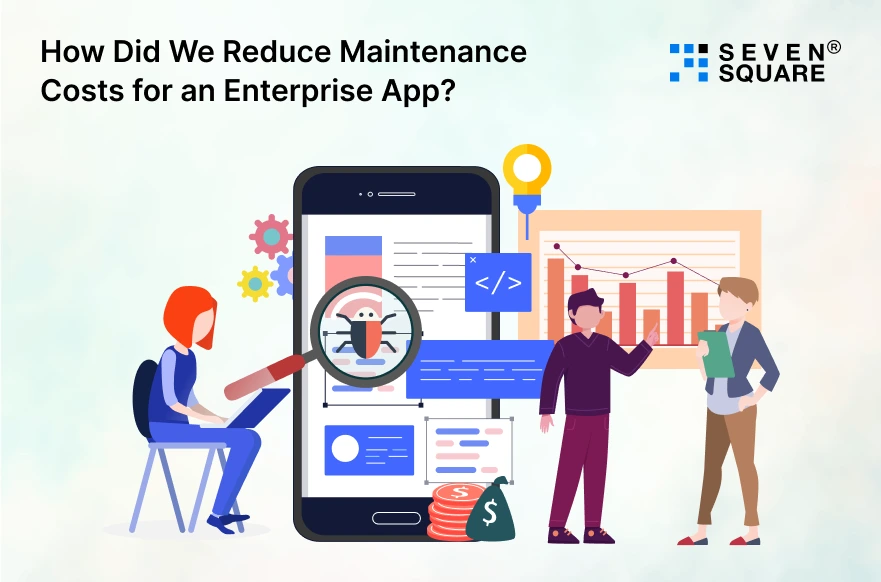
One of our enterprise clients came to us with a familiar problem. They had:
- Separate iOS and Android native apps.
- Growing user base across multiple regions.
- Increasing bug reports after every OS update.
- A maintenance budget that kept growing year after year.
What We Delivered?
Within 6 months, the impact was clear:
- 30% reduction in ongoing maintenance effort.
- 45% faster release cycles for updates.
- 50% fewer regression bugs after OS updates.
- Maintenance workload reduced from 40 hours/month to 26 hours/month.
Want Flutter Enterprise App Development Services? Contact Us Now!
How Flutter Lowers Long-Term Maintenance Costs by 30%?
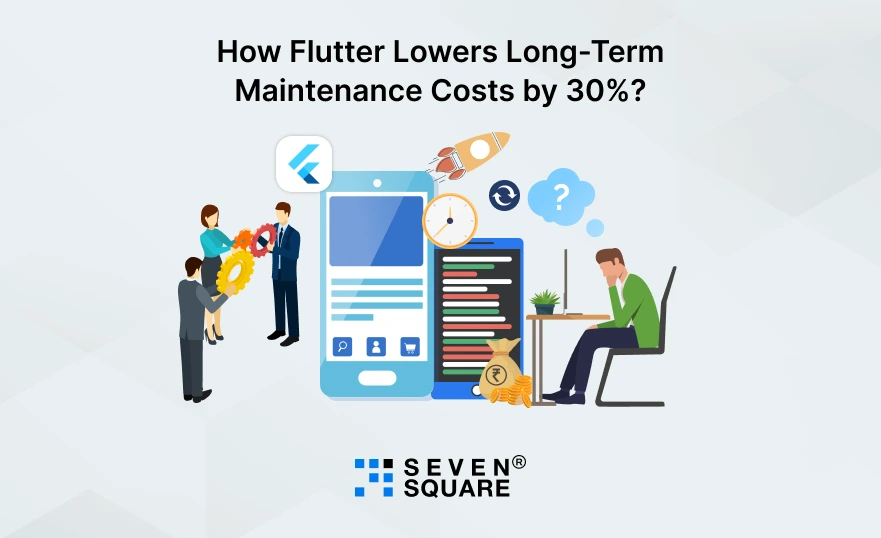
This is where the real savings come from: Execution.
- One Codebase, One Maintenance Cycle: Instead of fixing the same issue twice, Flutter lets teams fix it once. Over time, this alone cuts maintenance effort significantly.
- Faster Updates, Less Downtime: Flutter allows quicker updates across platforms. This reduces Emergency fixes, Support tickets, & Costly hotfix cycles.
- Reduced QA Overhead: One UI system means fewer platform-specific edge cases. Less testing time = lower cost.
- Lower Team Dependency: Flutter apps are easier to maintain even when teams change. This reduces reliance on specific developers and lowers long-term risk.
All of this contributes to measurable Flutter maintenance cost savings and explains why enterprises often see close to a 30% reduction in long-term maintenance costs.
Learn How Flutter Helps to Launch Faster & Improve Time-to-Market Profitability.
What’s Our Flutter Maintenance-First Approach Work?
We follow a clear, proven approach focused on cost efficiency. Our Process Includes:
- Clean, modular Flutter architecture.
- Clear documentation from day one.
- Code standards focused on long-term readability.
- Maintenance planning is built into the roadmap.
- Regular audits to prevent technical debt.
This approach aligns with best practices to reduce Flutter app maintenance expenses and helps enterprises avoid surprises later.
Why Flutter Is a Long-Term Investment, Not Just a Framework?
Flutter is about being smarter. For enterprises, the real cost of an app is not launch; it’s everything that comes after.
Flutter Enterprise App Development offers a practical way to control long-term costs, reduce complexity, and stay competitive.
When done right, Flutter becomes more than a framework. It becomes a long-term business advantage.
If you’re thinking about how to reduce enterprise app maintenance costs, now is the right time to act.
FAQs
- Yes. Flutter is widely used for complex, large-scale enterprise applications when designed with proper architecture.
- Savings vary, but many enterprises report 25 to 30%lower long-term maintenance costs compared to native apps.
- Flutter generally has a lower total cost of ownership due to a single codebase, fewer bugs, and simpler upgrades.
- Yes. Flutter supports enterprise-grade security standards when implemented correctly.