When your traffic suddenly grows 3x, the first thing that breaks is not your app; it’s your infrastructure costs.
Many businesses believe they have a “scalable” setup. But the moment traffic spikes, cloud bills start rising faster than revenue.
This happens because most frontend architectures are not optimized for real-world traffic patterns. Here’s what usually goes wrong:
- Rising cloud bills, even though the architecture was built to scale.
- Server overload during traffic spikes, causing slow pages or downtime.
- Poor TTFB (Time to First Byte) that hurts conversions.
- Over-provisioned infrastructure running 24/7, wasting money during low traffic.
Instead of paying only for what you use, you end up paying for unused capacity. This is where infrastructure cost optimization becomes a serious challenge.
For teams handling high-traffic web apps, these problems are common. As traffic grows, cloud cost management becomes unpredictable, and performance starts affecting user experience.
This is exactly the moment when businesses stop blaming traffic and start questioning their frontend architecture.
Here you will learn about NextJs web development services & some of the NextJs scalability best practices for reducing infrastructure costs.
Why Traditional Web Architectures Fail at Scaling Without Cost Explosion?
Traditional frontend architectures were never designed to scale efficiently with modern traffic demands.
Most setups rely on monolithic frontend deployments where every request hits the server, even when the content doesn’t change.
As traffic grows, this creates serious performance and cost issues. Here’s why traditional architectures fail:
- Always-on servers, even during low traffic hours.
- Poor CDN utilization, meaning content is not served closer to users.
- No flexibility between SSR and static rendering, increasing server load.
- Frontend performance bottlenecks caused by heavy server-side rendering.
In these setups, scaling means adding more servers, which directly increases hosting costs. There’s no smart way to balance performance and cost.
This is where the comparison of Next.js vs traditional web development becomes important.
With traditional stacks, you have little control over SSR vs static generation costs. You either overuse SSR (expensive) or under-optimize static content (slow updates).
This is why many growing companies start exploring Next.js web development services for cost-efficient scalability.
How Do We Solve Next.js Scalability & Cost Problems Frequently?
We have spent years building and optimizing high-traffic Next.js applications for startups, SaaS products, and enterprise platforms.
Our focus is not just performance, it’s Next.js infrastructure cost savings. What sets us apart?
- Deep experience with Next.js performance optimization.
- Hands-on work with Vercel, AWS, Cloudflare, and hybrid deployments.
- Practical understanding of how traffic, rendering, and cloud billing interact.
- Proven delivery of enterprise Next.js solutions that scale without cost spikes.
We don’t follow one-size-fits-all setups. Every project is designed around traffic behavior, usage patterns, and cost control.
Our Next.js web development services are built to answer one key question: How do you handle growth without burning money?
Learn Why SaaS Companies See Higher User Retention After Migrating to ReactJs.
What People Are Saying About Next.js Cost & Scalability?
Here you can see Next.js scalability challenges and infrastructure cost optimization, to see what people are discussing online.

Source: Reddit
What You Should Learn?
- People are actively debating cost vs performance.
- They’re comparing hosting options tailored to traffic needs.
- Edge deployments, static generation, and caching are front-page concerns.
- Many are trying to solve Next.js scalability challenges without breaking the bank.
What Actually Reduces Infrastructure Costs in Next.js?
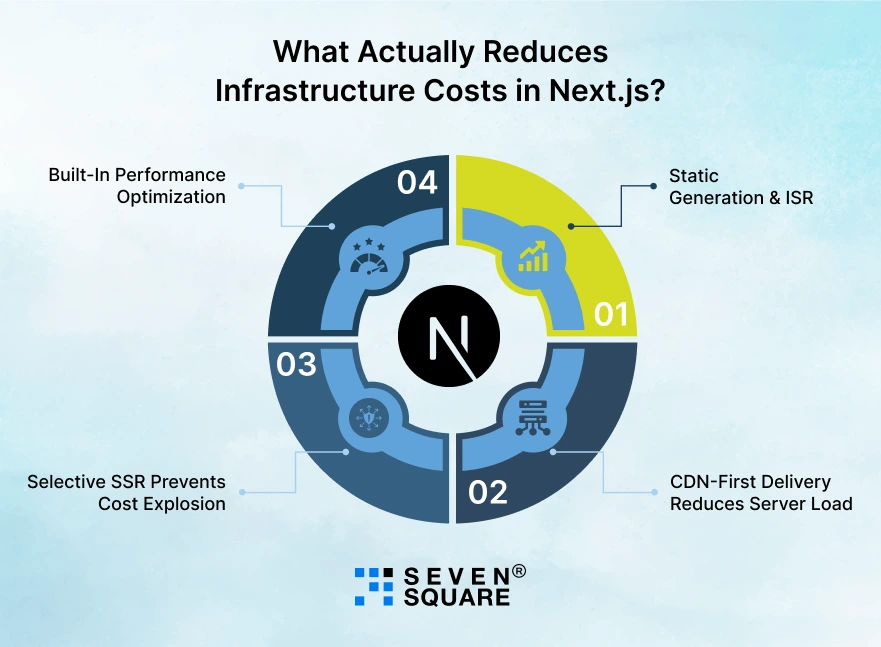
Next.js reduces infrastructure costs not because it is “fast,” but because it gives control over how your app consumes resources. Here’s what truly makes the difference.
1. Static Generation & ISR: Pay Less, Serve More
With Static Site Generation (SSG) and Incremental Static Regeneration (ISR), pages are pre-built and served via CDN instead of hitting servers every time.
This means:
- Fewer server requests.
- Lower compute usage.
- Predictable cloud bills.
For most content-heavy or semi-dynamic pages, this alone drives major infrastructure cost optimization.
2. CDN-First Delivery Reduces Server Load
Next.js works extremely well with CDNs. Assets, pages, and even data can be cached closer to users. Result:
- Faster load times.
- Reduced origin server traffic.
- Better handling of high-traffic web apps.
This is one of the biggest reasons companies see Next.js infrastructure cost savings.
3. Selective SSR Prevents Cost Explosion
Instead of rendering everything on the server, Next.js allows SSR only where truly needed. Smart use of SSR:
- Balances SSR vs static generation costs.
- Prevents unnecessary compute usage during traffic spikes.
4. Built-In Performance Optimization
Next.js includes:
- Image optimization.
- Code splitting.
- Lazy loading.
These reduce bandwidth usage and improve frontend efficiency, helping teams reduce hosting costs while improving UX.
How We Helped a Product Handle 3x Traffic With 20% Lower Infra Costs?
One of our clients experienced rapid growth after a marketing campaign. Traffic tripled within weeks, but so did their cloud bills.
What Did We Change?
- Replaced unnecessary SSR with ISR.
- Moved static content to CDN.
- Optimized API routes.
- Introduced traffic-based rendering logic.
The Result
- 20% reduction in infrastructure costs.
- Stable performance during traffic spikes.
- Faster page loads.
- Predictable cloud spending.
This is how Next.js scalability strategies work when implemented correctly.
Want to Get NextJs Development Services? Contact Us Today!
What’s Our Approach to a Cost-Optimized NextJS Framework?

We don’t follow templates. We build cost-aware Next.js architectures. Our approach includes:
- Traffic behavior analysis before development.
- Rendering strategy based on real usage.
- Hosting decisions aligned with growth plans.
- Continuous performance and cost monitoring.
Our Next.js web development services focus on one goal: Scale traffic without scaling costs.
This personal, business-first approach is what separates working apps from profitable ones.
How Can We Reduce Infrastructure Costs With Next.js?
We start optimizing today by:
- Auditing SSR usage.
- Introducing ISR for dynamic pages.
- Moving assets to CDN.
- Optimizing API routes.
- Monitor cloud usage regularly.
These steps alone can improve Next.js performance optimization and reduce costs. If you want it done right, faster, and without trial-and-error, that’s where we help.
Scaling Traffic Without Scaling Costs Is a Choice
Traffic growth should be exciting, not stressful. With the right Next.js architecture, you can:
- Handle 3x traffic.
- Reduce infrastructure costs.
- Stay ahead of competitors.
The real question is not whether Next.js can do it, but who is implementing it the right way.
FAQs
- Yes, when static generation, ISR, and CDN caching are used correctly.
- By serving cached pages from CDNs and reducing server dependency.
- Yes, many enterprise platforms use Next.js for scalable frontend delivery.
- Yes. It supports all major cloud and edge platforms.