Mobile apps are being downloaded more than ever, but most of them are deleted within days.
The real issue is not features, not design, and not even performance. The real problem is a lack of personalization.
Today’s users expect apps to understand them. When every user sees the same screen, same content, same offers, and same notifications, interest drops quickly.
That’s where mobile app engagement starts falling. Let’s see the biggest app retention problems businesses are facing today:
- Apps show the same interface to every user regardless of behavior or interest.
- Users get generic recommendations that don’t match their needs.
- Static onboarding flows confuse or bore users.
- Push notifications are sent without context or timing.
- Content feeds are not personalized.
- User journeys feel robotic instead of human.
A personalized user experience mobile app keeps users engaged because it adapts to them. A generic app forces users to adapt to it, and most won’t.
Simple truth: Most apps don’t fail because of features; they fail because they don’t feel personal.
Here you can see how, after implementing AI-based personalization layers, you can have measurable improvements in retention, session time, and conversions.
What Is AI Personalization in Apps?
AI personalization in apps means using artificial intelligence to automatically adjust app content, features, & user experience based on each user’s behavior, preferences, and context.
Instead of showing the same app to everyone, the app becomes dynamic and user-aware.
In simple words: AI personalization for mobile apps makes the app behave differently for different users automatically.
How AI Personalization in Apps Works?
AI systems inside the app analyze:
- What users click?
- How long do they stay?
- What do they search for?
- What do they ignore?
- When they open the app?
- What features do they use most?
Then AI models predict what each user is likely to want next and adjust the experience.
Rule-Based vs AI-Driven UX Personalization
| Rule-Based Personalization | AI-Driven UX Personalization |
|
|
This is why AI-driven UX personalization scales better and performs better than manual rule systems.
Real-Time vs Predictive Personalization
| Real-Time Personalization | Predictive Personalization |
|
|
Both together create powerful AI personalization in apps that feel intelligent and responsive.
Why Does AI Personalization Increase Mobile App Engagement?
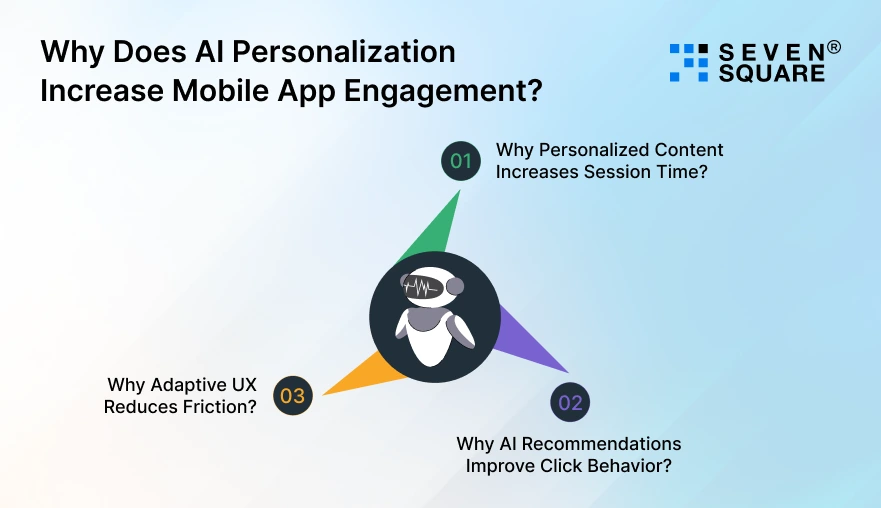
Now, let’s answer the core question: How does AI improve mobile app engagement?
AI personalization works because it aligns the app experience with human behavior patterns. When users feel understood, they interact more.
1. Why Personalized Content Increases Session Time?
When users see content that matches their interests:
- They scroll more.
- They click more.
- They explore more features.
Personalized feeds remove irrelevant noise. This increases average session duration and repeat visits.
This is one of the biggest impacts of AI personalization on mobile app retention.
2. Why AI Recommendations Improve Click Behavior?
AI recommendations in mobile apps analyze patterns across users and predict what each person is most likely to click. Examples:
- Product suggestions.
- Videos.
- Articles.
- Features.
- Services.
When recommendations are relevant, users feel helped.
3. Why Adaptive UX Reduces Friction?
Adaptive UX means the interface changes based on user behavior. Examples:
- Show advanced features only to power users.
- Simplify screens for beginners.
- Reorder menus based on usage.
This reduces cognitive load and decision fatigue. Less friction = more engagement.
AI uses this context to deliver the right message at the right moment. That’s how AI personalization in apps turns passive users into active users.
What People Are Talking About AI Personalization in Apps Online?
Here’s how personalization and improved mobile app UX make it more relatable.
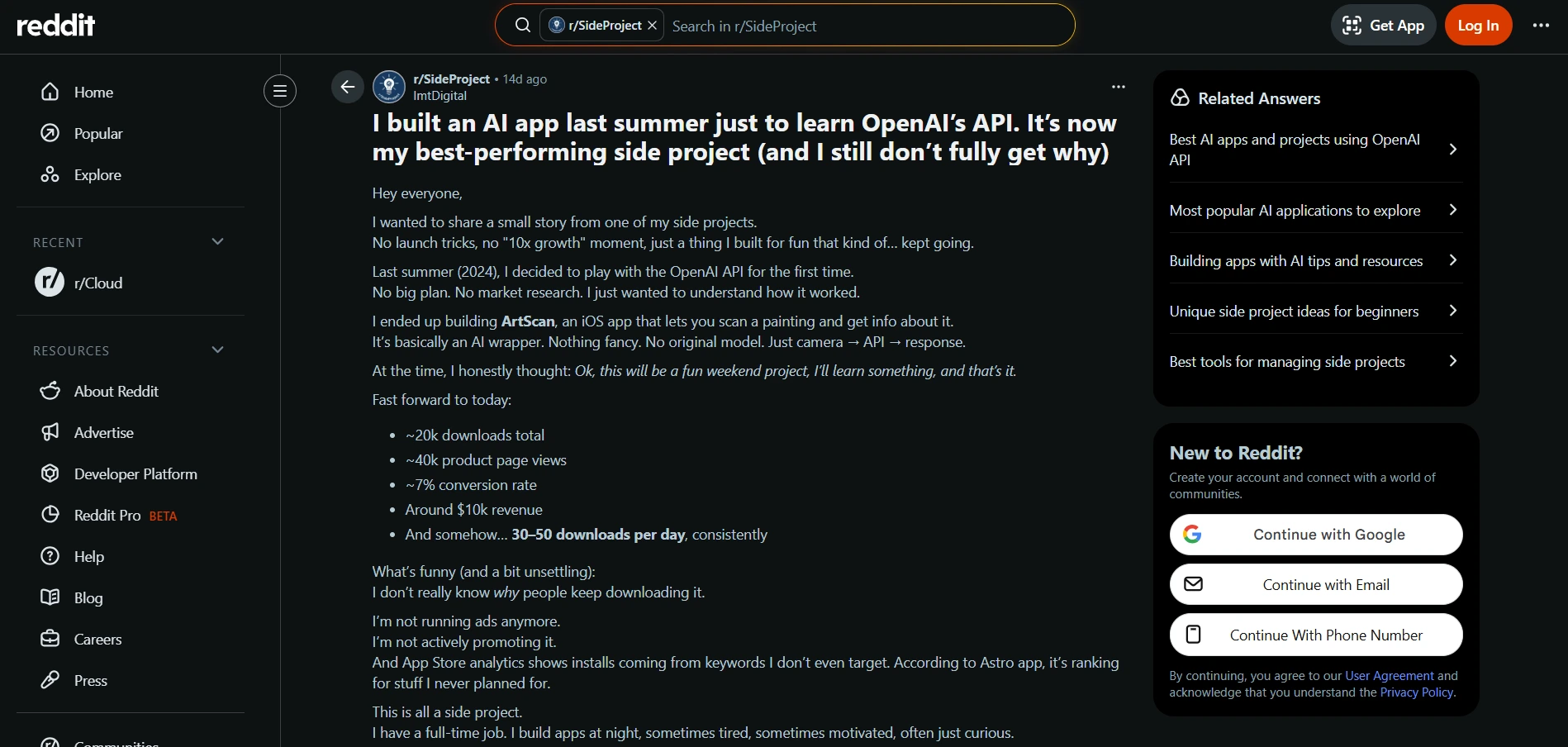
Source: Reddit
What You Can Learn From It?
- Users associate personalization with relevance.
- Generic experiences lead to quick disengagement.
- UX matters as much as features.
- People want apps that understand their needs, not present the same experience to everyone.
These insights show why AI personalization in apps is important in mobile apps.
Why Traditional App Personalization Strategies Don’t Work?
Before AI personalization in apps became practical, most personalization was rule-based. It depended on fixed logic and manual segmentation.
Today’s users generate too much behavior data for manual rules to handle properly. Traditional mobile app personalization strategies usually look like this:
- Show the same onboarding to all new users.
- Send the same push notification to all segments.
- Recommend top items instead of relevant items.
- Group users by age/location only.
- Update personalization rules manually.
Modern users expect adaptive UX with AI, where the app learns and improves automatically.
Old personalization answers: “Which group does this user belong to?”
AI personalization answers: “What does this specific user need right now?”
That difference directly impacts mobile app engagement and retention.
Learn How AI Insights Helps to Build User-Centric Mobile Apps.
How Does AI Personalization Improve Each Stage of Mobile App UX?
To understand the real value of AI personalization for mobile apps, let’s see it across the user journey.
1. How AI Personalizes Mobile App Onboarding?
AI tracks early behavior signals and adjusts onboarding steps. Examples:
- Shows shorter onboarding for fast explorers.
- Shows guided onboarding for hesitant users.
- Highlights features based on first clicks.
This creates a personalized user experience in the mobile app from the first session.
2. How AI Personalizes In-App Content?
AI ranks and filters content based on behavior patterns. Examples:
- Personalized feeds.
- Smart product lists.
- Dynamic dashboards.
- AI content recommendations.
This is where AI recommendations in mobile apps increase session time and depth.
3. How AI Personalizes Push Notifications?
Generic notifications reduce engagement. AI fixes this. Examples:
- Best send time prediction.
- Interest-based messages.
- Behavior-triggered alerts.
- Churn-risk recovery messages.
This improves CTR and reduces uninstall rates using personalized push notifications AI systems.
4. How AI Improves Retention & Re-Engagement?
AI models detect churn signals early. Examples:
- Drop in usage frequency.
- Shorter sessions.
- Feature abandonment.
Then apps trigger targeted re-engagement flows. This shows the real impact of AI personalization on mobile app retention.
Learn How AI Features Help to Retain More Users for Mobile Apps.
How We Solved This Using AI Personalization for an App?
We worked with a mobile platform where downloads were strong, but engagement was weak.
Client Problem
- High installs.
- Low session duration.
- Poor feature adoption.
- Push notifications ignored.
What We Implemented?
We built an AI personalization layer inside the app:
- Behavior tracking model.
- Interest clustering.
- AI recommendation engine.
- Adaptive home screen layout.
- Predictive notification timing.
Results After AI Personalization Implementation
- Session time increased significantly.
- Feature usage improved.
- Notification CTR doubled.
- Repeat visits increased.
This proves that AI personalization in apps is measurable.
Want AI Personalized Mobile Apps? Contact Us Now!
How to Implement AI Personalization in Mobile Apps? (Practical Framework)
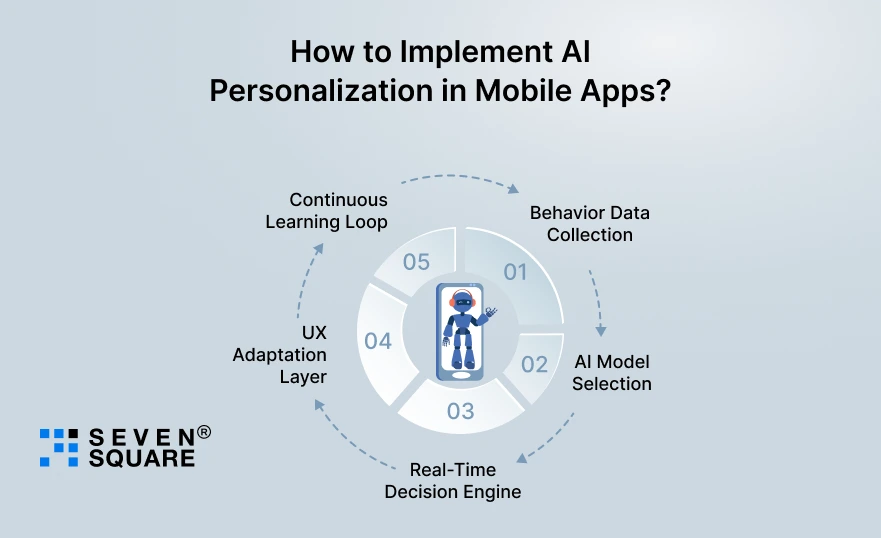
Many businesses ask: How to implement AI personalization in mobile apps?
Here is a simple execution framework:
Step 1: Behavior Data Collection
Track:
- Clicks.
- Scrolls.
- Searches.
- Session time.
- Feature usage.
Step 2: AI Model Selection
Choose based on use case:
- Recommendation engines.
- Prediction models.
- Clustering models.
Use the best AI tools for personalization in mobile apps, depending on scale.
Step 3: Real-Time Decision Engine
Add a logic layer that:
- Selects content.
- Ranks features.
- Adjusts UI.
Step 4: UX Adaptation Layer
Connect AI output to:
- Feeds.
- Dashboards.
- Onboarding.
- Notifications.
This creates AI-driven UX personalization.
Step 5: Continuous Learning Loop
AI must retrain and improve continuously using new behavior data.
How Do We Implement AI Personalization With a Personal Touch?
Many vendors build AI models. Few connect them properly to UX. We focus on:
- AI + UX combined architecture.
- Behavior-driven design decisions.
- Scalable personalization engines.
- Privacy-aware personalization.
- Fast deployment frameworks.
- Measurable engagement metrics.
We don’t just add AI; we design AI personalization strategies for increased user retention. That’s the difference.
What Metrics Improve After AI Personalization?
Businesses should track these mobile app engagement metrics for personalized UX:
- Session duration.
- Daily active users.
- Retention rate.
- Feature adoption.
- Recommendation CTR.
- Notification CTR.
- Conversion rate.
- Churn rate.
AI personalization improves these because relevance increases interaction.
AI Personalization Turns Apps Into Engagement Engines
Mobile users don’t want more features. They want more relevance.
That is exactly what AI personalization in apps delivers.
It changes:
- Generic UX → Adaptive UX.
- Static apps → Learning apps.
- Low engagement → Behavior-driven engagement.
If you want your mobile product to feel intelligent, adaptive, and engagement-driven, we can help you design and implement a complete AI personalization framework.
FAQs
- AI personalization in apps uses machine learning to adapt content, UX, and recommendations based on individual user behavior.
- It increases relevance, reduces friction, and delivers timely content, which increases clicks, session time, and repeat visits.
- No. Even mid-scale apps can implement AI-powered personalization features using modular AI tools.
- Yes. The impact of AI personalization on mobile app retention is proven through better relevance and reduced user fatigue.
- With the right architecture partner like us, implementation is structured and phased, not complex.