Can your current B2B platform handle a six figure order without breaking?
Most teams never test it until a real order fails. Wrong pricing, failed checkout, ERP out of sync. This blog is about fixing that before it happens to you.
Headless B2B commerce supports large order workflows by separating the frontend from backend systems.
It allows enterprises to manage bulk orders, contract pricing, ERP integrations, approval chains, and multi-location fulfillment without platform limitations.
Headless commerce solutions help B2B companies:
- Process high-value bulk orders faster.
- Automate complex approval workflows.
- Sync ERP and inventory systems in real time.
- Handle contract-based and tiered pricing accurately.
- Scale without rebuilding infrastructure.
If your enterprise manages recurring six-figure orders, distributors, or multi-team buyers, headless commerce for B2B businesses is a basic infrastructure.
Learn how Shopify Headless Commerce for eCommerce Brands works.
Here in this blog, you can learn about a headless ecommerce platform and how headless architecture works in detail.
What Is Headless B2B Commerce?
Headless B2B commerce is an API-first ecommerce model where the frontend and backend operate independently.
It gives enterprises full control over large order workflows and integrations. Unlike traditional platforms, a headless ecommerce platform allows you to:
- Customize checkout logic.
- Build role-based dashboards.
- Create contract pricing engines.
- Integrate ERP, CRM, and PIM systems via APIs.
- Deploy scalable microservices.
Get our eCommerce Development Services Now!
This decoupled headless architecture gives B2B organizations the flexibility required for enterprise-scale ordering.
How Headless Commerce Supports Large Order Workflows?
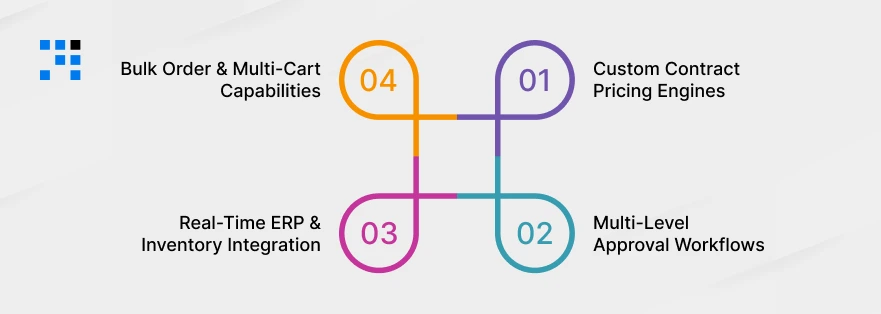
Headless commerce solutions support complex B2B order workflows by making every stage programmable and scalable. Here’s how:
1. Custom Contract Pricing Engines
Large B2B buyers don’t pay list prices. They use:
- Tiered pricing.
- Negotiated contracts.
- Volume-based discounts.
- Location-based rates.
Traditional platforms struggle here.
With headless B2B commerce, pricing logic lives in APIs or microservices, fully customizable and dynamically calculated.
2. Multi-Level Approval Workflows
Enterprise orders often require:
- Procurement approval.
- Finance validation.
- Budget confirmation.
- Regional authorization.
Headless commerce allows you to:
- Automate approval chains.
- Trigger workflow rules.
- Route orders based on value thresholds.
- Create role-based access.
This removes manual bottlenecks.
3. Real-Time ERP & Inventory Integration
One of the biggest pain points in B2B ecommerce: ERP sync delays. Learn Why you should Upgrade your Order Management System for Growth.
Headless commerce for B2B businesses enables:
- Real-time inventory validation.
- Live pricing updates.
- Automated invoice generation.
- Accurate stock visibility.
Because everything runs API-first, systems communicate instantly.
4. Bulk Order & Multi-Cart Capabilities
Large distributors often:
- Upload CSV order sheets.
- Order for multiple warehouse locations.
- Manage parallel carts for different departments.
- A traditional system may crash.
A traditional system may crash.
- Support bulk upload processing.
- Validate SKUs in real time.
- Split shipments intelligently.
- Handle multi-location checkout logic.
This is important for scalable B2B ordering.
Learn the Importance of Inventory Management Software to Improve Stock Accuracy & Profit.
What’s Our Expertise in Headless Commerce for B2B Businesses?
- We design scalable headless B2B commerce systems tailored for complex enterprise order workflows and integrations.
- Our API-first headless architecture enables real-time ERP synchronization, custom pricing logic, and approval automation.
- We build enterprise-grade headless ecommerce platforms optimized for bulk ordering, contract pricing, and multi-location fulfillment.
- Our headless commerce solutions eliminate manual bottlenecks and improve high-value order processing speed significantly.
- We integrate CRM, ERP, PIM, and inventory systems seamlessly into your headless commerce ecosystem.
Want a Customized Headless B2B Commerce Platform?
Why Traditional B2B Ecommerce Platforms Fail at Scale?
Traditional monolithic platforms fail because they are rigid and tightly coupled. Here are some of the Core Limitations:
- Fixed checkout logic.
- Limited pricing customization.
- Slow ERP synchronization.
- Inflexible role permissions.
- Front-end and backend dependency.
When order complexity increases, these systems break.
Headless vs Traditional Ecommerce for B2B Businesses
| Capability | Traditional Platform | Headless B2B Commerce |
| Bulk Orders | Limited | Fully customizable |
| Contract Pricing | Hard-coded | API-controlled |
| ERP Sync | Delayed | Real-time |
| Workflow Automation | Manual | Programmable |
| Scalability | Expensive rebuilds | Modular scaling |
If your enterprise relies on high-volume workflows, headless architecture wins in the long term.
What Features Should a Headless Ecommerce Platform Have?
If you’re evaluating the best headless commerce solution for B2B ecommerce, prioritize these:
- API-first architecture.
- Real-time ERP integration.
- Custom pricing microservices.
- Role-based access controls.
- Bulk order processing engine.
- Multi-location fulfillment logic.
- Approval workflow automation.
- Scalable cloud infrastructure.
Without these, it’s not enterprise-ready.
What Are the Real Enterprises’ Complaints About B2B eCommerce?
Source:Reddit
Common issues B2B teams report:
- Our $180k order failed at checkout.
- Contract pricing mismatches happen monthly.
- ERP sync takes hours.
- Manual approvals delay enterprise clients.
These are not operational mistakes. They are architectural problems.
How We Solved Large Order Workflow Problems for Headless B2B Commerce?
We worked with a wholesale distributor processing recurring six-figure orders.
The Problem:
- ERP syncing every 4 hours.
- Manual pricing overrides.
- 2 to 3-day approval delays.
- Frequent bulk upload errors.
Revenue was being delayed. Buyer satisfaction was dropping.
We implemented:
- A scalable headless ecommerce platform for enterprise B2B.
- Custom pricing microservice.
- API-driven approval workflow engine.
- Real-time ERP integration.
- Role-based dashboards.
The Results:
- 38% faster order processing.
- Zero pricing mismatches.
- 22% increase in repeat enterprise orders.
- Reduced manual operational workload.
That’s the impact of properly implemented headless commerce solutions.
Why Headless Commerce for B2B Businesses Is Now a Competitive Advantage?
Enterprise buyers expect:
- Instant inventory validation.
- Transparent pricing.
- Faster checkout.
- Flexible ordering options.
If your competitor adopts headless B2B commerce before you:
- They process orders faster.
- They reduce manual errors.
- They launch custom portals more quickly.
- They scale globally without platform rebuilds.
Speed becomes a market advantage. Headless architecture ensures the growth of your headless eCommerce platform.
How Do We Implement Headless B2B Commerce?
We follow a structured, enterprise-focused approach.
Step 1: Workflow Audit
- We analyze your current order lifecycle, bottlenecks, and integration gaps.
Step 2: System Mapping
- We map ERP, CRM, PIM, and inventory systems.
Step 3: Headless Architecture Design
- We create API-first, microservice-based architecture.
Step 4: Custom Development
- We build pricing engines, approval systems, and bulk order modules.
Step 5: Scalable Deployment
- Cloud-ready infrastructure built for performance and growth.
We don’t just implement headless commerce. We engineer scalable B2B ecosystems.
How to Choose the Best Headless Ecommerce Platform for Enterprise B2B?
Before investing, evaluate:
- Is it truly API-first?
- Does it integrate easily with your ERP?
- Can it handle custom pricing logic?
- Does it support role-based dashboards?
- Is it built on a scalable cloud infrastructure?
Choosing the right headless commerce solution determines long-term ROI.
Ready to Modernize Your Large Order Workflows?
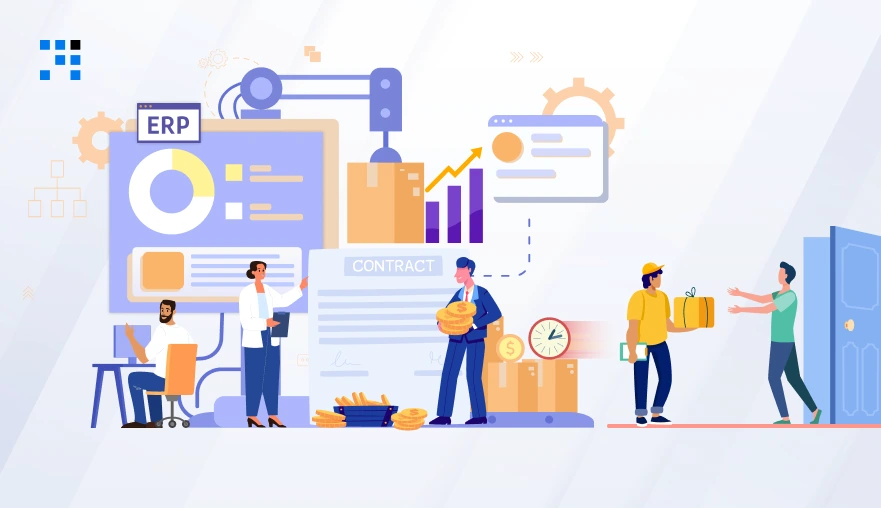
Headless B2B commerce is enterprise infrastructure. It allows:
- Faster bulk order processing.
- Automated approval workflows.
- Real-time ERP synchronization.
- Accurate contract pricing.
- Scalable enterprise growth.
If your organization processes high-value B2B orders, a traditional system will eventually limit you. Headless architecture removes those limits.
FAQs
- Headless B2B commerce is an API-first ecommerce model where the frontend and backend are decoupled.
- This allows enterprises to customize bulk ordering, contract pricing, ERP integrations, & approval workflows without platform restrictions, making it ideal for complex large order environments.
- Headless commerce supports large order workflows by enabling programmable pricing engines, automated approval chains, bulk upload systems, and real-time ERP synchronization.
- This flexibility ensures high-value B2B orders are processed accurately and efficiently at scale.
- Headless architecture separates the user interface from backend systems, giving enterprises full control over integrations & workflow customization.
- This is critical for managing contract pricing, distributor portals, multi-location shipping, and scalable order processing.
- Headless commerce is considered future-proof because it supports modular scaling, faster frontend innovation, & smooth integration with emerging technologies.
- This flexibility helps growing B2B enterprises adapt to increasing order complexity and digital transformation demands.