MIS reporting in complaint management should not be created manually.
The right system automatically tracks complaints, engineer activity, and SLA performance in real time, so reports are always ready without Excel work.
The moment a complaint is raised, does your system take control
or does your team start chasing it?

A machine stopped working 3 days ago.
The complaint was logged, and the service engineer was informed.
And updates were shared across WhatsApp messages, emails, and phone calls.
But when top management asks for a report?
No one can clearly explain what happened, when, or why.
Most service teams are not failing because of a lack of effort.
They fail because they are trying to manage complaint volumes on tools that were never built for scale.
A plant manager described spending 3 days every month just creating one report that time should have gone into actually managing the team.
The real problem is not effort.
It is the absence of a system.
Manual MIS Reporting Is Costing You More Than You Think

Stop pretending manual reporting “works.”
It’s a constant drain on time, SLAs, and team efficiency.
Every delayed report compounds into real costs you feel monthly.
1. Outdated Reports Put SLAs at Risk
Reports take 1-3 days to compile and by then, 20-30% of SLAs are already missed.
Each delay can cost $5K-$10K in factory downtime.
Engineers respond late, but the cost hits you immediately.
2. Data Prep Steals 80% of Your Week
Operations teams confirm that 80% of the work is just structuring the dataset properly.
That’s 10–15 hours per manager, time that should go into coaching or planning.
3. Recurring Problems Add Costs
A repeated issue like the same machine failing every week puts renewals at risk and can lead to losing customers.
Excel Didn’t Break the Process. Absence of Accountability Did

Excel is built to store and calculate data.
The problem is that at some point, it became the complaint management system and nobody questioned it.
Here is what actually happens inside teams running on Excel:
1. Ownership Disappears after Assignment
Engineer gets assigned over a call, no record or timestamp.
Just a conversation that everyone remembers differently when something goes wrong.
2. Operations Trapped in One Brain
The operation runs inside people’s heads, not inside a system.
One person goes on leave and suddenly nobody knows what is open, who is assigned, or what happened last time.
A complaint management system exists so that it never happens
3. Leadership Loses Trust in Data
When a report takes three days to build, people already assume it might be wrong.
They start cross-checking, export ERP data separately just to verify.
That habit of not trusting your own data is the real cost.
Already thinking about Saas tools?
It is a fair instinct.
But fair instincts and right decisions are not always the same thing.
Which is exactly what the next section is about.
Where SaaS Tools Start Falling Short in Service Operations
These tools solve the problem they were designed for but your operation runs across engineers, factory floors and machine types.
A custom-built system is the only thing that accounts for all of it.
| Challenge | SaaS | Custom System |
|---|---|---|
| Factory-Floor Connectivity | No offline support | Built for low-network conditions |
| Legacy System Integration | Limited or paid add-ons | Integrated by design |
| Role-Specific Workflows | Generic views for all users | Engineer, Manager, Admin each sees their own |
| Machine-Level Complaint History | Not built for this | Tied directly to asset records |
| Custom Escalation Logic | Template-based rules | Built around your actual SLA structure |
Every gap in those saas tools is the area where your operation absorbs the cost.
What your operation needs is custom software development because the system needs to be built around your operation and not someone else’s.
Where Operations Teams Lose Visibility and Decisions Go Wrong

1. Response and Resolution Time
Most reports show an average. Averages hide the outliers.
A region missing targets, an engineer consistently delayed none of those surfaces.
We track resolution by engineer, region, and machine type so service managers see exactly where performance is slipping before a client does.
2. Missed SLAs
If SLA data depends on someone updating a sheet, you do not have tracking.
You have estimation and estimations get you into difficult client conversations.
We automate compliance tracking so the number your COO sees is always accurate, not assembled after the fact.
3. Engineer Accountability Data
Performance reviews built on memory miss the real problems.
Who was assigned, when did they respond, how long on site that trail does not exist manually.
We build that trail into the system so every manager-engineer conversation is grounded in evidence, not opinion.
4. Recurring Issue Signals
The same machine failing three times. The same complaint type across two factories.
That pattern is in your data right now and nothing is connecting it.
We surface those patterns automatically so your service head sees them before the client brings it up first.
5. Escalation and Delay Analysis
Every operation has a stage where complaints slow down.
Most operations heads do not know which one and fixes get applied everywhere and nothing improves.
We map your complaint lifecycle so your VP of Service knows exactly where the process breaks and where to fix it.
These are not isolated problems.
They are connected gaps in the same broken process.
The fix is not a better spreadsheet, it is a system where reporting happens as a byproduct of daily operations.
What Automated MIS Reporting Looks Like in Complaint Management
Automated MIS reporting is not a faster version of what you do in Excel.
It is a different model where the system generates reports automatically from daily operations, not as a month-end task.
| Manual Pain | Automated Fix | Your Win |
|---|---|---|
| Complaint logged manually in Excel. | Auto log instantly with timestamp and priority | Zero lost complaints |
| Engineer assigned over call or WhatsApp. | System-based assignment with notifications | Accountability from the first minute |
| Status updated only when someone remembers. | Real time tracking of every action including transit, on site, and resolved | No chasing engineers |
| MIS report is built manually every month. | Live dashboard always up to date | Faster decisions |
| Recurring issues go undetected. | System detects patterns early before escalation | Proactive fixes save time |
This is not a product you configure over a weekend.
It is a system we build around how your operation actually runs.
How Trützschler Cut Complaint Response Time by 45%
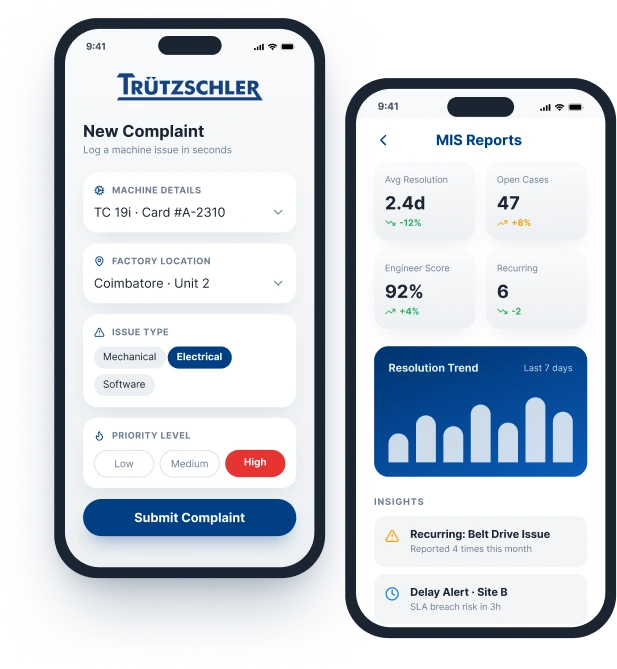
Trützschler is one of the world’s leading textile machinery manufacturers.
Their machines help manufacturers process cotton and fibers into everyday products.
Across India, China, Turkey, the USA, Brazil, and other countries.
Where Their Service Operation Was Breaking Down
| Area | What Was Happening |
|---|---|
| Complaint Logging | Tracked manually on Excel and paper |
| Engineer Assignment | Done over calls and WhatsApp, no written trail |
| Status Visibility | No real-time updates, managers are always chasing |
| MIS Reporting | Built from scratch every month, slow and error-prone |
| Management Oversight | Zero live visibility into field operations |
Everything depended on manual coordination.
And that dependence was slowing their entire service operation down.
What Changed After We Stepped In
We rebuilt how their entire complaint operation ran.
The moment a complaint was raised to the moment it was resolved.
Every gap area in the table above got a direct fix.
Business Impact After Implementation
| Metric | Result |
|---|---|
| Complaint Response Time | 45% faster |
| Management Visibility | 100% real-time |
| Manual MIS Reporting | Fully eliminated |
| Platform Coverage | One unified system across all roles |
The biggest change was not speed, it was clarity.
Trützschler’s management finally saw everything in real time and stopped second-guessing decisions.
Want to know exactly how we built it for them?
The whole story is worth your next 3 minutes.
What the First 30 Days Look Like When You Work With Us
Most teams worry about disruption.
Will engineers use it in the field? Or Will it break existing processes?
Here is what the first 30 days actually look like and what we handle.
1. Week 1 – 2 | We Learn Before We Touch Anything
We sit with your admins, managers, and engineers separately to understand:
How complaints actually move and where the process breaks down.
2. Week 3 – 4 | We Build and Your Team Will Test It
Prototypes go in front of your actual users before any full build.
Engineers test the update flow.
Managers test the dashboard.
Admins test reporting.
We refine based on what they tell us.
3. Go – Live | Zero Manual Reporting
We configure automated MIS, so your team never builds a report manually again.
Roles, workflows, and escalation logic are set up before the first user logs in.
Your team keeps running the operation.
We handle the system.
In service operations, the right data at the right time is everything.
Without it, every decision is already late.
Let’s make sure your team never operates blind again.
FAQ
Any business where complaints involve multiple engineers, locations, or machines needs this system. If your team relies on calls, WhatsApp, and shared sheets, the process has already outgrown Excel. We design the solution around your specific workflow so it feels like an upgrade, not a disruption.
A focused system with automated MIS usually takes 10–16 weeks from discovery to deployment. We plan the timeline around your complexity, roles, and integrations so nothing catches your team off guard. You focus on running your operations, we handle the build, testing, and rollout.
Most companies delay it until it becomes customer‑facing. We help you see the full cost early and build the system in phases so you can start seeing value without going all‑in at once. You don’t have to wait for a crisis, we’ll make sure the transition is smooth, predictable, and fully managed by us.
We start by auditing your existing tools and data before anything gets built. Your historical data stays intact and your internal systems keep running throughout. Nothing gets replaced until the new system is ready and your team is confident in it.
Most operations see visibility improve from day one complaints are logged, assigned, and tracked in real time the moment the system is live. Response time improvements like the 45% reduction Trützschler saw come within the first few weeks as the team stops chasing updates and starts acting on them.
Not at all. We configure everything like roles, workflows, escalation logic, and automated MIS reporting before your first user logs in. Your team runs the operation. We handle everything else.