Chennai manufacturers often rely on spreadsheets long after their operations demand systems built for production tracking, inventory visibility, and compliance, leading to inventory errors, delayed reporting, and decisions made on outdated data.
When a customer changes an order,
how many versions of the Master Sheet exist an hour later?

A machine component arrived four hours late at a factory.
The store’s operator updated his Excel sheet.
Production checked another version.
Dispatch referred to last week’s printed report.
Within minutes, three teams had three different inventory numbers.
Nobody made a mistake.
The operation simply had no single source of truth.
They happen because nobody built a system that catches exposure when it begins.
It is a manufacturing system problem.
What Makes Excel Unsustainable for Growing Manufacturers

1. Excel Was Built for Smaller Operations
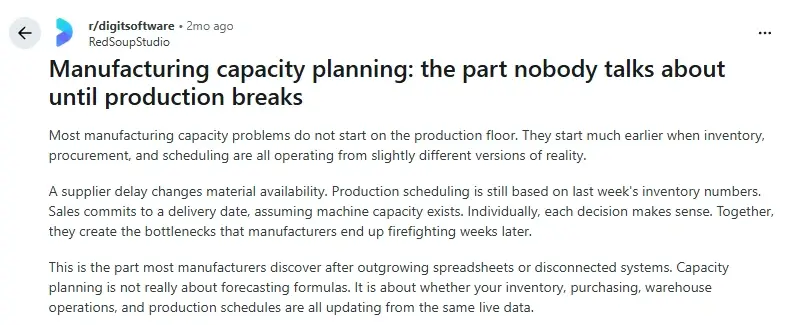
Every manufacturing company in Chennai starts somewhere.
Excel is inexpensive, familiar, and flexible.
It adapts faster than most software.
That makes it perfect during the early years.
Growth changes those requirements.
More orders and production demand consistent data, not spreadsheets.
The tool that once accelerated operations slowly becomes the reason they slow down.
2. The Master Sheet Is the Factory’s Biggest Dependency
Walk into any mid-sized manufacturing plant.
One spreadsheet controls production, inventory, dispatch, and planning.
Everyone depends on it
Very few understand how it actually works.
The business no longer depends on Excel.
It depends on the employee who created it.
When that person is unavailable, production decisions become uncertain.
Knowledge leaves with people instead of staying inside the business.
That is operational risk disguised as operational efficiency.
3. Flexibility Without Accountability Creates Bigger Problems
Plant managers trust Excel because it responds immediately.
Material delays, breakdowns, and schedule changes update in seconds.
Production continues without waiting for approvals.
That flexibility has a hidden cost.
Excel never records who changed data, when it changed, or why it changed.
Leadership loses visibility while operations believe everything is under control.
Fast updates mean very little without reliable accountability.
4. Software Adoption Remains a Production Floor Challenge
Many ERP software fail for one simple reason.
They are designed for tech teams, not factory workers.
Store operators and supervisors already understand Excel.
Replacing familiar workflows with complicated forms creates resistance.
Teams eventually maintain Excel alongside the ERP.
The result is duplicate work instead of better operations.
Technology rarely fails first.
Poor adoption usually does.
Why Excel No Longer Meets OEM Requirements

1. Auditors Do Not Accept “We Have It in a Sheet”
OEM auditors are not looking for an Excel file.
They expect digital traceability from raw material to dispatch.
Every inspection and production record should connect through one audit trail.
Excel stores information.
It does not create audit-ready traceability.
Factories without batch tracking spend days rebuilding audit records
That delay increases the risk of quality rejections.
Digital traceability is now an OEM expectation.
2. GST ITC-04 Compliance Is Not Optional
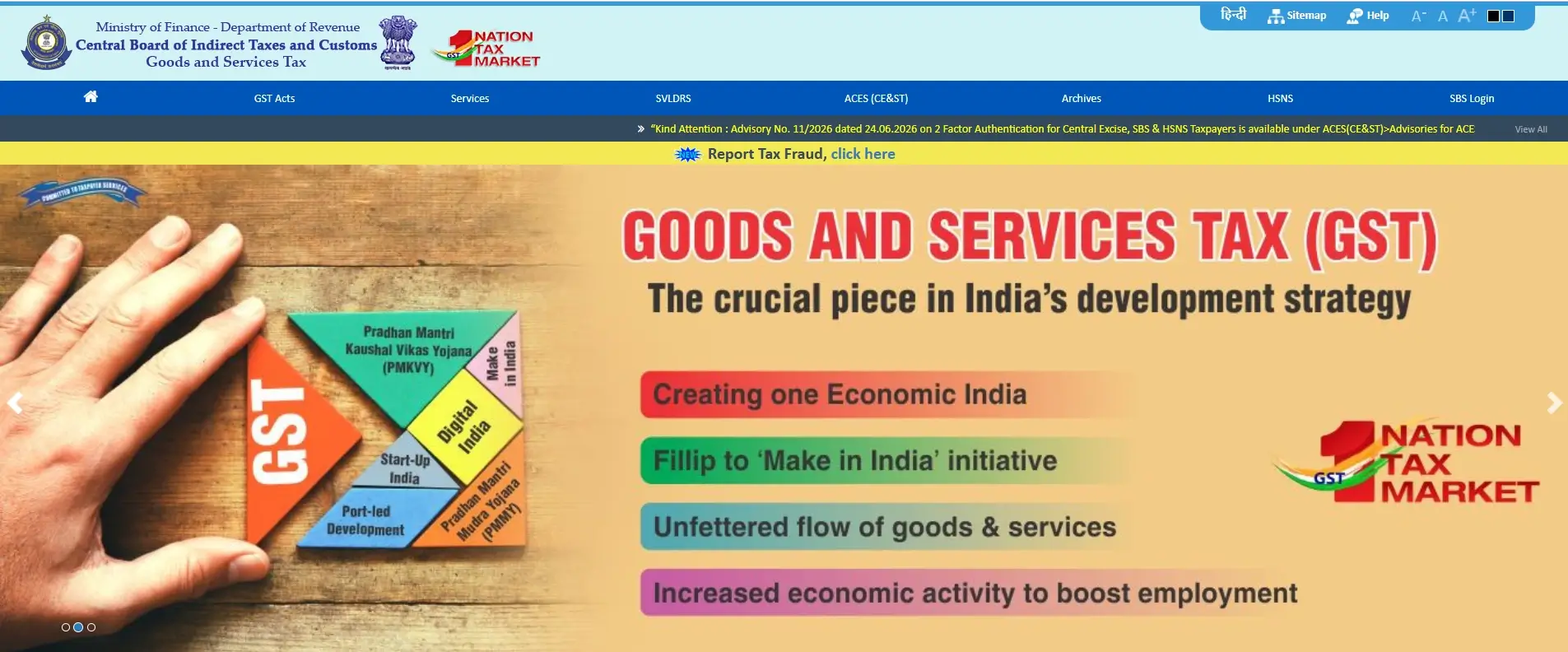
Production tracking is no longer only an operational requirement.
It is also a compliance requirement.
Job work requires every material movement to meet GST timelines.
Miss a deadline.
Record the wrong quantity.
Your Input Tax Credit may be affected.
Many Chennai manufacturers still track them in disconnected Excel sheets.
Separate departmental sheets create reporting gaps
A connected production tracking system records every movement automatically.
That makes compliance part of everyday operations.
3. Supplier Competitiveness Now Depends on Visibility
OEMs have already digitized their operations.
They expect the same visibility from suppliers.
Factories relying on spreadsheets respond late, audit manually and plan reactively.
Digital operations are becoming a supplier qualification factor.
The manufacturers investing today will compete better tomorrow.
Why Failed ERP Implementations Made Excel Stronger

1. Bad ERP Projects Created Lasting Distrust
Many Chennai manufacturers have already invested in ERP.
The implementation dragged for months.
Costs kept increasing.
The promised improvements never arrived.
The shop floor continued working on Excel.
That experience damaged confidence in future technology projects.
Excel survived because previous software failed to solve operational problems.
2. Monthly Software Costs Feel Bigger Than Hidden Losses
Excel has no monthly subscription.
That makes it feel cheaper.
The real comparison is different.
Factories lose money through inventory, reporting, and compliance gaps
Those costs rarely appear together on one balance sheet.
Once they become visible, software stops looking expensive.
It starts looking necessary.
3. Generic Manufacturing Software Misses Chennai’s Reality
Most ERP platforms follow standard manufacturing workflows.
Chennai manufacturers rarely operate that way.
OEM compliance, GST, and production workflows vary across industries.
Software built around generic assumptions creates workarounds.
Custom production software fits the factory instead of forcing the factory to fit the software.
One-size-fits-all rarely works on the shop floor.
What Most Manufacturers Miss When Replacing Excel

1. Understand What Your Master Sheet Actually Controls
Before replacing Excel, understand why it exists.
Every worksheet supports a business decision.
Some control production.
Others manage inventory.
Many connect departments that have no other communication process.
Replacing Excel without mapping workflows shifts old problems into new software.
Understand the process first.
Technology comes later.
2. Build for Operators Before Management
Dashboards impress leadership.
Simple screens help operators.
The people entering production data determine whether reports remain accurate.
If updating the system takes longer than updating Excel, adoption fails immediately.
Design for the busiest person on the factory floor.
Everyone else benefits from accurate information.
3. Prove the System Before Expanding It
Replacing every spreadsheet at once creates unnecessary risk.
Start with one production line.
Run both systems together.
Compare outputs.
Let supervisors validate the results.
Confidence grows through evidence, not presentations.
One successful deployment builds support for every future phase.
Where Custom Software Supports Growing Manufacturers
| Operational Complexity | Excel Falls Short | Custom Manufacturing Software |
|---|---|---|
| Multiple production lines | Separate sheets create planning conflicts | Live production scheduling |
| Customer schedule changes | Teams manually update every department | Production plans update instantly |
| Engineering changes | BOM revisions get shared through emails | Version-controlled BOMs |
| Vendor performance | Delivery and quality tracked manually | Live supplier scorecards |
| Shift handovers | Critical updates depend on verbal communication | Digital shift logs with history |
| Multi-plant operations | Data stays scattered across locations | Unified operations dashboard |
Growing operations demand connected workstreams, not disconnected spreadsheets.
Custom software development integrates production, inventory, and compliance into a single platform.
That is how manufacturers scale without increasing operational complexity.
How Trützschler Cut Complaint Response Time by 45%
Trützschler is one of the world’s leading textile machinery manufacturers.
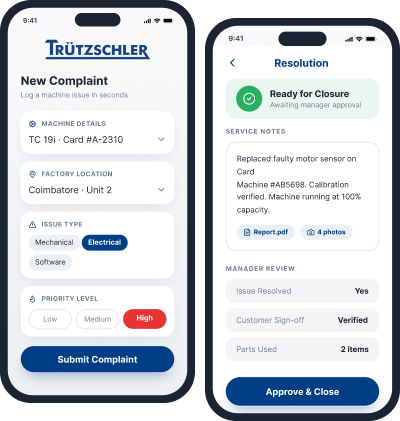
Their machines help manufacturers process cotton and fibers into everyday products.
Across India, China, Turkey, the USA, Brazil, and other countries.
Where Their Service Operation Was Breaking Down
| Area | What Was Happening |
|---|---|
| Complaint Logging | Tracked manually on Excel and paper |
| Engineer Assignment | Done over calls and WhatsApp, no written trail |
| Status Visibility | No real-time updates, managers are always chasing |
| MIS Reporting | Built from scratch every month, slow and error-prone |
| Management Oversight | Zero live visibility into field operations |
Everything depended on manual coordination.
And that dependence created operational delays.
What Changed After We Stepped In
We rebuilt how their entire complaint operation ran.
The moment a complaint was raised to the moment it was resolved.
Every gap area in the table above got a direct fix.
Business Impact After Implementation
| Metric | Result |
|---|---|
| Complaint Response Time | 45% faster |
| Management Visibility | 100% real-time |
| Manual MIS Reporting | Fully eliminated |
| Platform Coverage | One unified system across all roles |
The biggest change was not speed, it was clarity.
Trützschler’s management finally saw everything in real time and stopped
second-guessing decisions.
Want to know exactly how we built it for them?
The whole story is worth your next 3 minutes.
How Much Longer Will Spreadsheets Decide Your Growth?
1. Every Project Starts With Your Factory
We understand how production planning, inventory, dispatch, and reporting currently work.
Identify where manual processes slow decisions.
Only then do we recommend technology.
The software follows your operations.
Not the other way around.
2. Your Operations Define the Platform
All manufacturing businesses operate differently.
Production workflows and compliance become the foundation.
Nothing important gets forced into generic workflows.
The result feels familiar from the first day.
Custom software should simplify operations.
Not introduce new complexity.
3. Successful Launches Start With Testing
Operators test real production scenarios
Supervisors review dashboards.
Management verifies reports.
Feedback improves the system before launch.
That reduces disruption and builds confidence across departments.
Successful adoption begins long before deployment.

The answers already exist inside your operation.
We simply build the system around them.
FAQs
Excel has no subscription cost, but it creates hidden operational costs every day. Inventory errors, excess stock, reporting delays, and compliance risks reduce profitability. Most manufacturers find the cost of these inefficiencies is far higher than the cost of replacing Excel.
Only if the system is easier than Excel. Every workflow should reduce effort, not add more steps. When software aligns with existing shop-floor processes, adoption becomes much easier and more consistent.
Yes. Production records, quality checks, and material history remain connected inside one system. Required information is available when needed instead of being rebuilt before every audit. This reduces audit preparation time and compliance risk.
Most focused manufacturing solutions take between 10 and 16 weeks, depending on complexity. We introduce the system in phases while existing operations continue uninterrupted. Parallel testing ensures every process works before the transition is complete. Production never stops because software is being introduced.
No. The platform is configured before users begin working. User roles, reporting, workflows, and automations are already in place. Your team focuses on production while we ensure the system continues supporting daily operations.