Chennai manufacturers lose buyers when product specifications, certifications, and technical data are difficult to find online. Many B2B buyers shortlist suppliers before contacting sales, and incomplete product information can remove a supplier from consideration early.
Can a global buyer qualify your company without calling
or does every answer still require an email?

A procurement engineer in Stuttgart starts his morning with one task.
He needs a Chennai-based tier-2 supplier for precision-forged auto components.
He runs a search, and three suppliers appear.
He clicks the first result.
A scanned PDF catalog from 2019 loads slowly on his screen.
Material grades, tolerances, and ISO certifications were nowhere to be found.
He closes the tab without saving the name.
The second supplier has a searchable component index.
IATF 16949 certificates downloadable in one click.
An RFQ button sitting directly below the product specification table.
He submits an inquiry in 4 minutes and moves on with his morning.
The first Chennai company did not lose that deal in a price negotiation.
It lost that deal before a single person in their office knew the buyer existed.
What Decides the B2B Shortlist Before Sales Gets Involved

1. Anonymous Research Decides the Vendor
The 6sense Report shows 80% of B2B deals are won before sales contact.
95% of those vendors were on the buyer’s Day One shortlist.
Your sales team never saw those buyers coming.
Because those buyers never announced themselves.
Your product data is your only representative inside it.
2. Buyers Don’t Want Your Rep
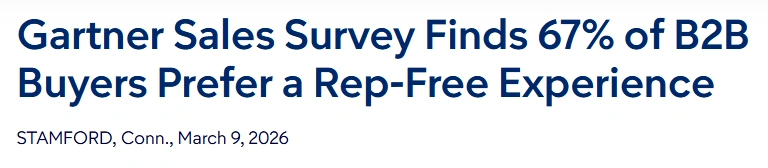
Gartner Survey Finds 67% of B2B Buyers Prefer a Rep-Free Experience
With any single vendor, that drops to 5 or 6 percent.
The rest of the journey happens on their own.
They are reading your specs, or they are not finding them.
If your data is missing, they are reading your competitor’s instead.
3. Why Qualified Prospects Never Call
McKinsey found digital visibility is now a key driver of B2B growth.
Buyers compare suppliers online before reaching out.
They evaluate product specifications, certifications, and technical capabilities.
If your website makes that information difficult to find, they move to the next supplier.
Missing or incomplete technical data creates unnecessary buying friction.
High-intent buyers expect to validate your capabilities independently.
How Missing Product Data Costs Chennai Manufacturers B2B Orders

1. Specifications Before Relationships
The industrial buying process follows a clear sequence.
Product information matters long before the RFQ.
If your website does not support that journey, buyers drop you earlier.
You are removed during supplier search, not proposal evaluation.
A 2026 industrial buying survey found 53% of B2B purchases happen within one month.
Fast access to product information determines who makes the shortlist.
2. Your Website Ignores the Buying Committee
Industrial purchases are rarely one-person decisions.
The MD is asking whether incomplete online presence is costing revenue.
The procurement head asks whether your data speeds supplier comparison.
The design or quality engineer verifies your specs meet technical requirements
One website must answer all three questions simultaneously.
Most Chennai manufacturer websites answer none of them.
3. Manual Data Sharing Is Costing You
When basic technical specifications are missing online, a predictable cost cycle begins.
A buyer emails or calls to request a standard tolerance sheet.
A sales engineer spends 45 minutes locating and forwarding a PDF.
That answer arrives 24 to 48 hours later.
A sales engineer earning ₹1,00,000 spends 30% of their time sharing basic information
That’s ₹30,000 per month per rep a better product page would save.
That is not a sales problem.
It is a product visibility problem.
4. Digitized Suppliers Are Taking Your Contracts
Chennai produces over 40% of India’s vehicle and component output.
Global procurement teams vet suppliers online before making contact.
If buyers cannot verify your IATF 16949 certification or machinery capacity, they move on.
They choose a digitized supplier in Vietnam or Western India.
The manufacturing capability exists in Chennai.
The product visibility does not.
What We Found in Chennai Manufacturer Website Audits

1. Global Clients Served Through a 2015 Website
Several Chennai manufacturers worth thousands of crores run decade-old websites.
Static HTML. Desktop-only layouts. Scanned PDFs instead of searchable pages.
One tier-2 supplier to Toyota and Cummins uses PDF-only product pages.
Those pages are not indexable by search engines.
A buyer searching for that component cannot find it.
Another OEM steel wheel manufacturer has no RFQ software or downloadable catalog.
These are not small operators.
These are companies built to compete globally.
The gap is entirely on the commercial side.
2. Catalogs Search Engines Cannot Read
A scanned 2018 catalog solves nothing.
Aerospace and electronics buyers filter by material grade, dimensional range, or thermal limit.
A 100-page unindexed PDF cannot support that search.
A structured, filterable digital index lets buyers confirm fit in two minutes.
That is the difference between shortlisted and invisible.
3. Credentials That Buyers Cannot Confirm
Chennai OEM suppliers often carry ISO 9001, IATF 16949, AS9100, and BIS certifications.
These represent years of investment and operational discipline.
But if certificates are not downloadable, a global buyer cannot verify them.
They will not contact you to verify what they expected to find.
The credential exists, but the visibility does not.
How High-Performing Manufacturer Websites Win B2B Orders
| Traditional Websitey | Buyer-Focused Website | Business Impact |
|---|---|---|
| Static PDF catalog | Searchable product pages | Faster qualification |
| Generic Contact Form | RFQ beside every product | More qualified inquiries |
| Certifications hidden | Downloadable certificates | Higher buyer trust |
| Products grouped randomly | Industry & application filters | Faster product discovery |
| Product Clarification | Website answers first | Less sales effort |
| One brochure for everyone | Individual product pages | Better Google visibility |
Every row in that table is a decision point your buyer moves through.
Fixing each layer requires more than a redesign.
It requires a website built for manufacturers
That is how qualified buyers find, evaluate, and shortlist you faster.
What the First 60 Days Look Like When You Work With Us
1. Week 1 to 3 | We Map Your Buyer’s Current Journey
We do not start with design or development.
We start with your actual inquiry process
How buyers find you and where they drop off
What your sales team still handles manually.
That mapping becomes the foundation for every build decision.
2. Week 4 to 6 | Your Team Sees It Before It Goes Live
Working prototypes go in front of your sales engineers and technical team.
Not to show them what we built.
To find every point where the flow breaks before development is finalized.
One gap caught here eliminates two to three weeks of rework after launch.
3. Go Live | Your Buyer Never Hits a Dead End
Every product page, RFQ path, and certificate download is configured first.
No buyer hits a dead end after launch.
Your sales team does not learn a new system.
They simply start receiving better-qualified inquiries.
A manufacturer’s website that qualifies buyers before sales gets involved is not a cost.

It is your highest-performing sales asset.
FAQs
Having data and making it accessible are two different things. If your specifications sit inside unindexed PDFs or require a form submission to access, buyers will not wait. They move to the supplier whose data is already structured and visible. We audit exactly where that accessibility gap exists and build the structure that closes it.
Yes, if it is built with your engineering team and not a web designer working from a brochure. Material grades, tolerances, machinery capacities, and certifications are all structurally indexable. That is the difference between a product page that generates RFQs and one that gets skipped. We build with your technical team from day one.
Because they are evaluating multiple suppliers simultaneously under time pressure. 53% of industrial purchase decisions close within one month. A buyer emailing four suppliers for a basic tolerance sheet will shortlist the one who already had it online. The others are removed before their reply arrives. We make sure you are never that supplier.
The problem is not how you handle inquiries. It is how many inquiries you are not receiving. Buyers who cannot self-evaluate on your website never become inquiries. They become lost opportunities with no record of their visit. We build the structure that turns those silent exits into actual RFQs.
It is especially relevant for mid-sized manufacturers. Large OEM suppliers operate on established procurement relationships. Mid-sized manufacturers competing for new contracts, new geographies, or export markets are evaluated almost entirely on their digital presence before any relationship begins. That is precisely where we focus.