Why is the AI Ask Maps feature in Google Maps a big update?
In this blog we explained how the AI works, conversational search, immersive navigation, real use cases, & how businesses can build similar AI-powered navigation apps.
Google Maps has helped people find places and navigate cities.
But even though it is one of the most popular navigation apps, many users often face real problems while using it.
One common issue was limited search understanding. Users had to type very simple keywords like “restaurants near me” or “coffee shop.”
If someone wanted something more specific, like a quiet café with Wi-Fi to work, Google Maps couldn’t fully understand the request.
Users had to open many places, read reviews, and compare options manually. Navigation could also be confusing sometimes.
While Google Maps showed routes clearly, users often struggled at complex intersections, highway exits, or crowded city roads because maps didn’t always show realistic visuals of the route.
That’s why the new AI Ask Maps feature in Google Maps is such an important update.
The Future of Navigation Is AI ‘Ask Maps’ Feature
Navigation apps are going through a lot of changes. Instead of typing simple keywords and scrolling through results, users can now talk to their maps like an AI assistant.
This change is happening with the new AI Ask Maps feature in Google Maps. With this update, AI navigation becomes more intelligent and conversational.
Users can simply ask questions such as “Where can I find a peaceful café to work?” or “What are the best scenic routes nearby?” and the map instantly understands the request.
Earlier, maps were just tools for directions. Today, they are becoming AI-powered travel assistants that help users discover places, plan trips, and make decisions faster.
- The new feature essentially turns Google Maps into a Google Maps AI assistant.
- Instead of searching multiple places manually, users can rely on AI-powered recommendations and conversational search.
- Another exciting part of this update is the Google Maps immersive navigation upgrade.
- With immersive navigation, users can see 3D previews of roads, buildings, and routes, making navigation more realistic and easier to understand.
The demand for AI navigation, AI-powered map applications, and intelligent location-based apps is increasing quickly.
We believe this is the beginning of a new generation of AI-powered navigation platforms.
What Is the AI ‘Ask Maps’ Feature in Google Maps?
The AI ‘Ask Maps’ feature in Google Maps is a new intelligent search capability that allows users to interact with the map using natural language questions.
Instead of typing simple search queries like “restaurants near me,” users can ask more complex questions, such as:
- “What are the best coffee shops nearby with Wi-Fi?”
- “Which scenic driving routes are worth exploring today?”
- “Are there family-friendly places to visit this evening?”
The system understands these requests and provides personalized suggestions instantly. It makes the Google Maps AI feature different from traditional search.
It works more like a chatbot inside Google Maps, allowing users to have conversations with the map.
The feature is powered by Gemini AI, Google’s advanced artificial intelligence technology.
Thanks to Gemini AI in Google Maps, the platform can analyze huge amounts of location data, user reviews, photos, & real-time information to generate helpful recommendations.
From a technology perspective, the Ask Maps Google Maps feature represents a big shift toward AI-driven local discovery.
It helps users find better places, faster routes, and more personalized experiences.
We see this innovation as a clear example of how AI-powered mapping platforms are transforming travel, navigation, and local search experiences.
Build AI Navigation Apps Like Google Maps with Us
If you want to create an app similar to Google Maps, our team at Seven Square can help. We specialize in:
- AI navigation app development.
- Custom mapping software development.
- Location intelligence solutions.
- AI travel app development.
- Google Maps API integration services.
Our experts design scalable, AI-powered location platforms that help businesses deliver smarter navigation experiences.
Want to Launch an AI-based Map Application?
How Does the Ask Maps AI Feature Actually Work?
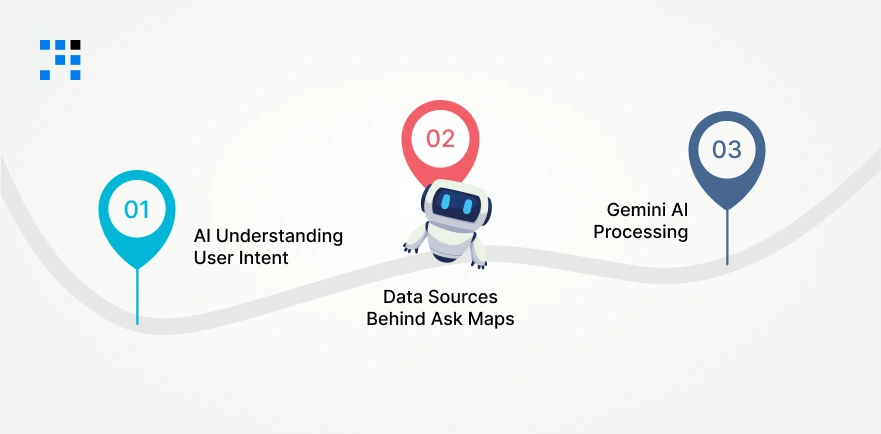
Many users are curious about how AI works in Google Maps and what happens behind the scenes when someone asks a question.
The AI Ask Maps feature in Google Maps combines advanced artificial intelligence, massive location data, & machine learning models to deliver accurate recommendations.
1. AI Understanding User Intent
When a user asks a question using Ask Maps, the system first tries to understand the intent behind the request.
Using natural language processing (NLP), the AI interprets conversational queries such as:
- “Find a quiet café with Wi-Fi.”
- “Best sunset viewpoints nearby.”
AI understands the context of the question & delivers context-aware search results, which is a major improvement over traditional navigation tools.
This intelligent interpretation is a key part of how AI works in Google Maps.
2. Data Sources Behind Ask Maps
After understanding the user’s intent, the system analyzes multiple data sources to find the best answer. These include:
- Location data from businesses and landmarks.
- User reviews and ratings.
- Photos uploaded by visitors.
- Real-time updates about traffic and availability.
By combining all this information, Ask Maps in Google Maps can generate highly relevant recommendations.
This process is what powers AI-driven local discovery and makes the search results more useful for users.
3. Gemini AI Processing the Query
The final step involves Gemini AI in Google Maps.
Gemini analyzes the collected data and generates personalized suggestions based on the user’s query, preferences, and location.
If someone asks for “quiet coffee shops nearby,” the AI evaluates:
- Cafés with high ratings.
- Places known for calm environments.
- Locations with Wi-Fi.
- User reviews mention a peaceful atmosphere.
Then it returns the most relevant recommendations.
This intelligent system is what makes the Google Maps AI feature so powerful.
We see this as a perfect example of how AI-powered location intelligence and smart navigation platforms are evolving.
What Is Immersive Navigation in Google Maps?

Along with the AI Ask Maps feature, another major update is Google Maps immersive navigation.
This feature enhances the navigation experience by adding realistic 3D visuals and interactive route previews.
With the Google Maps immersive navigation update, users can now view routes in a more intuitive way before starting their journey. Key improvements include:
- 3D Map Visualizations: Users can see buildings, streets, and landmarks in detailed 3D models, making it easier to recognize locations.
- Realistic Route Previews: Before starting navigation, users can preview the entire journey with real-world visuals of roads and intersections.
- Better Lane Guidance: The system clearly shows which lane drivers should take, helping avoid confusion during turns or highway exits.
- Improved Building & Area Visualization: Major landmarks and surrounding areas are displayed more accurately, making navigation smoother for travelers.
These improvements are part of the broader trend toward AI powered navigation apps that combine advanced mapping technology, AI intelligence, and visual guidance.
The combination of Google Maps immersive navigation and the AI Ask Maps feature is transforming traditional maps into powerful AI-powered travel & discovery platforms.
Why AI Navigation Is a Big Leap for Mapping Technology?
The introduction of AI navigation is changing how people explore cities, discover places, and plan journeys.
With innovations like the AI Ask Maps feature in Google Maps, maps are no longer just tools for directions.
They are becoming smart digital assistants that understand user needs and offer helpful recommendations instantly.
AI is enabling intelligent route planning, smarter local discovery, and faster decision-making for users.
- Smarter Local Discovery: One of the biggest benefits of AI powered Google Maps is its ability to suggest places based on user preferences.
- Personalized Travel Planning: Another powerful advantage is personalized route planning. Traditional maps only provide directions from point A to point B.
- Faster Decision Making: AI navigation also removes the need for manual searching and comparison.
Instead of browsing dozens of listings, users can simply ask a question and get instant recommendations.
We believe this is just the beginning of a new era of AI-powered location intelligence and smart navigation technology.
Ask Maps vs Traditional Google Maps Search
The AI Ask Maps feature in Google Maps represents a major shift from traditional keyword-based search to AI-powered conversational discovery.
Understanding the difference between Google Maps search and Ask Maps helps users see why this innovation is so powerful.
| Traditional Google Maps Search | Ask Maps AI Feature |
|---|---|
| Keyword search, such as “restaurants near me”. | Conversational search like “best rooftop restaurants nearby”. |
| Static results list. | AI-generated recommendations. |
| Limited personalization. | Context-aware answers based on preferences. |
| Manual comparison of places. | AI summarizes top suggestions instantly. |
| Requires multiple searches. | One question delivers curated results. |
Traditional search works well for simple queries. However, the Ask Maps Google Maps feature uses AI-powered conversational search to understand deeper user intent.
How Businesses Can Build AI Navigation Apps Like Google Maps?
Many companies are now interested in creating apps similar to Google Maps with AI capabilities.
Building such platforms requires a combination of mapping technology, artificial intelligence, and location intelligence infrastructure.
We help businesses create powerful AI powered map application development solutions using modern technologies.
1. Build a Location Data Infrastructure
The first step is collecting and organizing location data, such as:
- Geographic coordinates.
- Place listings.
- Business information.
- Traffic data.
This forms the foundation of a smart navigation platform.
2. Integrate AI Models
Next, AI models are integrated to analyze user queries, preferences, and travel behavior.
These models allow intelligent route planning, personalized recommendations, and conversational search.
3. Add Conversational Search
Modern navigation apps now include AI chat-based search, similar to the Ask Maps feature in Google Maps.
This allows users to ask natural questions and receive instant recommendations.
4. Use Mapping APIs
Mapping APIs are important for building navigation apps.
Businesses often rely on Google Maps API integration services to access mapping data, route calculations, and location services.
5. Build Personalized Recommendations
Finally, AI algorithms analyze user behavior to provide personalized suggestions for places, routes, and travel experiences.
With the right technology and expertise, businesses can successfully build AI-powered navigation apps similar to Google Maps.
AI Is Turning Google Maps into a Smart Travel Assistant
The launch of the AI Ask Maps feature in Google Maps marks a significant milestone in the evolution of navigation technology.
Instead of simple search tools, maps are becoming AI-powered travel assistants.
- Ask Maps introduces conversational AI search, making it easier for users to discover places.
- Google Maps immersive navigation enhances visual guidance with realistic route previews and 3D environments.
- AI-powered location intelligence is transforming navigation apps and creating smarter travel experiences.
For businesses, this innovation highlights the growing potential of AI navigation platforms, intelligent route planning systems, and location-based technologies.
We help companies build advanced AI navigation apps, custom mapping platforms, and location intelligence solutions that deliver smarter digital experiences.
FAQs
- The Ask Maps feature in Google Maps is an AI-powered search tool that allows users to ask questions naturally & receive personalized place recommendations.
- The feature is gradually rolling out across regions. Google is expanding it to more countries as part of its AI-powered navigation updates.
- AI improves navigation apps by enabling intelligent route planning, personalized place suggestions, real-time traffic analysis, and conversational search.
- Yes. Businesses can build AI-powered navigation platforms using mapping APIs, artificial intelligence models, & location data infrastructure.