Mobile app users are impatient. If your app feels slow, confusing, or irrelevant, they uninstall it, sometimes within seconds.
This is one of the biggest challenges businesses face today with mobile app user experience. Most apps fail not because they lack features, but because:
- Onboarding takes too long.
- Content doesn’t feel personalized.
- The app doesn’t adapt to user behavior.
- Users don’t instantly see value.
To fix this, product teams often try traditional UX improvements, new screens, more animations, and extra flows.
But this approach creates a new problem: Increasing app development costs. Every UX update means:
- More development effort.
- More testing and QA cycles.
- Longer release timelines.
- Higher maintenance costs.
They want better UX but worry that improving it will increase budgets and delay launches. This is exactly where AI in mobile app development changes the game.
Instead of adding more features, AI improves how existing features behave.
It learns from user actions, adapts experiences in real time, and removes friction, without requiring major redesigns or costly rebuilds.
We’ve helped startups and enterprises improve mobile app user experience using AI-based solutions, without rewriting entire apps or doubling development costs.
The focus is simple: Smarter UX, not heavier apps.
Why AI in Mobile App Development Is the Smartest UX Upgrade Right Now?
Artificial intelligence in app design focuses on how users behave. Instead of asking users to adapt to the app, AI helps the app adapt to users.
Here’s why AI mobile app UX improvements work so well:
AI studies real user behavior, taps, scrolls, time spent and optimizes existing user flows automatically.
There’s no need to build new screens or redesign entire journeys. Small, intelligent changes create a big UX impact. Machine learning models improve the experience over time.
The more users interact with the app, the better the UX becomes. This means fewer manual updates and less ongoing development effort. For businesses, this leads to:
- Higher user engagement.
- Better retention rates.
- Improved conversions.
- Lower long-term development and maintenance costs.
And the biggest advantage? You don’t need to expand your development team or increase your budget to see results.
AI in mobile app development is already being used in live production apps to improve UX, reduce churn, and drive growth, right now.
What People Are Complaining About?
Before we talk about solutions like AI for mobile user experience, let’s look at what real users are saying about mobile app UX problems online.
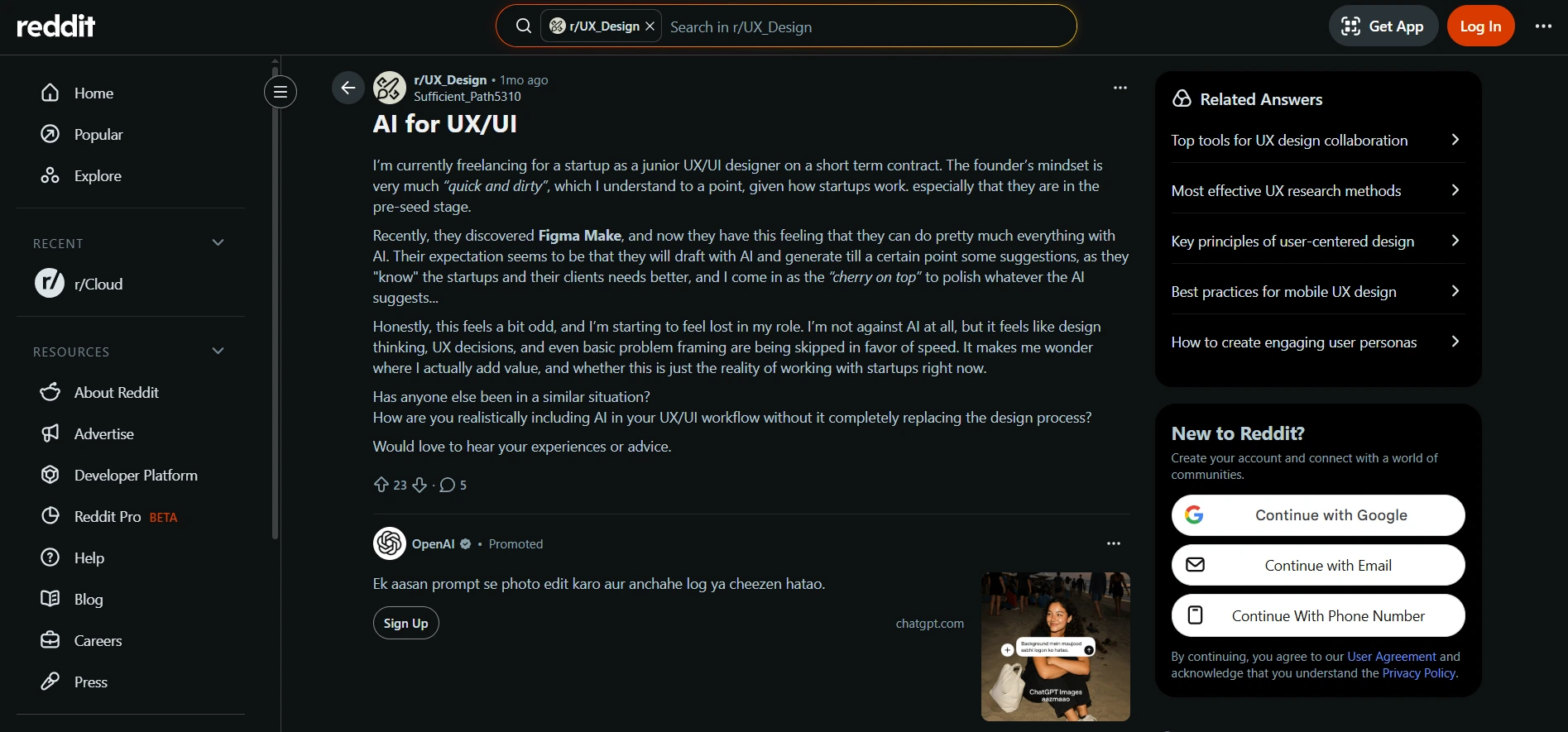
Source: Reddit
What You Can Understand?
- Confusing navigation and inconsistent design frustrate users.
- Performance issues like lag or reloads lead to disengagement.
- Poorly communicated UI changes can make users feel lost.
- Users expect intuitive behavior, not extra steps.
These recurring problems don’t just hurt mobile app user experience; they also impact retention, engagement, and overall app success.
This is exactly why improving UX through smart strategies like AI in mobile app development is so important.
What AI-Powered UX Actually Looks Like in Modern Mobile Apps?
When people hear AI, they often imagine complex systems or expensive features.
In reality, AI in mobile app development works quietly in the background to improve everyday user experiences. AI-powered UX focuses on making apps feel:
- Faster.
- Smarter.
- More personal.
- Easier to use.
Examples of AI-driven UX improvements include:
- Personalized onboarding based on user behavior.
- Smart recommendations instead of static content.
- Predictive search and auto-suggestions.
- AI chatbots that solve problems instantly.
- Adaptive interfaces that change based on usage patterns.
AI improves existing user flows instead of adding new ones. That’s why it enhances mobile app user experience without increasing development costs.
How We Solved the Same UX Problem Without Increasing Development Costs?
One of our clients came with a clear vision: They want better UX, but can’t afford a full redesign.
Instead of rebuilding the app, we applied AI-driven mobile UX optimization:
- Analyzed real user behavior using AI analytics.
- Identified friction points in onboarding and navigation.
- Added AI-based personalization to existing screens.
- Optimized content delivery using machine learning.
Results:
- Users spent more time in the app.
- Feature adoption increased.
- Churn is reduced without increasing development scope.
This is how AI in mobile app development delivers real UX improvements without rewriting codebases or expanding teams.
Why Traditional UX Fixes Fail? (And Cost You More Than AI Ever Will)
Traditional UX improvements usually mean:
- Adding more features.
- Redesigning screens.
- Releasing frequent updates.
But this approach is expensive and slow.
The problem is that manual UX changes don’t scale. Every new feature adds:
- Development effort.
- QA cycles.
- Maintenance costs.
AI takes a different approach, AI learns directly from behavior and adapts automatically. Over time, this reduces the need for constant UX updates.
That’s why AI vs traditional UX improvements is no longer a debate. AI is more cost-efficient, scalable, and effective.
How Do We Implement AI in Mobile App Development?
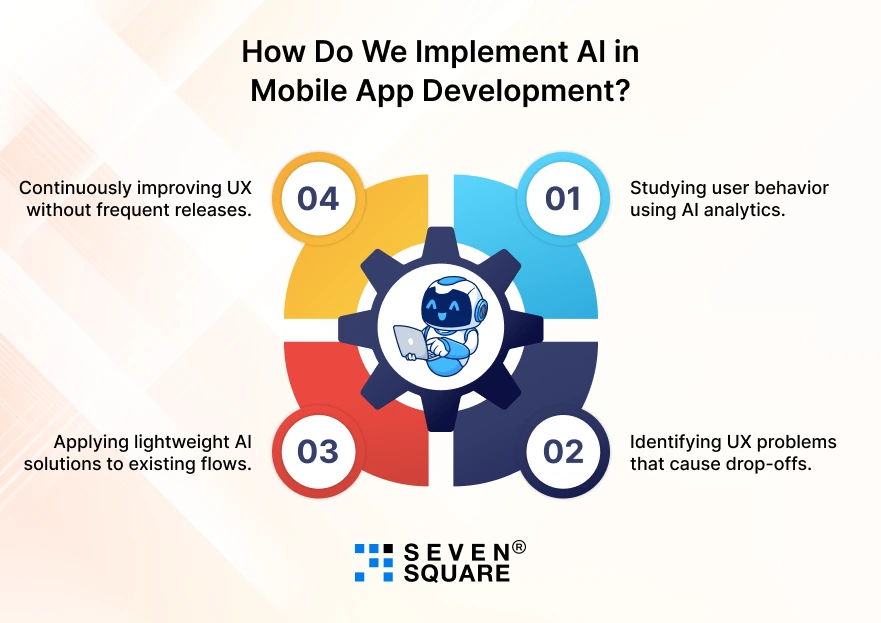
Our focus is always on business impact and user experience. Our approach includes:
- Studying user behavior using AI analytics.
- Identifying UX problems that cause drop-offs.
- Applying lightweight AI solutions to existing flows.
- Continuously improving UX without frequent releases.
We use AI where it matters most: Personalization, Engagement, and Retention, so clients see results without increased development costs.
Want to Get AI App Development Services? Contact Us Today!
How You Can Improve Mobile UX with AI? (Even Without a Full Redesign)
If you’re not ready for a big change, you can still benefit from AI for mobile user experience. Start with:
- Behavior tracking instead of assumptions.
- AI-based personalization instead of static screens.
- Predictive actions instead of manual inputs.
- Smart notifications instead of generic alerts.
Small AI improvements often create bigger UX wins than large redesigns. This is how teams improve mobile app user experience without increasing development budgets.
AI Is the Most Cost-Effective Way to Improve Mobile App UX

Improving mobile app user experience doesn’t have to mean higher development costs. AI in mobile app development allows apps to:
- Adapt to users.
- Learn from behavior.
- Improve continuously.
Businesses that adopt AI now will move faster, retain users longer, and outperform competitors.
If you want to improve your app’s UX without increasing your budget, we are here to help.
FAQs
- Yes. AI optimizes existing user flows instead of adding new features, reducing development and maintenance effort.
- Yes, most AI solutions can be integrated into current apps without full redesigns.
- Machine learning, behavior analytics, personalization engines, and AI chatbots deliver the highest UX impact.
- When implemented correctly, AI actually reduces complexity by automating UX decisions.