When a Node.js app is small, error handling feels easy. You throw an error in a controller, catch it somewhere, send a response, and move on.
But as the app grows, Node.js error handling is usually the first thing that breaks.
In real projects, errors get scattered everywhere, controllers handle some, services throw others, middleware catches a few, and some just leak to the client.
This creates inconsistent API errors that are hard to debug & even harder to maintain.
One endpoint might return a 400 Bad Request, another returns 500 for the same issue, and a third returns 200 with an error message inside the response body.
Error messages become unreadable, unpredictable, and sometimes unsafe to expose. Frontend teams are left guessing how to handle each case.
This is why the classic approach of “just throw an error” doesn’t work in production Node.js APIs.
Without a structured strategy, errors lose meaning, logs become noisy, and debugging slows the entire team.
Poor error handling directly impacts API reliability, developer experience, and user trust.
Here in this blog, you can see how to create a centralized error normalization layer in NodeJs with code.
What Is a Centralized Error Normalization Layer in Node.js?
A centralized error normalization layer in Node.js goes beyond basic centralized error handling.
It changes every error into a consistent, predictable format before sending it to the client. To understand this clearly, let’s break down the difference:
- Global error handler: A single place that catches unhandled errors.
- Error middleware: Express middleware that formats or sends errors.
- Error normalization layer: A dedicated layer that converts any kind of error into a standard structure.
Error normalization means that whether the error comes from validation, database queries, authentication, or external APIs, the response format stays the same.
This creates a single source of truth for API errors. With centralized error handling in Node.js combined with normalization, your backend speaks one consistent “error language.”
Why Centralized Error Handling Alone Is Not Enough?
Most Node.js tutorials stop at setting up a global Express error handler. In real-world projects, it often fails.
Why? Because errors don’t all look the same.
- Validation libraries throw one shape of error. Databases return another. Authentication errors follow different rules. External APIs add their own formats.
- A single Express error handler cannot magically standardize all of these.
- This leads to the hidden problem: API error responses become inconsistent even though they’re “centralized.”
- Frontend teams hate this. They don’t want to parse different error shapes or rely on message strings. “Message-only” error responses break UI logic and lead to fragile code.
- True best practices for Node.js error handling require error normalization, where every error is mapped into a structured, predictable format.
This is the foundation of proper API error standardization in Node.js, especially for apps used by multiple clients.
What Is the Ideal Error Response Contract for Modern Node.js APIs?
A scalable Node.js backend needs a clear error response contract, just like it needs a clear success response structure.
Here’s an example of an ideal Node.js structured error response:
        {
                "errorCode": "USER_NOT_FOUND",
                "message": "The requested user does not exist",
                "type": "BUSINESS_ERROR",
                "details": {
                        "userId": "12345"
                },
                "traceId": "abc-xyz-789"
        }
Each field has a purpose:
- errorCode: Stable identifier for frontend logic.
- message: Human-readable explanation.
- type: Validation, auth, system, or business error.
- details: Optional context for debugging.
- traceId: Helps track issues across logs and services.
This contract improves frontend handling, simplifies logging, and enhances monitoring.
When every error follows the same structure, teams spend less time debugging and more time building. This is the real value of API error standardization in Node.js.
How to Design the Error Normalization Architecture?
It’s important to understand where the error normalization layer lives in a Node.js backend. Most teams jump straight to Express middleware, but that’s where problems begin.
In a clean Node.js error handling architecture, the normalization layer sits between the raw error & the response sent to the client. Controllers should focus only on business flow.
Where the Error Normalization Layer Lives?
- Controllers & services → Throw errors.
- Error normalization layer → Converts errors into a standard shape.
- Logging layer → Logs normalized errors.
- Express error middleware → Sends response.
Error Flow
- An error occurs anywhere in the app.
- The error is passed to a central place.
- The normalization layer converts it into a predictable format.
- The normalized error is logged.
- A safe, structured response is sent to the client.
Error → Normalize → Log → Respond
This separation is what makes your Node.js error handling architecture scalable and future-proof.
Step-by-Step: Build a Centralized Error Normalization Layer in Node.js
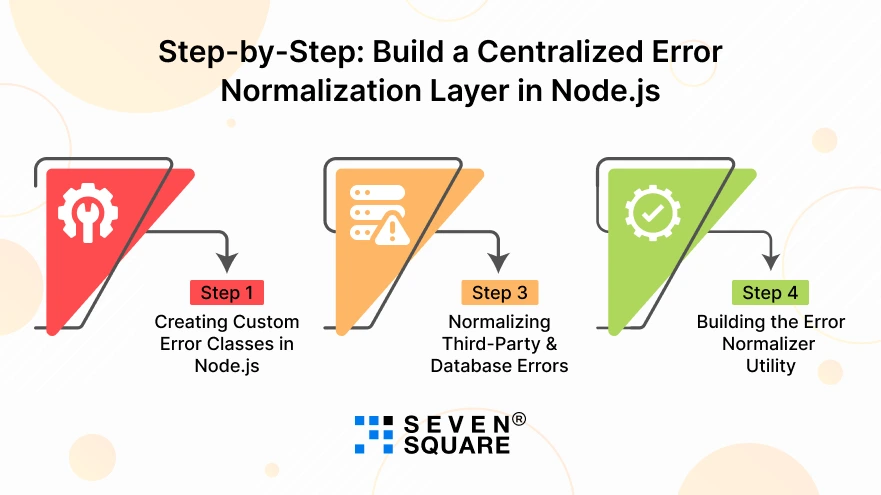
Here you can see the step-by-step guide to building a centralized error normalization layer in NodeJS.
Step 1: Creating Custom Error Classes in Node.js
Custom error classes are the foundation of centralized error normalization in Node.js.
BaseAppError (Core Error Class)
        // errors/BaseAppError.js
                class BaseAppError extends Error {
                constructor({ message, errorCode, statusCode = 500, type = 'SYSTEM_ERROR', details = null }) {
                        super(message);
                        this.name = this.constructor.name;
                        this.errorCode = errorCode;
                        this.statusCode = statusCode;
                        this.type = type;
                        this.details = details;
                        Error.captureStackTrace(this, this.constructor);
                }
                }

                module.exports = BaseAppError;
HTTP Error Example
                // errors/BadRequestError.js
                const BaseAppError = require('./BaseAppError');

                class BadRequestError extends BaseAppError {
                constructor(message = 'Bad Request', details = null) {
                        super({
                        message,
                        errorCode: 'BAD_REQUEST',
                        statusCode: 400,
                        type: 'VALIDATION_ERROR',
                        details
                        });
                }
                }

                module.exports = BadRequestError;
Business Error Example
                // errors/UserNotFoundError.js
                const BaseAppError = require('./BaseAppError');

                class UserNotFoundError extends BaseAppError {
                constructor(userId) {
                        super({
                        message: 'User not found',
                        errorCode: 'USER_NOT_FOUND',
                        statusCode: 404,
                        type: 'BUSINESS_ERROR',
                        details: { userId }
                        });
                }
                }

                module.exports = UserNotFoundError;
This clear separation between HTTP errors and business errors makes debugging and API responses much cleaner.
Step 2: Normalizing Third-Party & Database Errors
Real apps don’t fail only because of your code. Validation libraries, databases, and external APIs all throw different error shapes. This is where most Node.js apps break.
Error Normalizer for External Errors
                // errors/normalizeExternalError.js
                const BaseAppError = require('./BaseAppError');

                function normalizeExternalError(error) {
                // Validation library errors
                if (error.name === 'ValidationError') {
                        return new BaseAppError({
                        message: 'Validation failed',
                        errorCode: 'VALIDATION_ERROR',
                        statusCode: 400,
                        type: 'VALIDATION_ERROR',
                        details: error.errors || error.message
                        });
                }

                // Database / ORM errors
                if (error.code === 'ER_DUP_ENTRY') {
                        return new BaseAppError({
                        message: 'Duplicate record found',
                        errorCode: 'DUPLICATE_ENTRY',
                        statusCode: 409,
                        type: 'DATABASE_ERROR'
                        });
                }

                // External API errors
                if (error.response) {
                        return new BaseAppError({
                        message: 'External service failed',
                        errorCode: 'EXTERNAL_API_ERROR',
                        statusCode: error.response.status || 502,
                        type: 'INTEGRATION_ERROR',
                        details: error.response.data
                        });
                }

                return null;
                }

                module.exports = normalizeExternalError;
Handling Unknown Errors Safely
                function normalizeUnknownError(error) {
                return new BaseAppError({
                        message: 'Something went wrong',
                        errorCode: 'INTERNAL_SERVER_ERROR',
                        statusCode: 500,
                        type: 'SYSTEM_ERROR'
                });
                }
This ensures every error becomes predictable, which is the heart of normalize errors Node.js and error normalization middleware.
Step 3: Building the Error Normalizer Utility
Now we combine everything into one central function.
                // errors/normalizeError.js
                const BaseAppError = require('./BaseAppError');
                const normalizeExternalError = require('./normalizeExternalError');

                function normalizeError(error) {
                // Already normalized
                if (error instanceof BaseAppError) {
                        return error;
                }

                // External / third-party errors
                const externalError = normalizeExternalError(error);
                if (externalError) {
                        return externalError;
                }

                // Fallback
                return new BaseAppError({
                        message: 'Unexpected error occurred',
                        errorCode: 'UNEXPECTED_ERROR',
                        statusCode: 500,
                        type: 'SYSTEM_ERROR'
                });
                }

                module.exports = normalizeError;
Why Is This Better Than Controller-Level Logic?
- Controllers stay clean.
- No repeated error-handling code.
- One place to improve error behavior.
- True centralized error normalization in Node.js.
Express Middleware: Plugging the Normalization Layer into Your App
Finally, we connect everything using a global Express error middleware.
Global Error Middleware
                // middleware/errorHandler.js
                const normalizeError = require('../errors/normalizeError');
                const { v4: uuidv4 } = require('uuid');

                function errorHandler(err, req, res, next) {
                const traceId = uuidv4();
                const normalizedError = normalizeError(err);

                // Log once, centrally
                console.error({
                        traceId,
                        errorCode: normalizedError.errorCode,
                        message: normalizedError.message,
                        details: normalizedError.details,
                        stack: err.stack
                });

                res.status(normalizedError.statusCode).json({
                        errorCode: normalizedError.errorCode,
                        message: normalizedError.message,
                        type: normalizedError.type,
                        details: normalizedError.details,
                        traceId
                });
                }

                module.exports = errorHandler;
Plug It into Express
                const express = require('express');
                const errorHandler = require('./middleware/errorHandler');

                const app = express();

                // routes here...

                app.use(errorHandler);
This approach gives you a clean Express centralized error handler and a reusable Node.js error middleware that works at scale.
Here’s the Complete GitHub Code to Create Centralized Error Normalization Layer in NodeJs.
Why Businesses Trust Us for Scalable Node.js Error Architecture?
- We design centralized error normalization layers in Node.js that keep APIs predictable, stable, and easy to maintain.
- Our team builds production-ready Node.js error handling architectures tested across real-world, high-traffic applications.
- We help businesses eliminate inconsistent API errors using standardized, well-documented error response contracts.
- We focus on clean, framework-agnostic error normalization that works across monoliths, microservices, and APIs.
Want a Scalable NodeJs Solution for Your Business? Contact Us Now!
When Should You Implement an Error Normalization Layer?

You don’t need an error normalization layer on day one, but you’ll definitely need it sooner than you think.
- MVP stage: Optional, but helpful if multiple developers are involved.
- Scaling stage: Highly recommended as APIs grow and features multiply.
- Monolith applications: Keep error handling clean and maintainable.
- Microservices: Almost mandatory for consistent communication.
- Mobile, web, or third-party APIs: Critical for predictable client behavior.
If your backend serves more than one consumer or you’re building a scalable Node.js backend, introducing error normalization early will save weeks of refactoring later.
Treat Errors as a Product
Errors are part of your API’s user experience. When designed poorly, they confuse developers, frustrate users, and slow down teams.
When designed well, they become a strength. A centralized error normalization layer in Node.js helps you treat errors as a first-class product feature.
It improves long-term maintainability, team collaboration, and system reliability. A clean error system today means fewer production issues tomorrow.
FAQs
- Error normalization in Node.js means converting all errors, validation, database, auth, or external errors into a consistent response format using a centralized layer before sending them to the client.
- The best approach is to use Express error middleware combined with a centralized error normalization layer that standardizes error responses and prevents inconsistent API behavior.
- Yes. Custom error classes help categorize errors, attach metadata, and make error normalization easier, cleaner, and more scalable in production Node.js applications.