We see one clear trend: Customer expectations are rising faster than ever, and businesses are under constant pressure to deliver better experiences while keeping costs low.
That’s exactly why CRM ROI matters more now than at any time before. But here’s the real question every business owner is asking:
Cloud CRM vs Traditional CRM: Which one provides better ROI today?
As companies compare Cloud CRM vs Traditional CRM to reduce costs, improve efficiency, and scale faster, the choice directly impacts sales, support, customer retention, and long-term profitability.
In this blog, we break down what truly helps your business grow, practical insights, & a complete Cloud CRM vs Traditional CRM ROI comparison.
What Is Traditional CRM? (And Why Do Many Businesses Still Use It?)
A traditional CRM, also known as on-premise CRM or a legacy CRM system, is software installed on your company’s own servers.
You buy the license, set up the hardware, maintain the system, and handle everything internally.
Many large enterprises still choose traditional CRM because it gives them full control over data, customization, and internal security policies.
But from our experience helping businesses modernize their systems, traditional CRM comes with challenges like:
- On-premise CRM has drawbacks such as limited accessibility and higher setup time.
- High maintenance cost, as your IT team must fix issues, update servers, and manage backups.
- Difficulty scaling when your team or customer base grows.
- Slow performance for remote or hybrid teams.
Traditional CRM still works for companies with strict compliance needs, but for most growing businesses, it often limits speed and adaptability.
What Is Cloud CRM? (The Modern CRM Built for Speed, Scale & ROI)
A cloud CRM is a modern, internet-based solution where your sales, marketing, & support teams can access customer data from anywhere, on a laptop, mobile, or tablet.
We help businesses move to cloud CRM to unlock faster workflows and better ROI. Examples of cloud CRMs include Salesforce, HubSpot, & Zoho.
Key cloud CRM benefits include:
- No hardware setup.
- Easy accessibility for remote teams.
- Automatic updates and backups.
- Lower upfront costs and predictable monthly pricing.
- Fast integration with marketing and automation tools.
Because the system runs on the cloud, companies experience significant cloud CRM cost savings & a system that scales instantly as the business grows.
The ROI Battle: Cloud CRM vs Traditional CRM
Before diving deeper, here’s a quick Cloud CRM vs Traditional CRM ROI comparison that clearly shows how both systems perform:
| Feature | Cloud CRM | Traditional CRM (On-Premise) |
| Setup Cost | Low | High (hardware + installation) |
| Accessibility | Remote, mobile-friendly | Limited to office network |
| Scalability | Instant scaling with a few clicks | Slow & expensive |
| Maintenance Cost | None (handled by provider) | High (IT team + servers) |
| Security | Advanced cloud encryption | Depends on internal setup |
| ROI Speed | Fast | Slow |
This contrast helps businesses see how quickly cloud CRM pays off, especially for small and growing companies.
What can be the Total Cost of Ownership (TCO)? Which CRM Actually Saves You More?
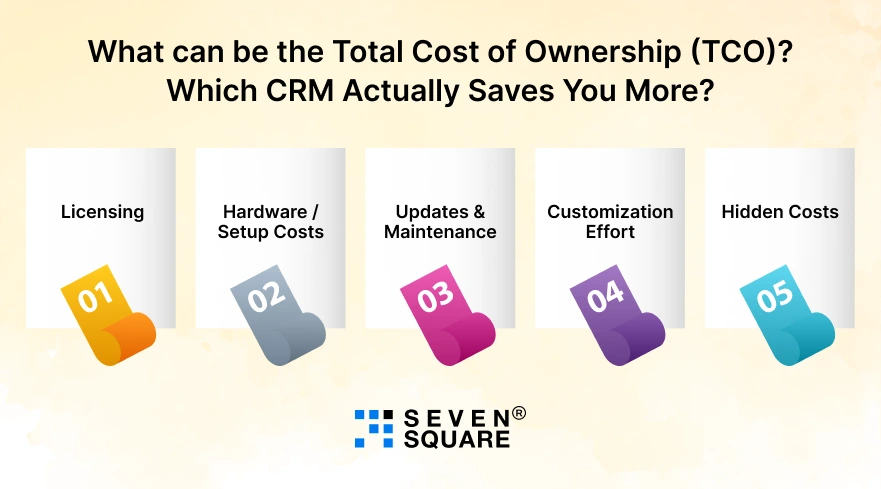
When clients come to us asking for a real CRM cost comparison, we analyze more than just license fees. Real ROI comes from long-term costs.
1. Licensing:
- Cloud CRM offers flexible monthly or yearly plans. Traditional CRM requires expensive upfront fees.
2. Hardware / Setup Costs:
- Cloud CRM needs zero hardware. Traditional CRM needs servers, installation, and dedicated support staff.
3. Updates & Maintenance:
- Cloud CRM updates automatically.
- Traditional CRM has on-premise CRM maintenance cost, which includes IT team hours, server patches, and downtime.
4. Customization Effort:
- Cloud CRM integrates faster with modern tools. Traditional CRM requires heavy technical work.
5. Hidden Costs:
- Traditional CRM often brings hidden costs like server upgrades, storage expansion, and security fixes.
Across all these factors, cloud CRM cost savings are far greater, making it the clear winner for ROI-focused businesses.
Scalability & Flexibility: Who Wins When Your Business Starts Growing?
We work with many growing companies that start with small teams and quickly scale. This is where the real difference becomes obvious.
Cloud CRM scalability vs on-premise CRM is not even close.
- Cloud CRM scales instantly, adds users, upgrades features, & expands storage in minutes.
- Traditional CRM grows slowly, & adding users requires server upgrades, IT configuration, and extra costs.
Imagine your team doubles next quarter.
- With cloud CRM: Simply add more accounts, done.
- With traditional CRM: Buy new hardware, upgrade servers, allocate IT staff, and spend more money.
This difference makes cloud CRM the smarter solution for businesses aiming for fast growth and higher ROI.
Learn more about eCommerce CRM Integration.
Is Cloud CRM Really Safe?
Many businesses still believe that on-premise systems are safer. Modern cloud CRMs offer:
- Strong data encryption.
- Role-based access control.
- 24/7 server monitoring.
- Automated backups.
- Enterprise-grade compliance.
When comparing Cloud CRM vs On-premise CRM security, cloud CRM often wins because providers invest millions into securing their systems, far more than most companies can on their own.
This makes cloud CRM not only secure but also more reliable for customer data protection.
Performance & Accessibility: Which CRM Works Better for Remote Teams?
We work with businesses that rely heavily on remote and hybrid teams, and one thing is very clear: Cloud CRM offers far better performance and accessibility.
- Cloud CRM operates online, allowing your sales, marketing, and support teams to log in from anywhere, office, home, or even mobile.
- This Cloud CRM accessibility for remote teams is important, where distributed work models are the new normal.
- Meanwhile, traditional CRM limits mobility because it depends on your internal office network.
- Employees must be at the office or connected through VPNs, which often slows down performance and productivity.
This is exactly why businesses looking for speed, flexibility, and remote collaboration prefer cloud CRM over on-premise CRM.
Explore the 5 Best WooCommerce CRMs.
How Does Each CRM Impact Revenue Growth?
The real power of a CRM is not just storing customer data; it’s how well it can automate the customer lifecycle. Cloud CRMs shine in this area.
Automations are only possible with Cloud CRM:
- Automatic lead scoring.
- AI-based sales forecasting.
- Automated email nurturing.
- Real-time marketing triggers.
- Automated support responses.
- Smooth integration with ERP, payment systems, & analytics tools.
We help clients use these capabilities to speed up sales cycles, reduce manual work, and improve customer retention.
Cloud CRM makes it easy to automate the entire customer lifecycle, while traditional CRM requires heavy coding, large IT involvement, and expensive customization.
This difference directly impacts revenue growth. Cloud CRM boosts efficiency, reduces human error, and gives teams the tools they need to close more deals faster.
Learn to Use AI in CRM for Better Customer Experience.
Why Do Businesses Trust Us for CRM Success?
We don’t just help companies choose between Cloud CRM vs Traditional CRM; we help them build the future of customer experience.
Our global expertise & long-term vision make us the preferred partner for businesses that want better CRM ROI, scalability, and automation.
- End-to-End Cloud CRM setup that boosts ROI with automation, integrations, remote accessibility, and modern customer lifecycle management.
- Scalable CRM architecture designed for growing companies needing instant scaling without heavy on-premise CRM maintenance costs.
- Expert migration from traditional CRM to cloud CRM with zero downtime and major cloud CRM cost savings.
- Fast integrations with ERP, accounting, & marketing tools to automate customer lifecycle and increase global revenue performance.
Want to Automate Your Business With Cloud CRM? Contact Us Now!
Where Cloud CRM Outperformed Traditional CRM?
Here are a few examples based on real experiences we’ve seen while helping clients to migrate from traditional CRM to cloud CRM:
1. SaaS Startup Increased Sales Conversion by 38%
- A growing SaaS company switched from an on-premise CRM to a cloud CRM.
- By using automation & remote access features, their sales efficiency improved by 38%, & the team saved 20+ hours per week in manual tasks.
2. Service Business Improved Response Time by 45%
- A service-based company required fast customer support.
- Cloud CRM helped them automate ticket routing and integrate live chat, improving response speed by 45% and boosting customer satisfaction.
These examples show that the Cloud CRM vs Traditional CRM ROI comparison consistently leans in favor of modern cloud systems, especially for businesses aiming for growth, speed, and cost savings.
When Traditional CRM Still Makes Sense?
Even though cloud CRM wins in most areas, traditional CRM can still be the right choice for specific business environments.
1. High-Security Industries:
- Sectors like government, defense, or large banking institutions prefer on-premise CRM to maintain complete control over data.
2. Legacy Infrastructure:
- Companies heavily dependent on older internal systems may find it challenging to switch immediately.
3. Custom Workloads:
- Some industries require unique, deeply integrated, on-site workflows that traditional CRM handles well.
We always recommend choosing the CRM type that aligns best with your compliance rules, technical environment, and long-term goals.
Which CRM Delivers Better ROI Today?
After comparing Cloud CRM vs Traditional CRM, the answer is clear:
Cloud CRM delivers better ROI for most modern businesses today.
With lower costs, easier scaling, stronger automation, and better support for remote teams, cloud CRM helps companies grow faster and operate smarter.
Traditional CRM still has value, but mainly for industries with strict compliance or heavy legacy dependencies.
Whether you want to migrate to cloud CRM or optimize your existing CRM setup, we’re here to help you get the highest ROI possible.
FAQs
- Yes. Cloud CRM provides faster updates, lower costs, better automation, & reduced maintenance, giving businesses higher ROI compared to traditional CRM.
- Small businesses benefit more from cloud CRM because it is affordable, scalable, and easy to use, without the heavy setup and maintenance costs of on-premise CRM.
- Cloud CRM typically delivers the fastest ROI due to quick deployment, automation, and low upfront investment.
- Modern cloud CRMs offer strong encryption, secure hosting, and regular backups, making them safer than many older on-premise CRM setups.
- Yes. Cloud CRM accessibility for remote teams allows faster collaboration, real-time updates, and mobile access from anywhere.