As AI-based development tools have become mainstream, people are asking one question: Codex vs Claude Code: Which is the Better AI Coding Agent?
Developers and businesses are comparing Codex vs Claude code to decide which AI coding agent delivers better accuracy, speed, and long-term value.
AI coding agents can now:
- Generate production-ready code.
- Refactor complex files.
- Debug errors in seconds.
- Assist with full-stack development.
- Improve developers’ productivity.
Because of this quick adoption, the debate around Claude vs Codex, and even OpenAI Codex vs Claude Code, has increased. Teams want clarity.
Startups want cost-efficiency. Enterprises want reliability and security.
Here in this blog, you will learn about Codex or Claude Code, which AI coding agent can provide better results.
What Is OpenAI Codex?
OpenAI developed OpenAI Codex, an AI model designed specifically for programming tasks.
It provides advanced code generation, understands natural language instructions, and converts them into working code across multiple programming languages.
When discussing OpenAI Codex vs Claude code, Codex is often recognized for its strong integration within development environments and structured code outputs.
OpenAI Codex is trained on a large dataset of public code and technical documentation. It:
- Understand plain English prompts.
- Generates functional code snippets.
- Completes partial code intelligently.
- Explains existing code logic.
It works as an AI pair programmer, assisting developers in real time. In the Codex vs Claude comparison, Codex is known for features like:
- Faster structured code generation.
- Strong syntax consistency.
- Efficient small-to-medium project handling.
- Good Git-based workflows.
Best Use Cases for OpenAI Codex
Codex is ideal for:
- Developers who need quick code generation.
- Teams building MVPs.
- Startups optimizing developer productivity.
- Structured coding tasks with clear instructions.
While comparing OpenAI Codex vs Claude code, Codex is often seen as more direct and implementation-focused.
What Is Claude Code?
Anthropic developed Claude models, and Claude Code represents their AI system optimized for coding workflows.
In the Claude vs Codex comparison, Claude Code stands out for reasoning depth and large context understanding. Claude Code is built to:
- Understand large codebases.
- Maintain context across long conversations.
- Provide reasoning-based debugging.
- Assist in complex architecture decisions.
It is considered a more analytical AI coding assistant. When analyzing Claude Code vs Codex, Claude Code offers:
- Large context window handling.
- Deep reasoning for logic-heavy tasks.
- Detailed explanations of generated code.
- Multi-file project awareness.
Strengths in Reasoning & Large Codebases
Claude Code performs well in:
- Complex debugging.
- Architecture-level suggestions.
- Refactoring large systems.
- Explaining legacy code.
While Codex focuses on structured output, Claude Code is better at strategic and analytical tasks.
How Do We Build AI Coding Agents for Modern Businesses?
We design and build custom AI coding agents according to your development workflow.
- We build custom AI coding agents using advanced AI software development tools for startups and enterprises.
- Our team designs intelligent systems beyond basic Codex vs Claude code integrations for real-world scalability.
- We develop AI coding agents trained on your internal repositories for enterprise-grade accuracy and security.
- We create hybrid systems combining strengths from OpenAI Codex vs Claude code for optimal performance.
- Our team implements an AI coding agent for enterprise environments with secure APIs and compliance-ready architecture.
Do You Want to Build a Customized AI Coding Agent for Your Business?
OpenAI Codex vs Claude Code: Side-by-Side Comparison
Now let’s see OpenAI Codex vs Claude Code performance comparison to determine which one is best for you.
| Feature | OpenAI Codex | Claude Code |
| Code Accuracy | Strong for structured, syntax-heavy tasks | Strong for logic-heavy and reasoning-based tasks |
| Context Window Size | Moderate context handling | Large context window, ideal for big codebases |
| Speed | Fast generation for small-to-medium tasks | Slightly slower but more analytical |
| Debugging Ability | Good at spotting syntax errors | Better at understanding logical and architectural issues |
| Refactoring Capability | Works well on individual files | Excels in multi-file and system-level refactoring |
| GitHub Integration | Smooth workflow compatibility | Supports repository-level understanding |
| API Access | Available via OpenAI APIs | Available via Anthropic APIs |
| Pricing Model | Token-based pricing structure | Usage-based pricing with larger context cost |
| Enterprise Readiness | Suitable for startups and product teams | Strong candidate for enterprise-scale development |
What to Learn from this Codex vs Claude Code Features Comparison?
- Choose Codex if you need speed, structured code generation, and fast MVP development.
- Choose Claude Code if you work with large systems, complex logic, and enterprise-level architecture.
Codex vs Claude Code performance comparison: Neither tool is universally better; the winner depends on your project type, team size, and technical requirements.
Codex vs Claude Code Performance Benchmark
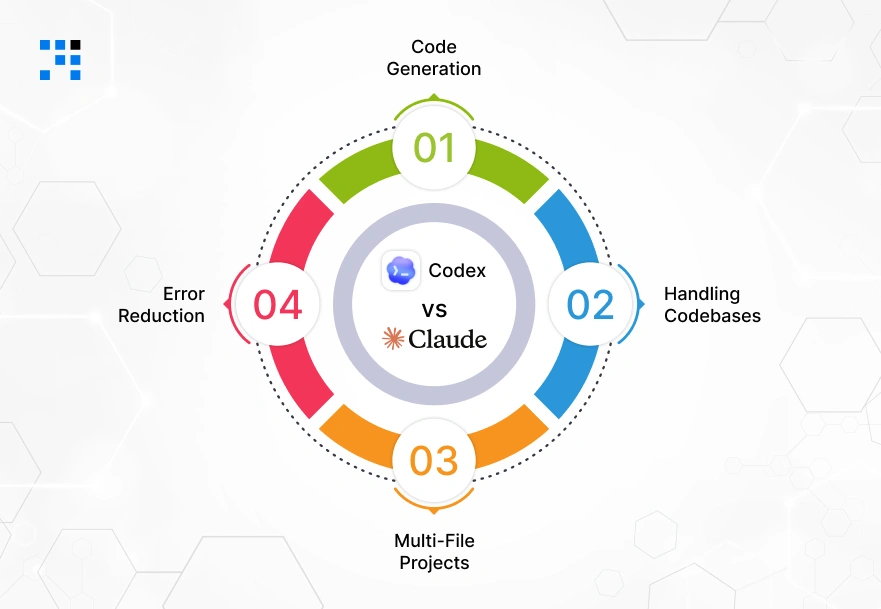
When developers search for a real Codex vs Claude Code accuracy test or Codex vs Claude Code speed comparison, they want proof.
1. Code Generation Tests
In structured coding tasks (like building APIs or writing utility functions):
- Codex generates clean, syntax-correct code quickly.
- Claude Code produces slightly more detailed code with explanations.
In short prompts, Codex often wins on speed. In complex prompts requiring reasoning, Claude Code can give more thoughtful solutions.
2. Handling Large Codebases
This is where the Codex vs Claude for large projects debate becomes serious.
- Codex works well for file-level tasks.
- Claude Code handles large repositories better due to its broader context understanding.
For enterprise or legacy systems, Claude Code often performs more consistently.
3. Multi-File Projects
In multi-file architecture:
- Codex handles independent files efficiently.
- Claude Code performs better when understanding relationships between files.
For microservices or SaaS platforms, Claude Code has the advantage.
4. Error Reduction Comparison
In a practical Codex vs Claude Code accuracy test:
- Codex reduces syntax errors effectively.
- Claude Code reduces logical and structural errors better.
This means Codex is strong for implementation, while Claude Code is best in reasoning-heavy workflows.
Example:
| Scenario | Better Choice |
| Build REST API quickly | Codex |
| Refactor legacy enterprise system | Claude Code |
| Fix syntax issues | Codex |
| Analyze complex system architecture | Claude Code |
The final takeaway from this Codex vs Claude Code performance comparison is simple: Speed vs reasoning depth, choose based on your project.
Which AI Coding Agent Is Better for Developers?
The answer depends on who you are and what you’re building.
1. For Solo Developers
If you’re a freelancer or indie developer:
- Codex helps ship features faster.
- It reduces boilerplate writing.
For quick productivity gains, Codex often feels more direct.
2. For Startups
Startups need speed + cost control.
- Codex works great for MVP development.
- Claude Code helps when scaling architecture.
If you’re asking for the best AI coding agent for business, it depends on whether you’re building fast or building long-term.
3. For Enterprises Teams
In Claude vs Codex for enterprise software, Claude Code usually has an advantage. Why?
- Handles large codebases.
- Better long-context reasoning.
- More consistent system-level suggestions.
For companies looking for an AI coding agent for enterprise, Claude Code may be the safer long-term choice.
4. For SaaS & Product Companies
SaaS teams need:
- Fast releases.
- Clean code.
- Scalable systems.
Codex helps accelerate feature development. Claude Code supports system stability and architecture.
The real answer in the Claude vs Codex debate: Choose based on scale and complexity.
When Should You Choose Codex Over Claude Code?
If you’re asking, should I use Codex or Claude Code? Here’s a simple guide for you.
Choose Codex if:
- You need fast code generation.
- You’re building an MVP.
- You want clean syntax quickly.
- You work on smaller code modules.
Choose Claude Code if:
- You manage large enterprise systems.
- You need deep reasoning.
- You refactor multi-file projects.
- Architecture decisions matter.
So, which is better Codex or Claude Code? The better tool depends on your workflow.
Future of AI Coding Agents: Who Will Dominate?

The competition between AI software development tools is only getting stronger.
- Model Upgrades: Both platforms continuously improve reasoning, accuracy, and integration.
- Enterprise Adoption: Large companies are actively integrating AI coding agents into development pipelines.
- Ecosystem Integrations: Integration with GitHub, CI/CD pipelines, and IDEs will determine long-term success.
- AI Agent Evolution: The best AI coding agent will be Context-aware, Autonomous in task execution, & Secure for enterprise environments.
The AI software development tools market will continue growing rapidly.
Claude vs Codex: Which Is the Better AI Coding Agent?
- Best Overall: Claude Code (for complex reasoning & large systems)
- Best for Enterprise: Claude Code
- Best for Startups: Codex
- Best for Complex Reasoning: Claude Code
- Best for Fast Code Generation: Codex
There is no universal winner. There is only the best tool for your specific needs.
FAQs
- Claude Code is better for large codebases and complex reasoning, while Codex is faster for structured code generation tasks.
- Codex focuses on fast, structured code output. Claude Code focuses on deep reasoning and large context understanding.
- In syntax tasks, Codex performs strongly. In logic-heavy tasks, Claude Code often produces more accurate results.
- Pricing depends on usage. Codex costs less for short tasks, while Claude Code can cost more due to larger context processing.
- Startups building MVPs may prefer Codex. Startups scaling complex systems may benefit from Claude Code.