Agentic RAG is an advanced AI architecture where autonomous agents control retrieval, reasoning, evaluation, & tool usage for scalable, reliable enterprise AI systems.
Traditional RAG pipelines fail while scaling.
An enterprise agentic RAG system introduces planning agents, reflection loops, dynamic retrieval, and memory layers to handle complex AI workloads.
If your AI:
- Hallucinates under pressure.
- Fails on multi-document reasoning.
- Struggles with tool orchestration.
- Breaks while scaling.
You need agentic RAG architecture, not a basic retrieval pipeline.
Here in this blog, you will learn about Agentic Rag architecture in detail and how to implement Agentic Rag Langchain.
What Is Agentic RAG?
Agentic RAG (Retrieval-Augmented Generation) is an AI architecture where intelligent agents decide:
- What to retrieve?
- When to retrieve?
- How to validate retrieved data?
- Which tools to call?
- Whether the answer needs refinement.
Unlike traditional RAG, an agentic RAG system does not blindly fetch documents and generate text. It plans actions.
What Are the Core Components of Agentic RAG?
An enterprise-ready agentic RAG architecture includes:
- Planning Agent.
- Retrieval Agent.
- Evaluation & Reflection Agent.
- Tool-Use Agent.
- Vector Database Layer.
- Memory System.
- Observability & Governance Layer.
This is what makes agentic RAG scalable.
Why Traditional RAG Fails at Enterprise Scale?
Traditional RAG fails because it is linear, static, and non-adaptive.
What Breaks in Production?
- Static retrieval logic.
- No reasoning loops.
- No delegation between tasks.
- High hallucination rate.
- Retrieval irrelevance.
- Context window overload.
- No feedback mechanism.
When enterprises scale, queries become complex:
- Multi-document reasoning.
- Cross-department knowledge.
- Tool-based decisions.
- Real-time updates.
Basic RAG cannot manage this. That’s where agentic RAG architecture becomes useful.
How Our Team Designs Scalable Agentic RAG Systems?
We don’t build AI demos. We build production systems. Our Enterprise Agentic RAG Approach:
- Security-first architecture.
- Custom multi-agent orchestration.
- Optimized vector database design.
- LangChain production pipelines.
- Memory & evaluation loops.
- Cost & latency optimization.
- Compliance-ready governance.
If you already have a RAG pipeline, we upgrade it into a scalable agentic RAG system.
Want an Enterprise-Grade Agentic RAG System?
What Is Enterprise Agentic RAG Architecture?
Enterprise Agentic RAG architecture is a multi-agent AI system design where autonomous agents control retrieval, reasoning, validation, and tool usage.
It makes enterprise AI scalable, accurate, and production-ready. Unlike traditional RAG, an agentic RAG system does not just fetch documents & generate answers.
It plans, retrieves, checks, corrects, & improves responses automatically.
Core Layers of Enterprise Agentic RAG Architecture
An enterprise-grade agentic RAG system includes multiple intelligent layers.
1. Input Understanding Layer
- Detects user intent.
- Classifies query type.
- Determines complexity level.
Example: “Compare last quarter revenue with competitor growth and suggest a strategy.”
This is not a simple retrieval task. It requires planning.
2. Planning Agent Layer
This is the brain of agentic RAG. It:
- Breaks the query into smaller tasks.
- Decides what data is required.
- Chooses whether tools are needed.
- Plans retrieval strategy.
Without this layer, your AI is reactive. With this layer, your AI becomes strategic.
3. Retrieval Agent Layer
In enterprise agentic RAG architecture:
- Retrieval can happen multiple times.
- Search queries adjust dynamically.
- Metadata filters are applied.
- Irrelevant documents are removed.
This reduces hallucinations significantly.
4. Tool Execution Layer
Enterprise AI rarely works alone. It may need to:
- Call APIs.
- Access ERP systems.
- Pull CRM data.
- Perform calculations.
- Trigger workflows.
The tool layer allows the agentic RAG system to act.
5. Evaluation & Reflection Layer
This is what makes agentic RAG powerful. The system:
- Check whether the answer makes sense.
- Verifies supporting documents.
- Detects inconsistencies.
- Re-run retrieval if needed.
This self-correction loop improves reliability.
6. Memory & Feedback Layer
Enterprise use cases require:
- Conversation memory.
- Historical context.
- Learning from past mistakes.
Memory enables:
- Personalized answers.
- Context-aware decisions.
- Better long-term performance.
7. Governance & Observability Layer
Enterprise AI must be:
- Secure.
- Auditable.
- Cost-controlled.
- Compliant.
An enterprise agentic RAG architecture includes:
- Logging of agent decisions.
- Retrieval tracking.
- Token monitoring.
- Access control policies.
This makes it production-ready.
This is the foundation of a production-grade agentic RAG system.
Learn How Multi Agent Systems in Artificial Intelligence Works.
Agentic RAG vs Agentic AI: What’s the Difference?
Many enterprises confuse agentic RAG vs agentic AI.
- Agentic RAG: Retrieval-focused autonomous reasoning system.
- Agentic AI: Broader category of autonomous AI systems.
| Feature | Agentic RAG | Agentic AI |
| External Knowledge Retrieval | Core Component | Optional |
| Enterprise Search | Primary Use Case | Sometimes |
| Tool Orchestration | Yes | Yes |
| Memory Integration | Yes | Yes |
| Scope | Knowledge Systems | Any Autonomous AI |
If your primary challenge is enterprise knowledge accuracy and scalable retrieval, you need an agentic RAG architecture, not a generic agentic AI.
How to Implement Agentic RAG Using LangChain?
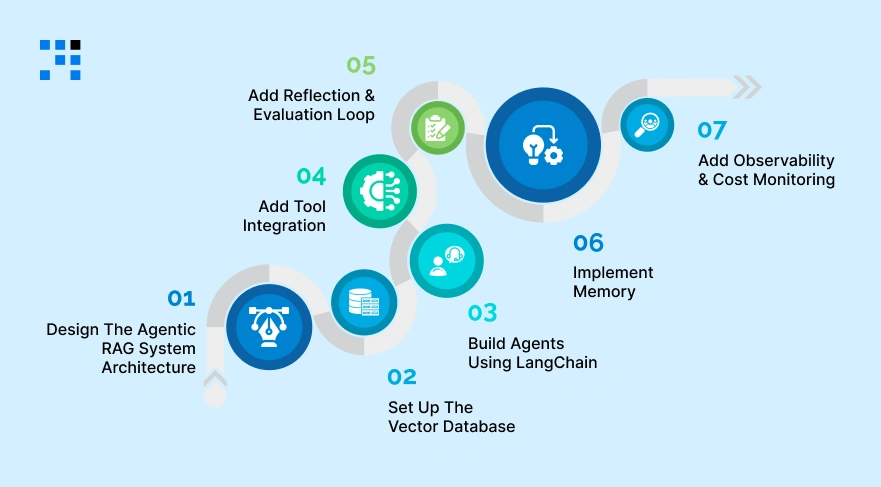
You can implement agentic RAG using LangChain by combining:
- LangChain agents.
- Vector databases.
- Tool integrations.
- Memory modules.
- Reflection loops.
- Observability tools.
This creates a production-ready agentic RAG LangChain system.
Step 1: Design the Agentic RAG System Architecture
Before coding, define:
- What agents are needed?
- What tools are required?
- What knowledge sources will be used?
- What validation logic will exist?
Typical agents in an agentic RAG system:
- Planner Agent.
- Retriever Agent.
- Evaluator Agent.
- Tool Agent.
Clarity at this stage prevents scaling issues later.
Step 2: Set Up the Vector Database
Vector databases are critical in agentic RAG architecture. You must define:
- Chunk size.
- Overlap strategy.
- Embedding model.
- Metadata filters.
- Index type.
Poor chunking leads to poor retrieval. In enterprise systems, use:
- Structured metadata.
- Department-based filtering.
- Access control layers.
This improves retrieval accuracy.
Step 3: Build Agents Using LangChain
LangChain supports:
- Agent Executors.
- Tool calling.
- Multi-step reasoning.
- Memory integration.
In agentic RAG LangChain implementation, the Planner Agent:
- Interprets the query.
- Selects tools.
- Calls retrievers.
- Delegates tasks.
This makes the system dynamic.
Step 4: Add Tool Integration
Enterprise AI often needs to:
- Query internal databases.
- Trigger APIs.
- Calculate metrics.
- Access live dashboards.
LangChain allows tool definitions like:
- SQL tool.
- REST API tool.
- Calculation tool.
- Search tool.
In agentic RAG, tools are not optional; they are part of the reasoning flow.
Step 5: Add Reflection & Evaluation Loop
This is where traditional RAG stops. But agentic RAG LangChain systems add:
- Answer validation.
- Source cross-checking.
- Re-retrieval logic.
- Confidence scoring.
You can implement:
- Secondary LLM validation.
- Rule-based checks.
- Retrieval re-ranking.
This reduces hallucination risk.
Step 6: Implement Memory
Enterprise use cases require:
- Session memory.
- Long-term memory.
- User preference memory.
LangChain provides:
- Conversation Buffer Memory.
- Vector-based memory stores.
Memory allows:
- Context-aware responses.
- Personalized decision support.
- Better multi-step reasoning.
Step 7: Add Observability & Cost Monitoring
Enterprise-grade agentic RAG architecture must include:
- Token usage tracking.
- Latency monitoring.
- Error logging.
- Agent trace visualization.
Without monitoring:
- Costs explode.
- Latency increases.
- Failures go undetected.
Observability turns your agentic RAG system into a stable production environment.
Explore the Comparison of Codex vs Claude Code.
How We Solved This Using Enterprise Agentic RAG Architecture?
We worked with an enterprise client facing:
- 38% hallucination rate.
- Multi-document reasoning failures.
- Slow knowledge retrieval.
- Tool coordination breakdown.
How We Built the Agentic RAG System?
We redesigned their architecture using:
- Multi-agent orchestration.
- Adaptive retrieval logic.
- Reflection-based evaluation.
- Tool execution chaining.
- Enterprise observability dashboard.
Results Achieved
- 42% reduction in hallucinations.
- 31% faster response time.
- 3x improvement in complex reasoning.
- Scalable enterprise deployment.
This is what proper agentic RAG architecture delivers.
How to Get Started with Enterprise Agentic RAG Development?
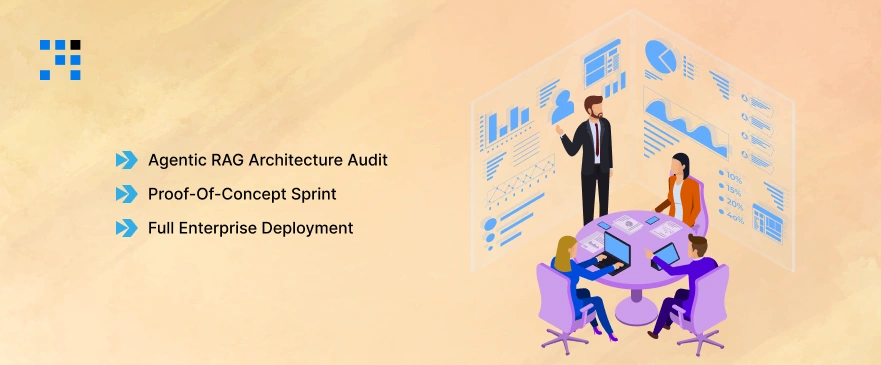
If you are serious about scalable AI, here’s how you can start:
- Agentic RAG Architecture Audit: We evaluate your existing RAG pipeline and identify scalability gaps.
- Proof-of-Concept Sprint: Rapid development of a working agentic RAG LangChain system.
- Full Enterprise Deployment: Complete architecture design, implementation, and optimization.
Agentic RAG Is the Future of Scalable Enterprise AI
- Agentic RAG is the evolution of traditional RAG.
- Agentic RAG architecture enables autonomous reasoning.
- Agentic RAG vs agentic AI is about retrieval focus.
- Agentic RAG LangChain enables real-world implementation.
- Static RAG will not scale for enterprise complexity.
Enterprise AI without agentic RAG will remain limited. Enterprise AI with agentic RAG becomes adaptive, reliable, and scalable.
FAQs
- Agentic RAG is an advanced AI system where autonomous agents control reasoning, validation, & tool usage.
- Unlike traditional RAG, an agentic RAG system can plan tasks, re-check information, and self-correct answers.
- This makes it more reliable and scalable for enterprise AI applications.
- Enterprise agentic RAG architecture is a multi-layer AI system design that includes planning agents, retrieval agents, evaluation loops, tool integration, and memory systems.
- It provides scalable AI development by improving accuracy, reducing hallucinations, and supporting complex enterprise workflows.
- Enterprises deal with complex queries, large knowledge bases, and compliance requirements.
- An enterprise agentic RAG system improves scalability, accuracy, and operational efficiency while reducing hallucination risks.
- Yes. Agentic RAG systems are designed for scalability.
- They use multi-agent orchestration, dynamic retrieval strategies, memory management, and monitoring layers.