If you’re building a mobile app today, speed is everything.
Yet many businesses still take 6 to 12 months just to launch their first version, and by then, the market has already moved on. Here’s what usually slows things down:
- Months wasted building the same app separately for iOS and Android.
- High development costs, but no real speed advantage.
- Competitors are launching faster, even with fewer features, and still winning users.
The issue is not your idea.
It’s not your team.
It’s your technology choice.
We’ve worked closely with startups and enterprises facing exactly this issue.
With our hands-on Flutter mobile app development, we’ve seen how the right framework can reduce launch timelines by 30 to 40% without compromising quality or scalability.
But real experience from projects where businesses needed to launch faster, reduce costs, and improve time-to-market profitability.
We’ve helped startups and enterprises cut launch timelines. Here’s how Flutter makes it possible.
What Is Flutter Mobile App Development & Why Businesses Are Switching Fast?
Flutter mobile app development is a modern, Google-backed approach to building mobile applications using a single codebase.
In practical terms, this means:
- One app codebase for iOS, Android, and even Web.
- Faster development with Hot Reload, which shows changes instantly.
- Consistent UI and performance across platforms.
Instead of building the same app twice, Flutter allows businesses to build once and deploy everywhere.
Why Flutter App Development Is Being Adopted by Businesses?
Businesses aren’t switching to Flutter because it solves real business problems. Here’s why Flutter app development is being adopted so fast:
- Faster mobile app development frameworks: Flutter reduces development cycles by removing duplicate platform work.
- Cost-effective Flutter app development: Fewer developers, shared testing, and lower maintenance costs.
- Flutter development for startups & enterprises: Startups launch MVPs faster, while enterprises scale without rewriting apps.
- Flutter vs native app development: Native apps still perform well, but Flutter often wins on speed, cost, and time-to-market.
We’ve seen teams move from idea to production weeks faster just by choosing Flutter early.
Why Time-to-Market Is the New Competitive Advantage in 2026?
In 2026, the biggest advantage is being first, learning faster, and improving continuously. Here’s why time-to-market matters more than ever:
- Faster launch = faster feedback + faster revenue: You learn what users want before your competitors do.
- Delayed apps lose users and money: Longer development means higher cloud costs, longer burn rate, and missed opportunities.
- Time-to-market profitability is real: The faster you launch, the sooner you validate, pivot, and start earning.
Using Flutter mobile app development, businesses can:
- Reduce development cycles.
- Release MVPs faster.
- Improve Flutter business app development ROI.
When people ask how Flutter reduces time to market, the answer is simple: Less duplication, faster iteration, and smoother releases.
That’s the real Flutter time-to-market advantage, and it’s why more businesses are switching now instead of later.
How Businesses Are Launching Apps Faster With Flutter?
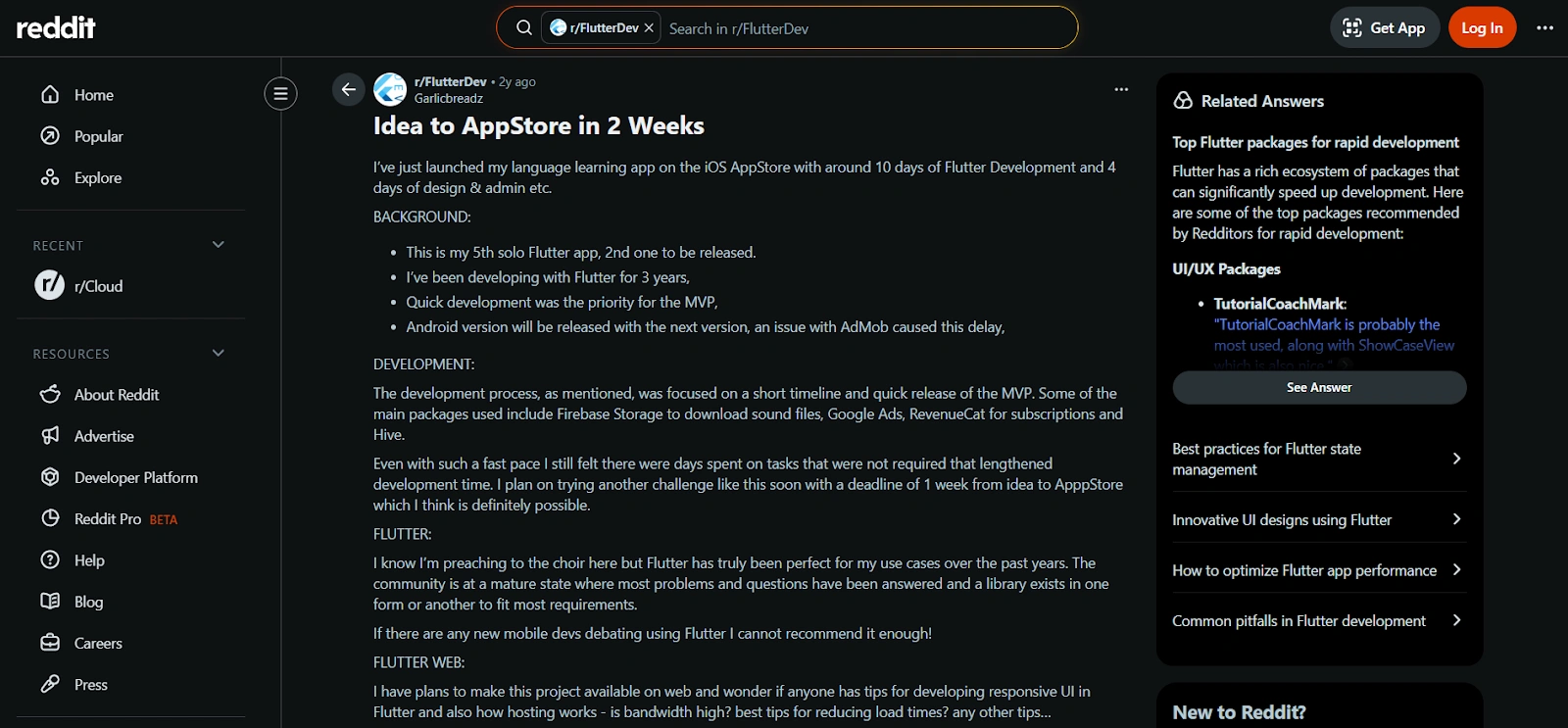
Source: Reddit
What You Should Learn From It?
- One developer building iOS and Android versions separately in native languages would take significantly more time.
- With Flutter, the effort nearly halves because one team builds both platforms in parallel.
- With industry findings that show Flutter projects often hit milestones 30 to 40% faster, helping teams validate, iterate, and launch sooner.
What Slows Teams Down Before Flutter? (And Why Most Businesses Don’t See It?)
Most businesses don’t plan to launch late. They simply don’t realize what’s slowing them down until it’s too late.
Here’s what usually happens with traditional or native app development:
- Two separate codebases: One for iOS, one for Android, doubling effort from day one.
- Repeated testing & bug fixing: The same issue appears on both platforms and must be fixed twice.
- Longer release cycles: Every update takes more time to coordinate across platforms.
- Rising maintenance costs: As features grow, managing two apps becomes expensive and complex.
When teams compare Flutter vs native app development, this is where Flutter clearly wins. With Flutter’s single codebase, businesses avoid duplication & move faster without sacrificing quality.
This is why many companies realize after launch that their technology choice quietly slowed their growth.
How Did We Solve This Problem Using Flutter for a Client?
One of our clients approached us with a clear problem: Their mobile app launch was taking too long, and development costs kept increasing.
Our approach:
- Switched the project to Flutter mobile app development.
- Designed a scalable, single-codebase architecture.
- Used Flutter Hot Reload for rapid testing and iteration.
- Simplified backend and CI/CD integration.
The results:
- Launch time reduced by nearly 35%.
- Lower development and maintenance costs.
- Faster updates and feature releases post-launch.
Which Flutter Mobile App Development Steps Do We Follow to Reduce 40% Time-to-Market?
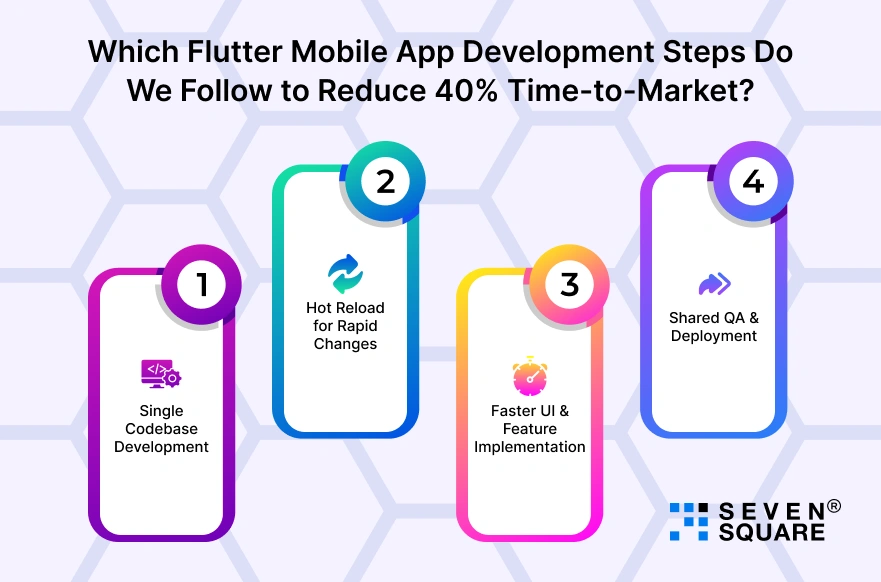
Flutter reduces time-to-market in very practical ways:
- Single Codebase Development: Build once, deploy on iOS and Android.
- Hot Reload for Rapid Changes: Developers see changes instantly, no long rebuild times.
- Faster UI & Feature Implementation: Flutter widgets speed up consistent UI creation.
- Shared QA & Deployment: One testing flow instead of two separate ones.
This is how Flutter reduces time to market, not through shortcuts, but through smarter development.
Want Flutter Mobile App Development Services? Contact Us Now!
Why Flutter Improves Time-to-Market Profitability?

Speed alone doesn’t matter unless it improves business results. Here’s how Flutter mobile app development improves profitability:
- Lower development cost: Smaller teams, fewer duplicated efforts.
- Reduced maintenance overhead: One app to maintain instead of two.
- Faster break-even point: Launch earlier, validate sooner, earn faster.
- Better scalability: Flutter supports both startups and large enterprise apps.
This directly improves Flutter business app development ROI, especially for startups and growing businesses.
What Happens If You Don’t Act Now?
While you’re planning, someone else is already building. Businesses using Flutter:
- Launch faster.
- Learn from users earlier.
- Improve features quicker.
- Capture market share sooner.
If you delay, your competitor won’t. And once they gain traction, catching up becomes far more expensive than launching right the first time.
FAQs
- Yes. Flutter supports scalable, enterprise-grade apps when built with the right architecture.
- In many cases, teams report 30 to 40% faster development due to a single codebase and faster iteration.
- Yes. Fewer developers, shared testing, and easier maintenance significantly reduce costs.
- Flutter often provides more consistent performance and faster UI development, especially for complex apps.