The right application performance management software is the one that gives you
real-time visibility, distributed tracing, AI-powered alerts, cloud-native compatibility, & smooth DevOps
integration without slowing down your system.
To choose the best application performance monitoring tools, you must:
- Identify your application architecture (monolith, microservices, serverless).
- Ensure distributed tracing is included.
- Check real user monitoring (RUM) capability.
- Compare pricing scalability.
- Validate DevOps & CI/CD integration.
- Test alert accuracy before purchase.
If your APM tool cannot detect performance issues before your users complain, it’s the wrong tool.
Here in this blog, you will learn the best way to choose the right application performance management software,
so that you know how your app performs.
What Is Application Performance Monitoring and Why Does It Matter?
Application performance monitoring (APM) is the process of tracking, analyzing, and optimizing application
behavior in real time.
To detect performance issues, downtime risks, & infrastructure inefficiencies. Modern applications are too
complex to manage without advanced application monitoring tools.
Why Does It Matters More Than Ever?
- Microservices increase system dependencies.
- Cloud-native apps scale unpredictably.
- Users expect sub-2-second response times.
- Downtime directly impacts revenue.
- DevOps teams need faster debugging cycles.
Without strong APM tools, businesses operate blindly. By the time an issue is visible to users, the damage is
already done.
How We Solved a Performance Crisis Using the Right APM Tools?
We recently worked with a SaaS client facing severe performance issues.
The Problem:
- The platform slowed during traffic spikes.
- No visibility into microservices.
- Checkout abandonment increased.
- The DevOps team is manually debugging logs.
Our Solution:
- Implemented enterprise-grade application performance monitoring tools.
- Enabled distributed tracing across services.
- Integrated real-time anomaly alerts.
- Optimized database queries.
- Configured performance dashboards for stakeholders.
Results:
- 42% reduction in latency.
- 60% faster root cause identification.
- 35% improvement in user retention.
- Reduced infrastructure waste.
The right application performance management software was only part of the solution. Proper configuration made
the difference.
Do You Want to Improve Your Application’s Performance?
What Features Should the Best Application Performance Monitoring Tools Have?
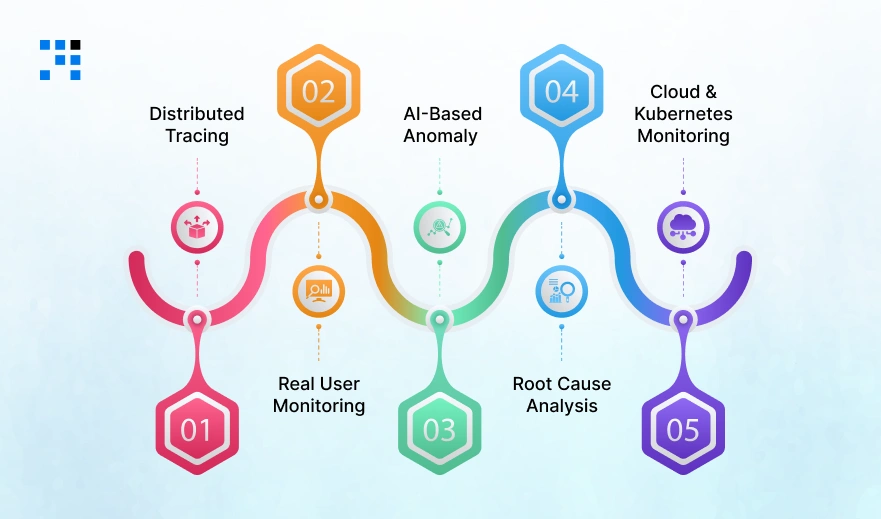
The best application performance monitoring tools give you complete visibility into your application, help you
detect problems early, and allow your team to fix issues fast.
If your current application performance management software only shows server uptime and basic CPU usage, it is
not enough.
Let’s see the must-have features:
1. Distributed Tracing (For Microservices & Modern Apps)
Modern applications are built using microservices. That means:
- One user request may touch 10+ services.
- One slow API can slow everything.
- One database query can block checkout.
Without distributed tracing, you cannot see where the delay happens. The best application monitoring tools allow
you to:
- Track a request from start to finish.
- See which service failed.
- Identify slow database calls.
- Detects API issues instantly.
If your app uses microservices or cloud-native architecture, distributed tracing is non-negotiable.
2. Real User Monitoring (RUM)
Real User Monitoring (RUM) shows how real users experience your application. This includes:
- Page load time.
- Button click delays.
- Checkout performance.
- Device-specific performance issues.
- Geographic performance issues.
Why does this matter?
Your server might look healthy, but users may still face slow loading. The best application performance
monitoring tools track:
- Frontend performance.
- Browser issues.
- Mobile responsiveness.
- Network delays.
This helps improve real user experience, not just backend metrics.
3. AI-Based Anomaly Detection
Manual monitoring is outdated. Modern application performance management software uses AI to:
- Detecting unusual traffic patterns.
- Identify performance spikes.
- Predict system overload.
- Reduce false alerts.
Instead of constant alert noise, AI-based APM tools:
- Filter important alerts.
- Highlight critical issues.
- Detecting hidden anomalies.
This saves DevOps teams hours of manual log checking.
4. Root Cause Analysis
One of the biggest benefits of advanced application performance monitoring is faster debugging. Without proper
tools:
- Teams spend hours checking logs.
- Multiple teams get involved.
- Issues escalate slowly.
With proper root cause analysis, your application monitoring tools should:
- Identify the exact line of code causing the delay.
- Highlight failed database queries.
- Detects memory leaks.
- Show dependency failures.
The faster you find the root cause, the faster you fix it.
5. Cloud & Kubernetes Monitoring
Most businesses now run on:
- AWS.
- Azure.
- Google Cloud.
- Kubernetes clusters.
Your APM tools must support:
- Cloud auto-scaling environments.
- Container monitoring.
- Kubernetes pod visibility.
- Infrastructure-level metrics.
Traditional monitoring tools fail in dynamic cloud setups. Modern application performance management software
must scale automatically as your infrastructure scales.
Why Do Most Companies Choose the Wrong APM Tools?
The biggest mistake? Choosing based on price instead of visibility.
Common Errors When Selecting Application Monitoring Tools:
- Selecting open-source tools without scalability planning.
- Ignoring distributed tracing requirements.
- Choosing tools that slow down applications.
- Not checking integration with the DevOps stack.
- Buying enterprise software without testing alert accuracy.
Many companies invest in application performance monitoring tools but fail to configure them correctly. A tool
alone does not solve the problem; an implementation strategy does.
How to Evaluate and Compare Application Performance Management Software? (Step-by-Step)
Step 1: Identify Your Architecture
Ask:
- Are you running microservices?
- Using Kubernetes?
- On AWS, Azure, or a hybrid cloud?
- Handling high transaction volume?
Your infrastructure determines your required APM tools.
Step 2: Define Your Performance Goals
Clarify your objective:
- Reduce downtime?
- Improve customer experience?
- Speed up root cause detection?
- Optimize infrastructure cost?
Your goal defines your tool selection.
Step 3: Compare APM Tools Based On:
- Pricing structure (per host, per user, ingestion-based).
- Monitoring depth.
- Dashboard usability.
- Alert configuration flexibility.
- Integration ecosystem.
- Performance overhead.
Do not skip technical validation.
Step 4: Run a Controlled Pilot
Never purchase enterprise-level application performance management software without testing it under real
traffic.
Run a 14 to 30-day proof of concept.
What Should You Expect from Application Performance Management Software?
Common Pricing Models:
- Per host pricing.
- Per user pricing.
- Per transaction pricing.
- Data ingestion-based pricing.
Choose based on scalability.
ROI Drivers:
- Reduced downtime.
- Faster feature releases.
- Better DevOps efficiency.
- Improved user retention.
- Infrastructure cost optimization.
The ROI of strong application performance monitoring often exceeds the cost within months.
How Do We Help You Choose and Implement the Right APM Tools?
We don’t just suggest tools. We design performance ecosystems. Our Process:
- Performance audit.
- Infrastructure assessment.
- Tool comparison & vendor analysis.
- Proof-of-concept deployment.
- Full DevOps integration.
- Continuous optimization & monitoring refinement.
We align application performance management software with your business goals, not just your infrastructure.
What Should You Do Next?
Choosing the right application performance management software is not about buying the most popular tool. It is
about:
- Matching architecture needs.
- Ensuring distributed tracing.
- Integrating DevOps workflows.
- Planning for scalability.
- Prioritizing proactive monitoring.
If your application is critical to revenue, monitoring must be equally important.
FAQs
- Application performance monitoring tools (APM tools) track, analyze, and optimize application behavior in real time.
- They help detect slow performance, downtime risks, and system bottlenecks before users are affected, improving overall application stability and user experience.
- Distributed tracing allows application performance monitoring tools to track a single user request across multiple microservices.
- This helps identify exactly where delays or failures occur, making debugging faster and more accurate.
- Yes. Modern application performance monitoring tools are designed for cloud-native and Kubernetes environments.
- They provide container monitoring, auto-scaling visibility, and infrastructure insights necessary for dynamic cloud applications.
- A business should upgrade its APM tools when applications become slow, microservices increase complexity, downtime impacts revenue, or debugging takes too long.
- Modern application performance management software ensures proactive monitoring and scalability.