OpenAI’s investment in Merge Labs is not just another funding headline.
From our perspective, this move clearly shows a major shift in how humans and AI will interact in the future.
When OpenAI backs a brain-computer interface startup, it tells us one thing:
AI is moving beyond screens, keyboards, and voice commands.
The OpenAI Merge Labs investment highlights the next evolution of human AI integration technology, where AI systems are designed to understand humans more naturally, directly, and dynamically.
Chatbots, dashboards, and voice assistants work, but they don’t fully capture human intent, context, or cognitive signals.
Brain-computer interfaces open a new door where AI can become more responsive, personalized, and human-centered.
From what we see across enterprise AI projects, companies that start exploring human AI integration technology early will have a serious advantage in the next wave of AI-driven innovation.
Here in this blog, you will learn about Sam Altman’s brain-computer interface startup and Funding in it by OpenAI.
What Is Merge Labs? Inside Sam Altman’s Brain-Computer Interface Vision
Merge Labs is a Sam Altman brain-computer interface startup focused on one bold idea: Bridging biological intelligence and artificial intelligence.
Unlike traditional AI startups that only build software, Merge Labs is working at the intersection of AI, neuroscience, and human-machine interaction.
Their goal is to improve how humans interact with intelligent systems. A key difference is their focus on non-invasive brain-computer interface AI.
Instead of implants or surgery, Merge Labs is exploring safer, scalable ways to read and interpret neural signals. This is important for real-world adoption, especially in enterprise and consumer environments.
At its core, this is about BCI artificial intelligence, using advanced AI models to translate complex brain signals into meaningful actions, insights, or interactions.
From an ecosystem standpoint, Merge Labs fits neatly into OpenAI’s long-term roadmap.
OpenAI builds powerful AI models; Merge Labs explores how humans can interact with those models in more natural ways.
Together, these points toward a future where AI feels less like a tool and more like an extension of human capability.
Why OpenAI Is Betting on Brain-Computer Interfaces Now?
Current AI interfaces are powerful, but they’re also limited. Typing prompts, clicking buttons, or even talking to AI creates friction.
We’ve seen enterprises struggle to fully unlock AI’s potential because human interaction becomes the bottleneck.
This is where the OpenAI brain-computer interface vision comes in.
AI neural interface development is the next logical step because it allows AI systems to understand intent, attention, and cognitive signals, not just text or voice.
Instead of telling AI what to do, humans could think, react, or learn in ways that AI systems can adapt to in real time.
It is one of the main reasons why OpenAI invested $250 million in Merge Labs at a valuation of $850 million.
OpenAI clearly sees brain-computer interfaces as a way to build more human-centered AI solutions, systems that adapt to people.
- Faster decision-making.
- More intuitive AI tools.
- Better learning and training systems.
- Deeper personalization without added complexity.
This investment shows OpenAI is thinking far beyond today’s interfaces, and enterprises should too.
Merge Labs vs Neuralink: Two Very Different Paths to Human-AI Integration
When people think of brain-computer interfaces, Neuralink often comes up first.
But among brain-computer interface companies, Merge Labs is taking a very different approach.
Neuralink focuses on invasive implants, which come with higher risk, regulatory hurdles, and limited enterprise scalability.
Merge Labs, on the other hand, is exploring non-invasive human-machine interface AI, which is far more practical for widespread use.
From an enterprise perspective, the differences are clear:
- Lower risk makes non-invasive approaches more acceptable.
- Higher scalability supports broader adoption.
- Faster experimentation fits enterprise innovation cycles better.
When we look at enterprise AI integration services, non-invasive human-AI interfaces are far more realistic.
Enterprises need solutions that can be tested, iterated, and scaled. That’s why Merge Labs’ approach aligns better with how real businesses adopt emerging AI technologies.
From Research to Reality: Where Human-AI Integration Is Headed?
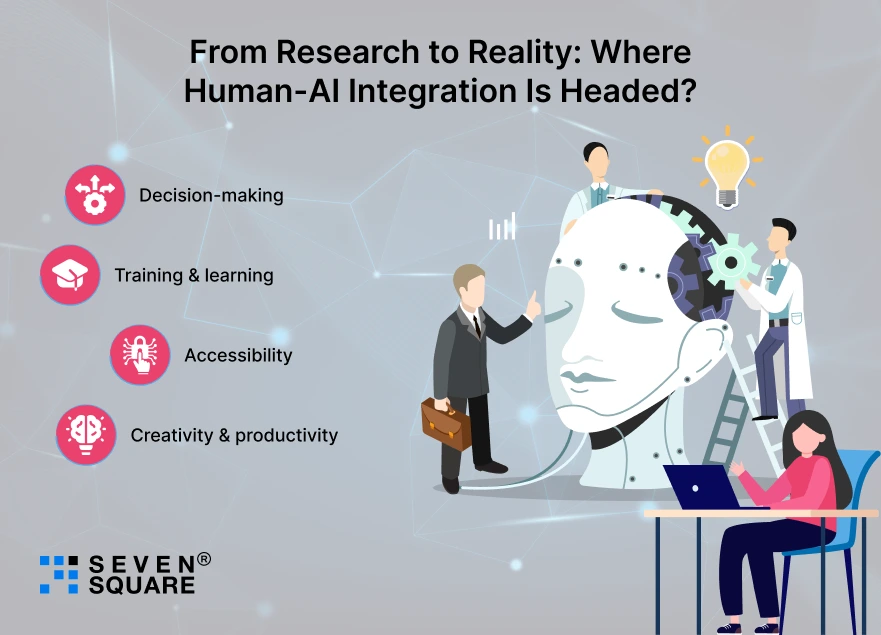
For years, human-AI integration sounded impossible, but now it’s becoming a serious enterprise AI strategy discussion.
What’s changing is the combination of AI + neural signals, powered by future AI interface development and applied AI research for enterprises.
In practical terms, this could change:
- Decision-making: AI systems that understand cognitive load or intent can support faster, smarter choices.
- Training & learning: Adaptive systems that respond to how people learn, not just what they click.
- Accessibility: New interfaces for users with physical or communication limitations.
- Creativity & productivity: Tools that reduce friction between ideas and execution.
Enterprises that invest early in applied AI research, experimentation, & next-generation interfaces will be the ones changing how AI is actually used in the real world.
How Can We Help to Start Building Human-AI Integration?
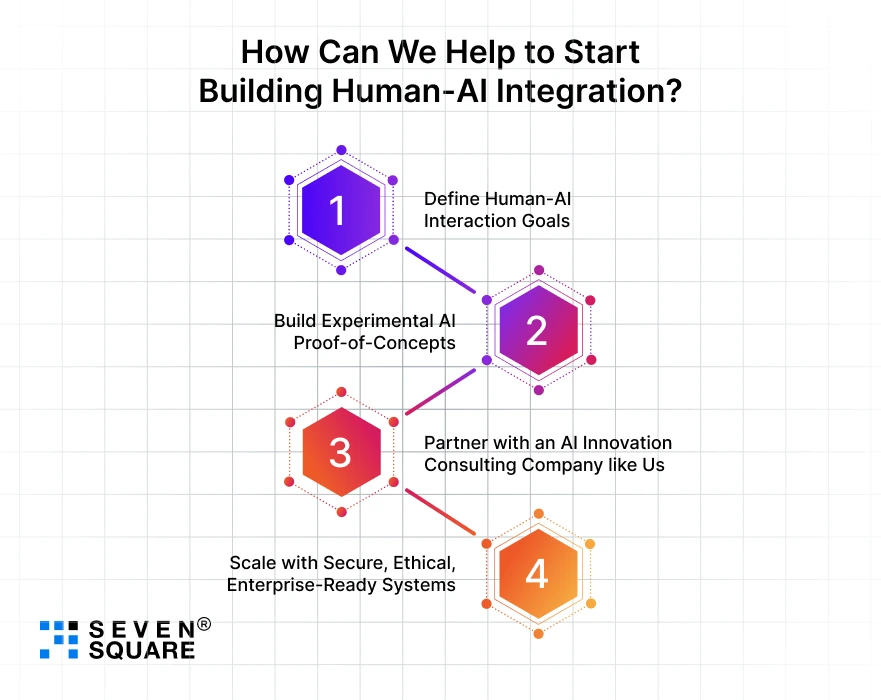
We guide enterprises through a practical & step-by-step approach.
Step 1: Define Human-AI Interaction Goals
- Start with real business problems like productivity, training, decision-making, & accessibility. Clear goals shape better AI systems.
Step 2: Build Experimental AI Proof-of-Concepts
- This is where innovation begins. As an AI proof of concept development company, we help enterprises validate ideas quickly without heavy risk.
Step 3: Partner with an AI Innovation Consulting Company like Us
- Human-AI integration cuts across AI, UX, architecture, and ethics.
- Partnering with an AI innovation consulting company accelerates learning and avoids costly mistakes.
Step 4: Scale with Secure, Ethical, Enterprise-Ready Systems
- Once validated, systems must scale responsibly with security, compliance, and long-term maintainability built in from day one.
This approach keeps enterprises flexible while preparing for future AI interfaces.
Want AI Integration Services? Contact Us Today!
What This Means for Enterprises Exploring Next-Gen AI?
Forward-thinking enterprises aren’t waiting for brain-computer interfaces to become mainstream.
They’re already investing in AI research and development services to prepare for what’s coming next. Why? Because human-AI integration technology won’t arrive overnight.
It will evolve through experimentation, pilots, and incremental breakthroughs. Enterprises that want to stay ahead should:
- Explore how future AI interfaces could reshape workflows.
- Test AI systems that adapt to human behavior.
- Build internal readiness for next-generation AI interaction models.
This is where enterprise AI integration services become important. It’s about building the right foundations, understanding constraints, and running controlled experiments.
Why Human-AI Integration Requires an AI R&D Partner?
Off-the-shelf AI platforms are great for standard use cases. But human-AI integration is not standard. At this stage, enterprises need:
- Custom experimentation.
- Advanced AI architecture.
- Deep integration across systems.
That’s why working with an enterprise AI development company matters.
Tools can’t design experiments, adapt models, or align AI systems with long-term business strategy.
As complexity grows, there comes a point when it’s smarter to hire AI research and development teams who understand both emerging technology & enterprise realities.
Is Merge Labs the Start of the Human-AI Era?
OpenAI’s investment in Merge Labs matters because it shows where AI is heading.
Over the next 5 to 10 years, human-AI integration could shift from experimental labs to real business environments, deciding how people learn, work, and interact with intelligent systems.
For enterprises, this isn’t about copying Merge Labs.
It’s about understanding the direction and preparing strategically with the right human AI integration consulting services.
The future of AI will belong to businesses that invest early in experimentation, research, and the future of AI human interaction.
FAQs
- Merge Labs focuses on non-invasive brain-computer interface AI, while Neuralink relies on invasive implants.
- This makes Merge Labs more scalable for enterprise and consumer use.
- Direct BCI use is still emerging, but enterprises can already experiment with AI systems designed for future human-AI integration.
- By investing in AI research and development services, running proof-of-concept, and building flexible AI architectures.
- Yes. Neural data requires custom AI system development and strong AI hardware & software integration to be usable at enterprise scale.