Today, website users are more impatient than ever. If your website takes more than a few seconds to load, users leave.
This is one of the biggest reasons businesses lose traffic, leads, and sales even after investing heavily in design.
Slow load times directly impact bounce rates, Core Web Vitals, and conversion rate optimization.
Google now prioritizes websites that load fast, respond quickly, and provide a smooth user experience. If your website fails these benchmarks, your conversions drop.
Research shows that a 1-second delay in page load time can reduce conversions by up to 7%.
For an eCommerce or SaaS business, that can mean thousands of dollars lost every month.
Yet many websites still depend on traditional frontend setups that were never built for today’s performance expectations. The real problem lies deeper:
- Heavy JavaScript files slow down rendering.
- Poor UX increases bounce rates.
- Outdated frontend stacks fail Core Web Vitals.
- Websites struggle on mobile networks.
Through our hands-on React.js development experience, we help companies fix performance issues & improve user experience.
We optimize real products, measure real results, and ship real improvements, and that’s exactly why we’re writing this.
Why React.js Development Is the Go-To Choice for High-Performance Websites?
When businesses want faster websites and better user experience, React.js development is often the first choice, and for good reason.
Unlike traditional frontend frameworks that reload entire pages, React works differently. It updates only what’s needed on the screen.
This makes websites feel faster, smoother, and more responsive to users.
What Makes React.js Different?
Traditional websites re-render full pages whenever something changes. React uses a Virtual DOM, which means it compares changes first and updates only the required elements.
The result? Less processing, faster rendering, and better performance. Even for non-technical users, the benefit is clear:
- Pages load faster.
- Buttons respond instantly.
- Navigation feels smooth.
- Users stay longer on the website.
React follows a component-based architecture. Instead of loading everything at once, the website loads small reusable components.
This improves speed, scalability, & long-term maintainability. React makes it easier to achieve all of this.
With proper React.js performance optimization, businesses can meet Google’s performance standards and improve both rankings and user engagement.
How React.js Improves Website Performance by Up to 40%?
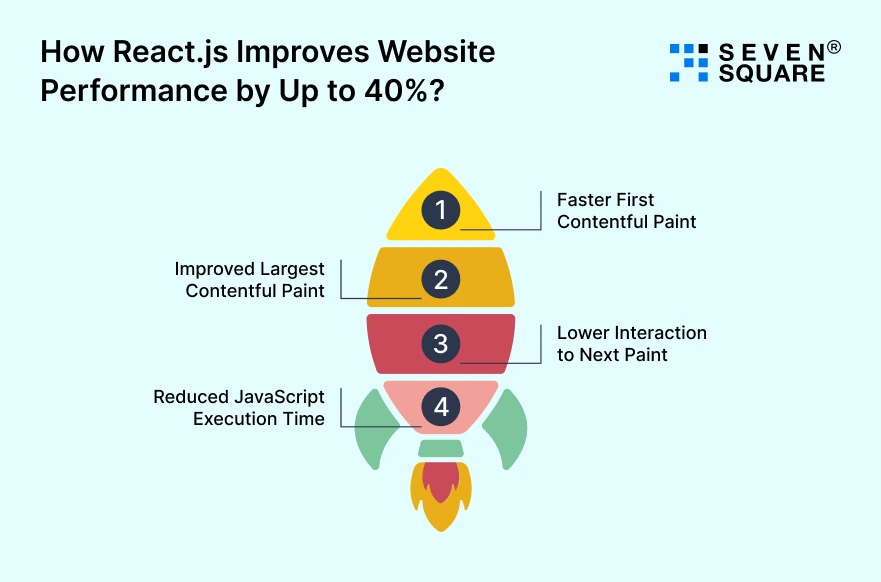
One of the biggest advantages of React.js development is its measurable impact on performance.
When optimized correctly, React can improve website speed by up to 40%, especially when migrating from traditional frontend stacks.
1. Faster First Contentful Paint (FCP)
- React loads critical UI elements faster, allowing users to see content sooner.
- This reduces perceived load time and keeps users engaged from the first second.
2. Improved Largest Contentful Paint (LCP)
- By optimizing component loading and rendering only what’s needed, React improves LCP, one of Google’s most important Core Web Vitals.
3. Lower Interaction to Next Paint (INP)
- React’s efficient event handling ensures faster response times when users click, scroll, or interact with the website.
- This creates a smooth and frustration-free experience.
4. Reduced JavaScript Execution Time
- Through techniques like code splitting and lazy loading, React minimizes JavaScript execution, reduces browser workload, & speeds up page interactions.
These performance gains directly improve user retention, lead generation, and revenue growth.
Learn How React Native Helps Businesses to Reduce Mobile App Development Costs.
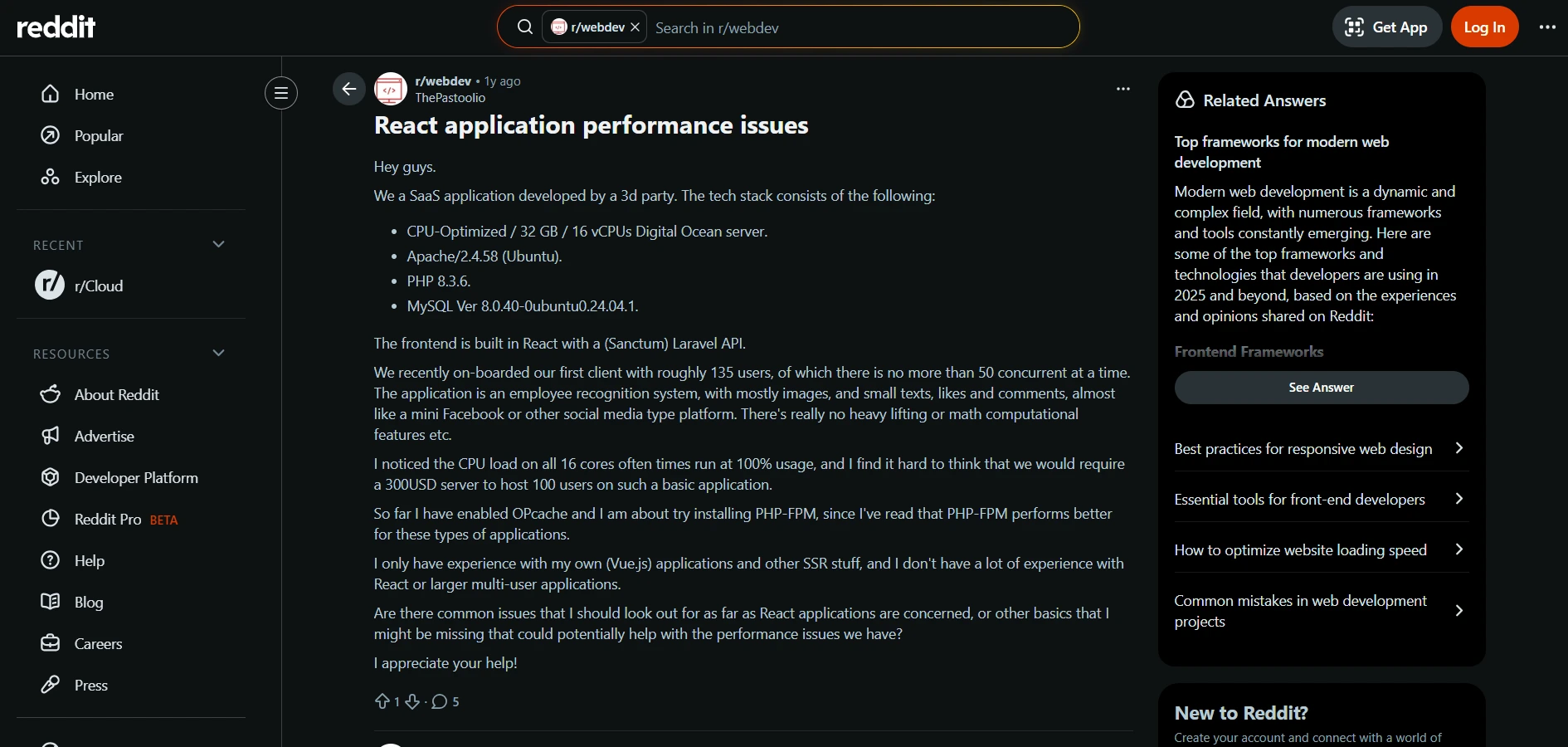
What Are the Performance Complaints That People Are Discussing About?
Here you can see a React frontend SaaS app that notices high CPU load and performance problems.
Source: Reddit
What Does It Show?
- Even React sites can suffer performance setbacks without proper optimization.
- Slow loading and large JavaScript bundles are real bottlenecks.
- Community members actively seek solutions to improve performance.
How React.js Directly Boosts Conversion Rates?
Most businesses think website performance is only about speed. But in reality, speed directly affects user behavior, trust, and conversions.
This is where React.js development makes a real difference. When a website loads fast and responds instantly, users feel confident.
They click more, scroll longer, and complete actions without frustration. React enables this by creating smooth, app-like experiences instead of slow, page-by-page reloads.
Here’s how React improves conversions:
- Faster page loads reduce bounce rates.
- Smooth navigation keeps users engaged.
- Instant UI updates increase interaction.
- Better mobile experience improves checkout and form completion.
This directly improves conversion rate optimization and overall ROI. ReactJs improves how users feel while using your website, and that feeling turns into conversions.
How Our Team Solved This Exact Problem for a Growing Business?
We recently worked with a growing business that was struggling with slow website performance, high bounce rates, and declining conversions.
Their existing frontend was built on a traditional stack that couldn’t meet modern performance expectations.
Our team rebuilt key parts of the frontend using React.js development best practices. We focused on:
- Component-based architecture.
- Code splitting and lazy loading.
- Performance-focused UI rendering.
The Results
- Significantly faster load times.
- Improved user engagement.
- Noticeable increase in conversions.
This project clearly showed how the right React performance optimization strategy can transform both website speed and business results.
Want to Improve ReactJs Website Performance? Contact Us Today!
How Do We Optimize React.js Websites for Speed & Conversions?
We don’t just build React websites, we optimize them for real-world performance and growth. Here’s how we do it:
- Break large codebases into lightweight components.
- Use lazy loading so users only load what they need.
- Optimize Core Web Vitals for Google rankings.
- Ensure mobile-first performance.
- Continuously test and monitor speed.
Our approach to React.js development balances performance & user experience. The goal is simple: Fast websites that rank higher and convert better.
Why Most Businesses Fail at React.js Performance Optimization?
React is powerful, but many businesses still fail to get performance benefits from it. The reason? Poor implementation. Common mistakes we see:
- Loading unnecessary JavaScript libraries.
- No real performance testing before launch.
Without proper planning, React apps can become bloated and slow, hurting rankings & conversions. That’s why React.js performance optimization is just as important as development itself.
How Can We Help You Build a High-Performance React Website?
If your website is slow, struggling to rank, or failing to convert, it’s time to rethink your frontend strategy. We help businesses:
- Build fast, scalable React websites.
- Optimize existing React apps for performance.
- Improve Core Web Vitals.
- Increase engagement and conversions.
Whether you’re launching a new product or improving an existing one, our React.js development services are designed to deliver measurable results.
FAQs
- Yes. When optimized correctly, React can significantly reduce load times, improve responsiveness, and enhance overall user experience.
- Yes, faster load times and smoother UX lead to lower bounce rates and higher conversions.
- Many businesses see 20 to 40% performance improvements, depending on their previous tech stack and optimization strategy.
- If performance, scalability, and conversions are priorities, migrating to React.js can be a strong long-term investment.