One of the most common complaints clients have is this: The timeline sounded great, but delivery got delayed.
Most software delays don’t happen because teams are careless. They happen because timelines are guessed instead of estimated.
We follow a simple rule: We don’t commit fast; we commit correctly.
Explore some of the project estimation best practices you should look for while choosing a partner to build your customized solution.
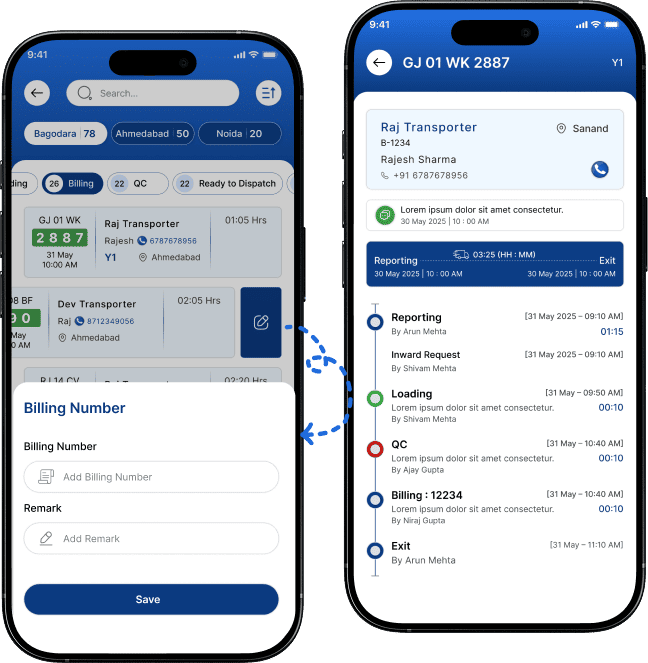
In this blog, we explain our realistic project timeline estimation approach using a real project as an example that we built: Vehicle Monitoring App.
Why Do Most Software Project Timelines Fail?
Most project timelines fail due to planning gaps, not coding speed. Here are some of the common causes:
- Requirements not fully understood.
- Features are estimated as one large block.
- No dependency mapping.
- No buffer for unknowns.
- Ignoring feedback cycles.
- Scope stays hidden as “small changes”.
Realistic project timeline planning focuses on risk visibility & not optimistic promises.
What Do We Check Before Committing to Any Project Timeline?
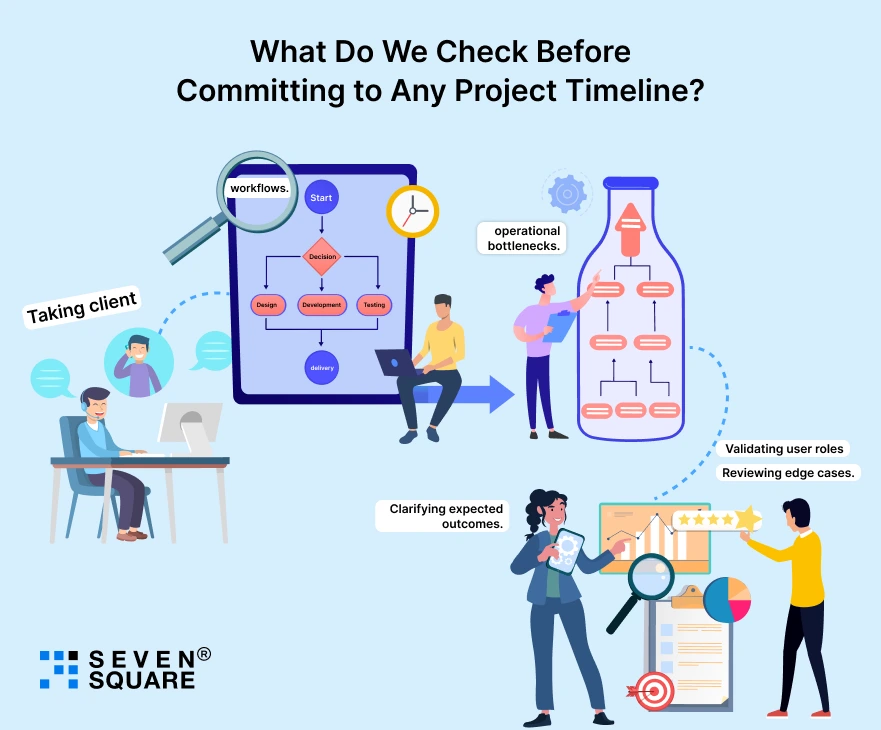
We never give a development timeline before requirement clarity.
In our vehicle monitoring app project, the client was using SAP-based processes that were slow and complex. They wanted a custom application.
Before estimating anything, we spent: 7 to 10 days only on requirement understanding.
We did this by:
- Taking frequent client calls.
- Mapping real workflows.
- Understanding operational bottlenecks.
- Clarifying expected outcomes.
- Validating user roles.
- Reviewing edge cases.
Our team believes that a fast estimate without clarity is only a guess, not a commitment.
Why Do We Estimate Design and Wireframes Before Development Timelines?
Many teams directly estimate development. We don’t.
We first estimate the design and structure. For this project:
- Screen designs were created.
- Navigation flows were mapped.
- Wireframes were prepared.
- User journeys were validated.
We committed to a 30-day timeline for the Client.
We Completed Design & Wireframing within 28 days.
The client approved with only minor changes, which confirmed alignment.
Estimating design first improves software project estimation accuracy and reduces rework risk.
How Do We Break Large Features to Make Timelines More Realistic?
We never estimate a full app as one number. We split it into functional modules.
In this custom app, modules included:
- Vehicle tracking workflows.
- Entry and exit logging.
- Role-based access control.
- Admin dashboards.
- Reporting systems.
- API integrations.
- Data sync logic.
Breaking features down helps:
- Detect risks early.
- Estimate accurately.
- Test properly.
- Avoid timeline overruns.
During our project timeline planning process, we always make sure to follow this step to give a realistic & accurate project timeline.
What Unknown Factors Do We Always Include in Timeline Estimation?
Unknowns are always present in custom app development. We plan for them intentionally.
For this project, we added 10 to 15% buffer time for:
- API issues.
- Third-party integrations.
- Data quality problems.
- Environment setup challenges.
- Unexpected behavior with real data.
Buffers are not laziness; they are realism. This is a core part of project estimation best practices.
How Do Resource Changes Affect Development Timelines?
Most estimates assume the same team works throughout. Real life is different. We consider:
- Developer availability changes.
- Designer replacement if needed.
- Resource shuffling for speed.
- Absence or workload balancing.
Most companies don’t consider these factors while giving the project development timelines.
We always consider these factors because, whether you want to believe it or not, they often come & somehow affect the development cycle.
This adds a realistic 5 to 10% operational risk factor. Ignoring resource variability leads to unrealistic delivery timelines.
How Does Client Availability Impact Project Timelines?
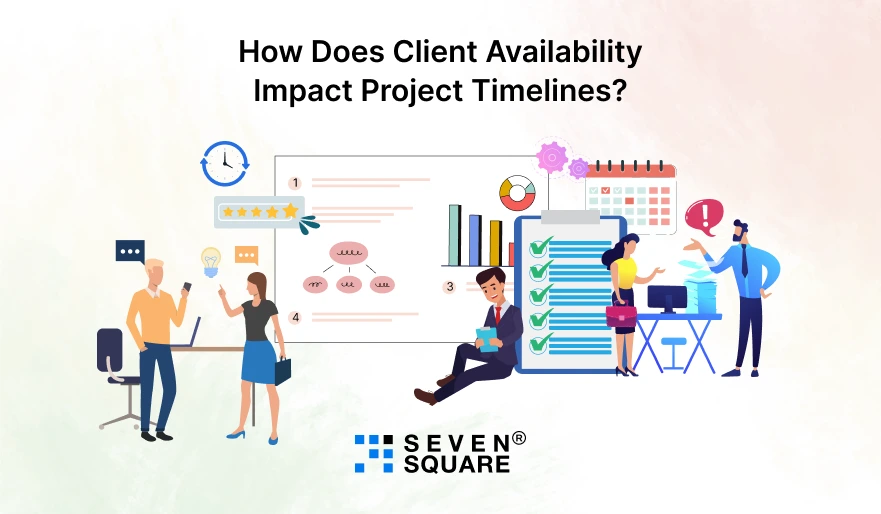
Client-side delays are real and common. These include:
- Approval delays.
- Feedback gaps.
- Clarification of wait times.
- Stakeholder unavailability.
We factor this into project timeline planning because: Dependencies affect timelines more than effort.
Timeline estimates without dependency planning are fragile.
What Timeline Did We Commit vs What Did We Deliver in This Real Project?
After requirement clarity and design approval:
Committed development timeline:10 weeks
Actual delivery: 8 to 9 weeks
Why did earlier delivery happen:
- Requirements were validated.
- Designs were approved early.
- Modules were defined.
- Risks were planned.
- Buffers were included.
Realistic estimation creates space for early delivery. Optimistic estimation creates delay.
How Do We Respond When Clients Ask Us to “Just Give a Date”?
We understand urgency, but we don’t replace clarity with pressure.
Our response is: Let us validate properly and come back with a committed timeline.
Wrong promises cost more than delayed commitments. Accurate commitments build long-term trust.
Want a Realistic Timeline for Your App? Contact Us Now!
How Do We Communicate Timeline Delays Without Damaging Trust?
Even with strong planning, change can happen. Our rule is simple:
- Communicate early.
- Explain the reason.
- Share revised timelines.
- Offer solution paths.
- Avoid silence.
Trust breaks from lack of communication, not from delays.
What Should Clients Look for in a Realistic Timeline Estimate?
Ask your development partner:
- Did they ask deep requirement questions?
- Did they separate design and development timelines?
- Did they discuss risks and unknowns?
- Did they include buffer time?
- Did they talk about dependencies?
- Did they break features into modules?
If not, the estimate may be optimistic, not realistic.
Why Is Accurate Commitment Better Than Early Commitment?
Early commitment feels fast. Accurate commitment feels safe. Accurate timelines:
- Reduce stress.
- Prevent overruns.
- Improve delivery quality.
- Build trust.
- Protect relationships.
We choose sustainability over speed.
What Makes Realistic Project Timeline Estimation Work?
Realistic project timeline estimation works when:
- Requirements are validated.
- Features are broken down.
- Dependencies are mapped.
- Unknowns are planned.
- Buffers are added.
- Communication is continuous.
Our vehicle monitoring app project shows that when planning is realistic, delivery becomes predictable, and sometimes even faster than expected.
FAQs
- Realistic project timeline estimation means calculating delivery time based on validated requirements, task breakdown, dependencies, risks, and buffer time, not guesses or optimistic promises.
- Most software timelines get delayed due to unclear requirements, scope creep, missing dependency planning, third-party integration issues, delayed approvals, and a lack of buffer time in estimation.
- Large features should be broken into small functional modules such as design tasks, development tasks, testing cycles, and feedback loops.
- Module-based estimation improves timeline accuracy.
- Yes. Third-party APIs and integrations often introduce uncertainty due to documentation gaps, performance issues, version changes, and dependency risks, and should always be included in estimation buffers.