Shopify headless commerce separates your store’s frontend from Shopify’s backend, allowing full design freedom, faster performance, and advanced integrations.
It is right for you if:
- Your store is growing fast.
- You need advanced customization.
- Website speed is hurting conversions.
- You sell across multiple channels.
- You want an app-like user experience.
If you run a small store with simple needs, traditional Shopify themes may still work. Shopify headless is a growth booster.
When implemented correctly, it improves speed, scalability, UX flexibility, and conversion rates.
Our team helps brands adopt Shopify headless commerce strategically, only when it drives ROI.
What Is Shopify Headless Commerce?
Shopify headless commerce means using Shopify as the backend (products, checkout, orders, & payments).
While building a completely custom frontend using frameworks like React, Next.js, or Shopify Hydrogen.
How Headless Shopify Works?
- Shopify manages backend operations.
- APIs (like Storefront API) connect the frontend to the backend.
- Developers build a custom UI layer.
- You control performance, layout, personalization, and experience.
Traditional Shopify: Theme-based structure.
Headless Shopify: Custom architecture.
How We Solved a Shopify Headless Commerce Problem?
A fashion ecommerce brand approached us with:
- 4+ second load time.
- High bounce rate.
- Limited design flexibility.
- Conversion stagnation.
They were using traditional Shopify themes.
The Solution
We implemented Shopify headless services:
- Built a custom React frontend.
- Integrated Shopify Storefront API.
- Optimized performance architecture.
- Improved UX flow.
The Results
- 38% faster load speed.
- 26% higher conversions.
- Improved organic rankings.
- Better mobile performance.
The difference wasn’t just visual; it impacted revenue.
Do You Want a Customized Shopify Headless Solution?
What Are the Benefits of Shopify Headless Commerce?
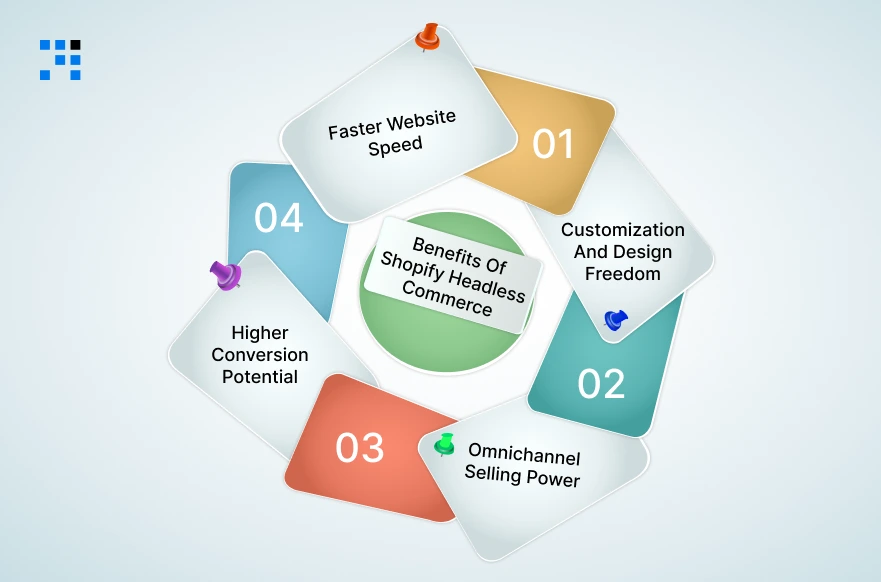
Here you can see some of the main benefits of using Shopify headless architecture:
1. Faster Website Speed
One major reason brands move to headless Shopify is performance.
How does headless Shopify improve online store speed?
- Lightweight frontend frameworks.
- Optimized API calls.
- Better caching control.
- Improved Core Web Vitals.
Speed impacts:
- Bounce rate.
- Conversion rates.
Faster stores consistently outperform slower competitors.
2. Full Customization and Design Freedom
With Shopify headless commerce, you are not limited by theme restrictions. You can:
- Build custom checkout flows.
- Create immersive landing pages.
- Design app-like experiences.
- Implement advanced personalization.
This is why many enterprise retailers explore Shopify headless services.
3. Omnichannel Selling Power
Headless commerce Shopify architecture supports:
- Web storefront.
- Mobile apps.
- Progressive Web Apps (PWA).
- In-store kiosks.
- IoT integrations.
If you’re scaling globally or across platforms, headless is powerful.
4. Higher Conversion Potential
A custom frontend enables:
- Faster browsing.
- Personalized recommendations.
- Better UX journeys.
- Smooth checkout.
Many brands see improvement in:
- Add-to-cart rates.
- Checkout completion.
- Customer retention.
That’s why Shopify headless benefits for conversion rates are widely discussed.
Learn the Importance of Headless Commerce for B2B Businesses.
What Is the Cost of Shopify Headless Commerce?
Shopify headless commerce cost depends on complexity, but it typically requires a higher upfront investment than theme-based stores.
Typical Cost Range
- Mid-level brand: $5,000 to $8,000
- Enterprise-level: $10,000+
Cost factors:
- Custom frontend development.
- API integrations.
- Infrastructure.
- Ongoing maintenance.
ROI Perspective
Shopify headless commerce cost and ROI analysis usually shows benefits when:
- Monthly revenue is strong.
- Traffic volume is high.
- Conversion improvement significantly impacts revenue.
If a 1% conversion increase equals large revenue gains, headless can justify the cost quickly.
What Is the Difference Between Headless Shopify vs Traditional Shopify?
Here you can see the clear comparison between Headless Shopify vs Traditional Shopify:
| Feature | Traditional Shopify | Shopify Headless |
| Frontend | Theme-based | Custom-built |
| Speed | Theme dependent | Optimized |
| Flexibility | Limited | Full control |
| Omnichannel | Basic | Advanced |
| Development Cost | Lower | Higher |
- Traditional Shopify works well for small and mid-sized stores.
- Headless Shopify works best for scaling and enterprise brands.
Why Are Growing Brands Switching to Headless Commerce Shopify?
Brands shift because:
- Themes limit advanced UX ideas.
- Mobile-first shopping demands speed.
- Global expansion needs flexibility.
- Personalization requires control.
Headless commerce Shopify for mobile apps and PWAs is growing fast because users expect app-like performance.
If your competitor launches a blazing-fast custom storefront and you don’t, customers notice.
How to Know If Shopify Headless Commerce Is Right for Your Business?
You likely need Shopify headless commerce if:
- You generate strong revenue.
- You need complex integrations.
- You want advanced UX.
- You plan omnichannel expansion.
- Performance impacts sales.
You likely don’t need it if:
- You are early-stage.
- Your theme performs well.
- The budget is limited.
Knowing what to know before switching to headless Shopify is crucial.
Why Your Competitors Might Already Be Exploring Shopify Headless?

Speed is a competitive advantage. Custom experience is a competitive advantage. Scalability is a competitive advantage.
If your competitors invest in headless Shopify architecture and you remain limited by themes, they can:
- Launch faster campaigns.
- Offer better personalization.
- Improve performance rankings.
Ecommerce is performance-driven. Technology is part of that performance.
How Do We Deliver Shopify Headless Services?
We follow a strategic approach:
Step 1: Readiness Audit
We evaluate:
- Revenue scale.
- Technical complexity.
- UX goals.
- ROI potential.
Step 2: Architecture Planning
We design:
- Headless commerce Shopify architecture.
- API strategy.
- Frontend framework selection.
Step 3: Development & Optimization
We deliver:
- Custom frontend development.
- API integrations.
- Performance optimization.
Step 4: Ongoing Support
We help you:
- Scale globally.
- Optimize continuously.
- Maintain high performance.
Is Shopify Headless Commerce Right for You?
Shopify headless commerce is right for ecommerce brands that prioritize speed, customization, scalability, and omnichannel growth.
It is not mandatory for every store. But for scaling brands, it can be transformational.
If performance, UX control, and long-term scalability matter, headless Shopify deserves serious consideration.
FAQs
- Shopify headless commerce means using Shopify as the backend while building a completely custom frontend using modern frameworks like React or Hydrogen.
- The backend manages products, checkout, and payments, while the frontend controls design, speed, and user experience.
- Headless Shopify improves speed by using lightweight frontend frameworks, optimized API calls, and better caching control.
- This reduces load time, enhances Core Web Vitals, and improves user experience and conversion rates.
- Shopify headless is usually better for growing or enterprise brands.
- Small businesses using simple themes may not need it unless speed, customization, or advanced integrations directly impact revenue and long-term scalability goals.
- Headless commerce Shopify architecture commonly uses React, Next.js, or Shopify Hydrogen for frontend development.
- Shopify’s Storefront API connects the custom frontend to the backend for managing products, checkout, and customer data.