Not sure which tech stack to use for your startup?
Learn how to choose the best web app tech stack based on your goals, budget, and scalability needs in 2026.
Choosing the right tech stack for startups is one of the most critical decisions you’ll make in 2026.
It directly impacts how fast you launch, how much you spend, and how well your product scales as users grow. For every web app, you need a different tech stack.
The best tech stack for your startup depends on your product type, budget, team skills, and how quickly you need to go to market.
In this blog, you’ll learn how to choose the best tech stack for web development based on real-world startup needs, so you can build faster, scale smarter, & avoid costly mistakes.
Why Choosing the Right Tech Stack Matters in 2026?
Selecting the right startup tech stack is a business survival strategy. Startups work in a fast-moving environment where speed and scalability define success.
If your tech stack for startups is not optimized, you risk falling behind competitors even before your product gains traction. Here’s why it matters more than ever:
- Faster competition means faster launches: Startups are expected to build & launch MVPs in weeks. The right web app tech stack helps you move quickly.
- AI integration is becoming standard: Modern apps are AI-powered experiences. Choosing a modern web development tech stack that supports AI is crucial.
- Poor tech choices lead to scaling issues: Many startups struggle when user growth increases because their stack wasn’t built for scalability.
- Higher long-term costs: A bad startup software development stack can increase maintenance, infrastructure, and hiring costs.
- Investor expectations are higher: Investors now evaluate whether your product is built on a scalable tech stack for startups before funding.
Insight: Many startups fail not because of bad ideas, but because of poor technical decisions early on, especially choosing the wrong web application tech stack.
How Do We Help to Choose the Right Tech Stack for Your Startup?
Still wondering “how to choose the right tech stack for a startup?” Our team is here to help:
- Define Your Product Type: Understand if you’re building SaaS, ecommerce, or an AI app.
- Decide MVP Scope: Focus on essential features first.
- Evaluate Team Skills: Choose technologies your team already knows.
- Choose a Scalable Backend: Pick a backend that supports future growth.
- Select the Right Frontend Framework: React is often the safest choice for most startups.
- Plan DevOps Early: Set up deployment, hosting, and scaling from the start.
This approach helps you build a startup software development stack that is both efficient and future-ready.
Need help choosing your startup tech stack?
Common Mistakes Startups Make While Choosing a Tech Stack
Most founders don’t realize how much impact the wrong tech stack for web development can have until it’s too late.
Here are the most common mistakes startups make:
1. Choosing trendy tech instead of the right tech
- Just because a framework is popular doesn’t mean it’s right for your product.
- Many founders blindly follow trends instead of choosing the best tech stack for a startup web app based on their needs.
2. Ignoring scalability in the early stage
- Startups often focus only on MVP speed and ignore future growth. This leads to rebuilding the entire system later, increasing costs.
3. Overengineering the MVP
- Adding too many technologies early slows down development. A simple, focused tech stack for MVP development is always better.
4. Not considering developer availability
- Some technologies are powerful but hard to hire for. Choosing a widely used full stack development technology reduces hiring challenges.
5. Getting locked into expensive ecosystems
- Certain platforms and tools may seem easy at first, but become costly as you scale.
- Always evaluate long-term costs when choosing a startup tech stack in 2026.
Avoiding these mistakes can save months of development time and thousands in cost.
What Are the Key Factors to Consider Before Choosing a Tech Stack?
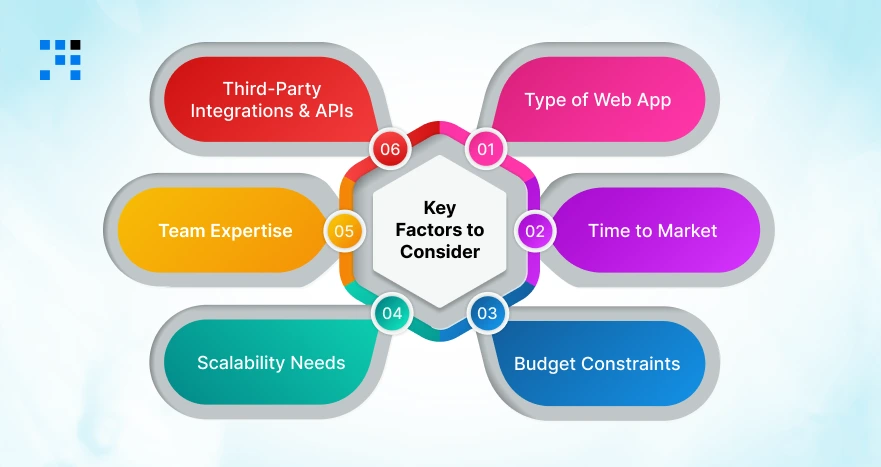
If you’re wondering “how to choose the right tech stack for a startup?” This is where you start. These factors will help you make the right decision.
1. Type of Web App
Your product defines your web app tech stack.
- SaaS platforms need a scalable backend + strong database.
- Ecommerce apps need performance + integrations.
- Marketplaces require real-time features + security.
- AI-based apps need Python + AI frameworks.
The tech stack for SaaS startups will be very different from a tech stack for ecommerce web apps.
2. Time to Market (MVP vs Full Product)
If you’re building an MVP, focus on speed.
- Use a simple and fast tech stack for MVP development.
- Avoid complex architectures early.
For long-term products, choose a scalable tech stack for startups that can grow with your business.
3. Budget Constraints
Budget plays a huge role in choosing a startup tech stack.
- Open-source technologies reduce cost.
- Cloud services can scale, but may increase expenses.
- Hiring costs vary based on technology.
A low-cost tech stack for startups should balance affordability and performance.
4. Scalability Needs
Think about your future growth.
- Will your app handle thousands or millions of users?
- Do you need real-time features?
Choosing the right scalable tech stack for startups early prevents expensive rebuilds later.
5. Team Expertise
Your team’s skills should guide your decision.
- If your team knows React, then use it.
- If your backend team prefers Node.js or Django, then match with that.
The best tech stack for startups is one your team can build and maintain efficiently.
6. Third-Party Integrations & APIs
Modern apps rely heavily on integrations:
- Payment gateways.
- AI APIs.
- Analytics tools.
Choose a web application tech stack that easily supports integrations and APIs.
Understanding a Modern Web App Tech Stack (2026)
To choose the best tech stack for web development, you need to understand what a modern stack looks like.
A web app tech stack is made up of multiple layers working together.
Core Layers of a Modern Tech Stack
| Layer | Purpose | Popular Technologies |
| Frontend (UI/UX) | What users see and interact with | React, Vue, Angular |
| Backend (Logic) | Handles business logic and APIs | Node.js, Django, Spring Boot |
| Database | Stores and manages data | PostgreSQL, MongoDB |
| DevOps & Hosting | Deployment and scaling | AWS, Vercel, Docker |
| AI Layer (2026 Trend) | Adds intelligence to apps | OpenAI APIs, Vector Databases |
How Do These Layers Work Together?
- The frontend interacts with users.
- The backend processes requests.
- The database stores data.
- The DevOps layer ensures smooth deployment.
- The AI layer powers smart features like recommendations and chatbots.
Why Does This Matters for Startups?
A well-structured startup software development stack ensures:
- Faster development.
- Better performance.
- Easy scalability.
- Lower long-term costs.
In 2026, the most successful startups are using a modern web development tech stack that combines performance, scalability, and AI capabilities.
Best Tech Stacks for Startups in 2026
Choosing the best tech stack for startups depends on what you’re building. Here are the most effective startup tech stacks in 2026 based on real use cases.
1. Best Tech Stack for MVP Development
If your goal is to launch fast, test your idea, and iterate quickly, you need a tech stack for MVP development that is simple and flexible.
Recommended Stack: MERN / Next.js stack
- Frontend: React or Next.js
- Backend: Node.js
- Database: MongoDB
Why does this work?
- Fast development and deployment.
- Large developer community.
- Low development cost.
- Easy to scale later.
This is one of the best tech stacks for startup web apps when speed and flexibility matter the most.
2. Best Tech Stack for Scalable SaaS Startups
SaaS products need a scalable tech stack for startups that can handle growing users and data.
Recommended Stack: React + Node.js + PostgreSQL
- Frontend: React
- Backend: Node.js
- Database: PostgreSQL
Why does this work?
- Strong performance for high-traffic apps.
- Structured database for complex data.
- Easy integration with APIs.
Microservices Advantage
As your SaaS grows, you can break your backend into a microservices architecture, allowing:
- Independent scaling.
- Faster updates.
- Better system reliability.
This makes it one of the best tech stacks for SaaS startups in 2026.
3. Best Tech Stack for Ecommerce Web Apps
Ecommerce startups require speed, performance, and smooth integrations.
Recommended Stack: Headless Commerce + Next.js + Shopify APIs
- Frontend: Next.js
- Backend: Headless CMS / APIs
- Platform: Shopify APIs
Why does this work?
- Faster page load speeds.
- Flexible frontend customization.
- Easy integration with payment and inventory systems.
This is the ideal tech stack for ecommerce web apps that want both performance and flexibility.
4. Best Tech Stack for AI-Based Startups
AI startups need a modern web development tech stack that supports machine learning and data processing.
Recommended Stack: Python + FastAPI + React + AI APIs
- Backend: Python (FastAPI)
- Frontend: React
- AI Layer: OpenAI APIs / ML models
Why does this work?
- Python is the standard for AI development.
- FastAPI enables high-performance APIs.
- Easy integration with AI tools.
This is the best tech stack for AI-based web apps in 2026.
5. Low-Cost Tech Stack for Early-Stage Startups
If you’re working with limited resources, you need a low-cost tech stack for startups.
Recommended Stack: Firebase + React / Vue
- Frontend: React or Vue
- Backend: Firebase (BaaS)
Why does this work?
- No need to manage servers.
- Faster development.
- Lower infrastructure cost.
This is perfect for founders looking for an affordable tech stack for startups without compromising speed.
Not sure which tech stack fits your idea?
Tech Stack Selection Based on Startup Stage
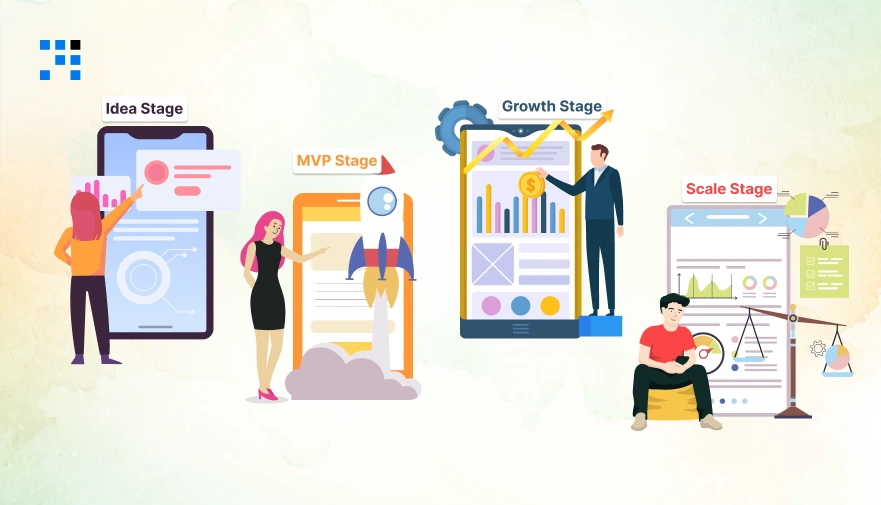
One of the smartest ways to choose the right tech stack for startups is based on your growth stage.
Idea Stage
- Use no-code or low-code tools.
- Focus on validating your idea.
Keep your startup tech stack simple and cost-effective.
MVP Stage
- Use a fast and flexible tech stack for MVP development.
- Prioritize speed over perfection.
MERN or Firebase-based stacks work best here.
Growth Stage
- Shift to a scalable tech stack for startups.
- Optimize performance and architecture.
Introduce better databases and structured backend systems.
Scale Stage
- Move to microservices + cloud-native architecture.
- Focus on high availability and performance.
This is where advanced web application tech stack decisions matter most.
Make the Right Tech Stack Choice for Long-Term Success
There is no perfect tech stack for startups, only the one that fits your goals. To make the right decision, focus on:
- Speed: For launching your MVP quickly.
- Scalability: For handling future growth.
- Cost: For managing early-stage budgets.
The right web application tech stack can accelerate your startup’s success, while the wrong one can slow everything down.
FAQs
- The best tech stack for startups depends on your use case.
- MERN is great for MVPs, while React + Node.js + PostgreSQL works well for scalable SaaS apps.
- A tech stack for MVP development should be fast and cost-effective.
- MERN or Firebase-based stacks are commonly used.
- To choose the right web app tech stack, consider your product type, budget, scalability needs, and team expertise.
- Yes, MERN is one of the best tech stacks for startup web apps due to its flexibility, speed, and large developer community.
- A scalable tech stack for startups usually includes React, Node.js, and PostgreSQL with a microservices architecture.