Choosing between TypeScript vs JavaScript directly impacts your product’s cost, scalability, and long-term success in modern web development.
Projects built without proper planning often face frequent crashes, unclear code, and expensive fixes later.
This is where most businesses and startups get confused between JavaScript and TypeScript.
JavaScript feels faster to start, while TypeScript promises better structure. But which one is actually better for your web app?
In this blog, we’ll help you understand:
- The real differences between TypeScript and JavaScript.
- Which one suits startups, enterprises, and long-term products.
What is JavaScript & Why is It Used For Web Development?
JavaScript is the backbone of the web. From small websites to complex platforms, it’s everywhere. One of the biggest JavaScript advantages is its simplicity.
It runs directly in the browser and works smoothly for frontend development. Developers can quickly build features, test ideas, and launch products faster.
Dynamic Typing
- JavaScript uses dynamic typing, which means you don’t need to define data types in advance.
- This gives flexibility and speed during development. However, it can also lead to unexpected errors if not managed carefully.
When JavaScript Is Still the Smartest Choice?
We often recommend JavaScript when:
- You’re building small projects or MVPs.
- Speed matters more than strict structure.
- Teams want quick results without a learning curve.
JavaScript remains a powerful choice when used correctly.
What Is TypeScript and Why So Many Teams Are Switching to It?
TypeScript is essentially JavaScript with superpowers. It adds rules and structure on top of JavaScript, making code easier to manage.
The biggest TypeScript benefits come from static typing, where you define data types in advance. This helps catch errors early, even before the code runs.
How Static Typing Improves Code Quality?
Static typing improves readability, reduces runtime bugs, & makes collaboration easier.
Why Do Enterprise Teams Prefer TypeScript?
We recommend TypeScript for scalable web applications because it:
- Improves long-term maintainability.
- Reduces costly production bugs.
- Works perfectly for large and complex systems.
This is why many enterprise teams are switching to TypeScript.
TypeScript vs JavaScript: Core Differences That Actually Matter
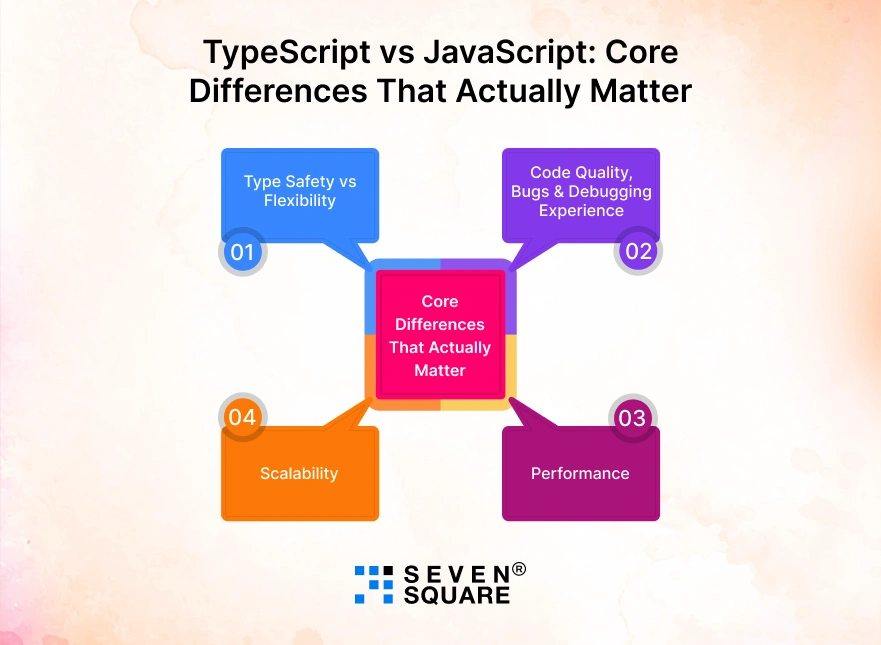
The difference between TypeScript and JavaScript is about structure vs flexibility, safety vs speed, and short-term vs long-term thinking.
1. Type Safety vs Flexibility: Static vs Dynamic Typing
One of the biggest differences in the TypeScript vs JavaScript comparison is how they handle data.
JavaScript uses dynamic typing. This gives flexibility & faster coding at the start. It also increases the risk of errors.
TypeScript focuses on type safety using static typing. You define what type of data a variable can hold, and the system checks it before the code runs.
From Our experience:
- Dynamic typing is great for quick ideas and MVPs.
- Type safety is essential for long-term and business-critical applications.
Static typing helps developers catch problems early, saving time and cost.
2. Code Quality, Bugs & Debugging Experience
Code quality directly affects maintenance, performance, and user experience.
With JavaScript, errors often appear during runtime. This means bugs can slip into production, increasing debugging time. Over time, this makes it harder to maintain clean code.
TypeScript helps reduce bugs by catching errors during development. This leads to a maintainable codebase that is easier to understand and improve.
Why do we prefer TypeScript for large apps?
- Cleaner and more readable code.
- Easier debugging and faster fixes.
- Less risk of breaking existing features.
Better code quality always means lower maintenance costs.
3. Performance: Is TypeScript Faster Than JavaScript?
This is one of the most common questions in the JavaScript vs TypeScript performance debate. The simple answer: Performance is the same.
TypeScript compiles into JavaScript before running in the browser or Node.js. This means TypeScript does not slow down performance.
What actually improves performance?
- Better code structure.
- Fewer runtime errors.
- More predictable behavior.
We focus on performance optimization through clean architecture.
4. Scalability: Which One Handles Large Projects Better?
When it comes to growth, TypeScript vs JavaScript scalability becomes a deciding factor.
JavaScript works well for small projects, but as the codebase grows, it becomes harder to manage.
New developers struggle to understand logic, and changes can break existing features.
TypeScript is built for scale. It enforces structure, improves documentation, and makes teamwork easier.
Why does TypeScript scale better?
- Clear data contracts.
- Easier collaboration in large teams.
- Strong support for enterprise and long-term projects.
For large projects, TypeScript offers stability, predictability, and confidence.
Learn more about the Comparison of ExpressJs vs NestJs.
TypeScript vs JavaScript for Frontend Development
When it comes to frontend frameworks, both languages perform well, but the experience differs.
JavaScript vs TypeScript for React
- For React apps, JavaScript is easier to start with.
- However, TypeScript provides better component structure, cleaner props handling, and fewer runtime issues as the app grows.
Angular and TypeScript: A Perfect Match
- Angular is built with TypeScript in mind.
- This combination offers strong typing, better tooling, and enterprise-level stability.
Developer Productivity Comparison
- JavaScript feels faster initially.
- TypeScript feels safer and cleaner over time.
We choose based on project size and future scalability.
TypeScript vs JavaScript for Backend Development
In backend development, especially with Node.js, the difference becomes more noticeable.
Node.js with JavaScript vs TypeScript
- JavaScript works well for lightweight APIs.
- But as backend logic grows, TypeScript helps manage complexity with clearer contracts and error handling.
API Stability and Long-Term Maintenance
- TypeScript improves API stability by implementing consistent data structures.
- This reduces breaking changes and simplifies long-term maintenance.
Which Is Better for Scalable Backend Systems?
For scalable backend systems, TypeScript is often the better choice due to cleaner architecture and reduced bugs.
When Should You Choose JavaScript Over TypeScript?
Knowing when to use JavaScript is important. JavaScript is perfect for:
- Small projects and MVPs.
- Rapid prototyping.
- Teams with limited TypeScript experience.
If speed and simplicity matter more than long-term structure, JavaScript is a smart choice.
When Is TypeScript the Better Choice for Your Web App?
TypeScript helps to future-proof your product. TypeScript is best for:
- Large projects and enterprise applications.
- Long-term products with frequent updates.
- Teams focused on scalability and clean architecture.
For complex systems, TypeScript provides clarity and confidence.
Comparison Of TypeScript vs JavaScript
| Feature | JavaScript | TypeScript |
|---|---|---|
| Language Type | Dynamic & loosely typed language. | Superset of JavaScript with static typing. |
| Ease of Learning | Very easy for beginners | Slight learning curve, especially for beginners. |
| Syntax | Simple, flexible, and less strict | More structured and strict syntax. |
| Error Detection | Errors often found during runtime. | Errors caught early during development. |
| Code Quality | Can become messy in large projects | Cleaner, more readable, and maintainable code |
| Scalability | Limited for large and complex applications | Excellent for scalable web applications |
| Performance | Fast execution in browsers and Node.js | Same runtime performance as JavaScript |
| Frontend Development | Great for quick UI and small apps | Ideal for large frontend frameworks like Angular |
| React Development | Easy to start with for React apps | Better for long-term React projects |
| Backend Development | Works well with Node.js | Better structure for complex backend systems |
| API Stability | APIs can break easily if not managed | Strong API contracts improve stability |
| Debugging Experience | Debugging can be time-consuming | Easier debugging with type safety |
| Tooling & IDE Support | Good support in modern IDEs | Excellent auto-completion and suggestions |
| Best Use Cases | Small projects, MVPs, quick launches | Large projects, long-term products |
How Do We Provide Top-Notch TypeScript & JavaScript Development Services?
- We help clients choose between TypeScript vs JavaScript based on scalability, performance, and long-term business goals.
- Our team builds modern web development solutions using JavaScript for speed and TypeScript for structure and reliability.
- We design scalable web applications by applying TypeScript’s static typing to reduce bugs and improve code quality.
- For startups, we balance JavaScript advantages with future-ready TypeScript planning to avoid costly rewrites later.
- Our developers ensure clean, maintainable codebases that support growth, updates, and easy team collaboration.
Want a TypeScript or JavaScript Solution? Contact Us Today!
TypeScript or JavaScript: Which One Should You Pick?
So, which is better, TypeScript or JavaScript?
Our Suggestion:
- Choose JavaScript for speed, MVPs, and simple apps.
- Choose TypeScript for scalability, enterprise systems, and long-term success.
Quick Decision Checklist:
- Small app? JavaScript.
- Growing product? TypeScript.
- Large team & complex logic? TypeScript.
FAQs
- Yes, especially for large and scalable web applications.
- Yes, JavaScript knowledge makes TypeScript easier to learn.
- Yes. Static typing helps catch errors before runtime.
- No. TypeScript compiles to JavaScript, so performance is the same.
- Not always. JavaScript may be faster for small or short-term projects.