Choosing between TypeScript vs Python has become one of the most important decisions for different types of businesses.
With the growth of AI applications, backend development, automation tools, & enterprise-scale platforms, businesses want to know which language is better for their next project.
We work with both TypeScript and Python every day while building scalable apps, AI-driven dashboards, automation systems, real-time web apps, & enterprise backends.
We see one clear trend: Businesses want the right technology that ensures long-term growth, security, scalability, and fast development.
People are searching for “TypeScript vs Python: which should I choose?”
In this blog, we have shown in simple language so you can make the right decision for your next project.
What Makes TypeScript and Python So Popular?
When we talk about TypeScript vs Python popularity, both languages lead for different reasons, and both have massive global adoption.
Why TypeScript Is Popular?
- Strong support for large, scalable web apps.
- Adopted by companies like Microsoft, Slack, Airbnb, & Shopify.
- Perfect fit for modern frontend + backend (full-stack) systems.
- Close integration with JavaScript gives a huge ecosystem advantage.
Why Python Is Popular?
- The #1 language for AI, machine learning, & data science.
- Used by Google, Meta, Netflix, Spotify, & NASA.
- Simple syntax makes it easy for beginners and fast prototyping.
- Massive ecosystem of ML libraries like TensorFlow, PyTorch, & Pandas.
Python ranks in the top 3 most used languages globally. TypeScript is one of the fastest-growing languages for web development.
More than 62% of developers prefer TypeScript for large enterprise applications. Python is the core programming language behind 80% of modern AI/ML projects.
What Are the Core Differences Between TypeScript and Python?
When comparing TypeScript vs Python syntax differences, the biggest variations come from typing, structure, and flexibility.
| Feature | TypeScript | Python |
| Typing | Static typing → fewer errors | Dynamic typing → more flexible |
| Speed | Faster in web apps | Slower but excellent for AI |
| Ecosystem | Best for web & full-stack | Best for AI & automation. |
| Learning Curve | Medium | Easy |
| Use Cases | Web apps & enterprise systems. | AI, ML, & data apps. |
- Typing System: TypeScript uses static typing, which means fewer bugs & better scalability. Python uses dynamic typing, which makes it easier to write quick code.
- Speed: TypeScript (built on JavaScript) performs better in large web apps. Python can be slower, but it shines in heavy AI/ML workloads.
- Flexibility: Python wins in flexibility and rapid prototyping. TypeScript wins in maintainability.
- Ecosystem: TypeScript has strong frameworks for scalable apps. Python dominates AI, ML, data analysis, and automation.
Python Vs TypeScript: Which Is Faster for Real Projects?
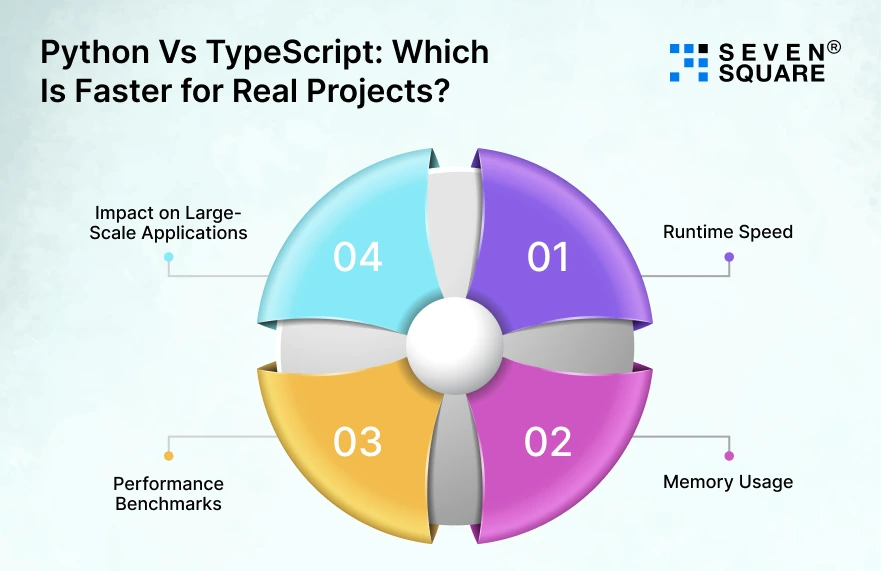
When comparing TypeScript vs Python performance, the results can be different based on the type of application.
1. Runtime Speed
- TypeScript (JavaScript V8 engine) is faster for APIs, web apps, microservices, and real-time dashboards.
- Python is slower in raw execution but extremely fast in AI tasks because of optimized C-based libraries.
2. Memory Usage
- TypeScript uses memory efficiently in large concurrent applications.
- Python uses more memory, especially in heavy multi-threading or high-traffic APIs.
3. Performance Benchmarks
- TypeScript apps handle more requests per second than Python in backend APIs.
- Python performs 10x faster in AI/ML model training due to NumPy, Pandas, and TensorFlow.
4. Impact on Large-Scale Applications
If your business needs:
- High-speed APIs.
- Real-time dashboards
- Concurrent users.
TypeScript is better.
If your business needs:
- AI.
- ML model training.
- Automation.
- Complex data workflows.
Python is the clear winner.
We often combine both: TypeScript for the product and Python for AI automation, so that you can have the best performance and cost efficiency.
Explore the Comparison Between TypeScript vs JavaScript.
TypeScript vs Python for Web Development: Who Wins?
Here you can see the comparison of TypeScript vs Python for web development.
TypeScript Web Frameworks
- NestJS: Enterprise-level backend framework.
- ExpressJS: Lightweight and fast.
- Next.js (JavaScript/TS): Used for high-performance full-stack apps.
TypeScript frameworks are built for modern, scalable, production-ready web apps.
Python Web Frameworks
- Django: Secure, stable, & all-in-one framework.
- FastAPI: Super-fast & perfect for APIs.
- Flask: Lightweight and flexible.
Python is a great choice for AI-backed web applications, dashboards, automation tools, and data portals.
Who Wins?
- TypeScript wins if you need a scalable backend, microservices, real-time features, & full-stack compatibility.
- Python wins if you need AI-driven features, automation workflows, ML-backed recommendation engines, & data-heavy dashboards.
We analyze your business model, performance needs, and long-term scalability requirements to suggest the perfect fit.
AI & Machine Learning: Can TypeScript Compete With Python?
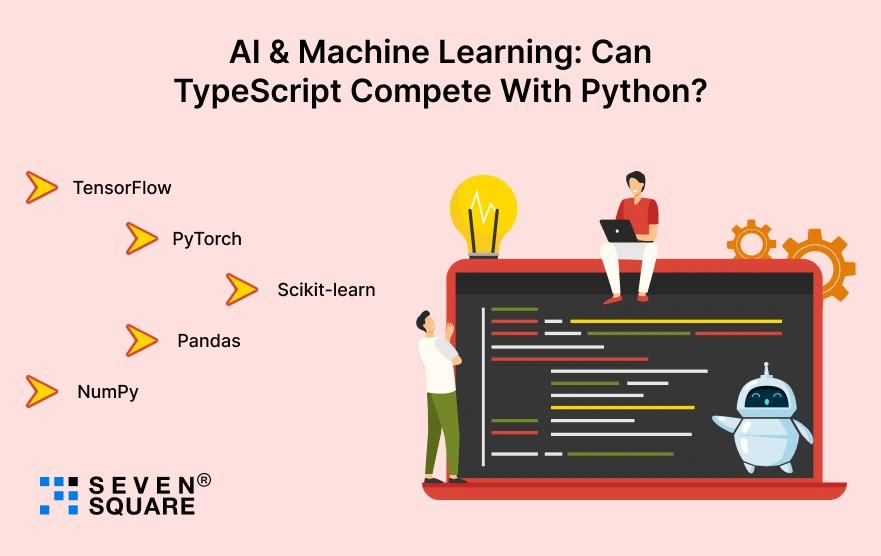
When it comes to TypeScript vs Python for AI, there is a clear winner, and it’s Python.
Python is still the backbone of machine learning, deep learning, and data science because of powerful ML libraries like:
- TensorFlow
- PyTorch
- Scikit-learn
- Pandas
- NumPy
Python has decades of community support and one of the strongest ecosystems for AI development.
But where does TypeScript fit in AI?
TypeScript may not be the best choice for machine learning models, but it plays an important role in:
- AI dashboards.
- ML model monitoring tools.
- Frontend AI integrations.
- Real-time visualization panels.
- AI-based SaaS platforms.
We often use Python to build the core ML engine and TypeScript to deliver fast, interactive AI dashboards or real-time AI output UIs.
Comparison of TypeScript vs Python in Table Form
| Category | TypeScript | Python | What We Recommend |
| Main Use Case | Best for large-scale web apps, enterprise apps, frontend + backend development | Best for AI/ML, automation, data analytics, rapid prototypes | Choose TypeScript for scalable apps, Python for AI-powered solutions |
| Learning Curve | Moderate; requires understanding of JavaScript + TypeScript types | Easy; very beginner-friendly and widely used in education, AI | Python wins for simplicity; TS wins for code reliability |
| Performance (Speed) | Faster for web development, shorter response times in backend APIs | Slightly slower for high-performance web apps, but excellent for AI workloads | TypeScript for speed, Python for computation |
| Development Speed | Slightly slower due to strict typing, but reduces bugs | Very fast development; minimal code required | Python for faster MVPs, TS for stable long-term apps |
| Scalability | Extremely scalable with strong typing, excellent for enterprise systems | Scalable but requires additional frameworks & architecture planning | TypeScript for long-term growth, Python for data-heavy systems |
| Ecosystem & Libraries | Rich ecosystem for web, mobile, cloud apps | Huge ecosystem for AI, ML, data science, automation | Depends on project: TS for products, Python for AI |
| Community Support | Growing fast due to the popularity of Node.js & frontend frameworks | Very large community, especially in AI & research | Both strong, but Python has a longer history |
| Error Handling & Code Safety | Excellent due to static typing; reduces production errors | Dynamic typing can cause runtime errors if not handled carefully | Choose TS if you want fewer critical bugs |
| Total Project Cost | Lower long-term cost due to cleaner, safer code | Lower for prototypes, higher for production-level AI projects | TS for budget-controlled scaling, Python for innovation |
| Popular Frameworks | Next.js, Angular, NestJS, Express | Django, Flask, FastAPI, TensorFlow, PyTorch | We supports both ecosystems |
| Best For | SaaS products, dashboards, marketplaces, CRMs, enterprise apps | AI apps, automation tools, data platforms, research tools | Depends on your project goals |
Which Helps Teams Build Faster?
When comparing TypeScript vs Python developer productivity, both languages offer strong benefits but in different ways.
Python Productivity
Python is known for being one of the easiest languages to learn. Its simple syntax and flexibility help teams:
- Build prototypes faster.
- Automate tasks easily.
- Write less code with more output.
Python is ideal when speed of development is more important than strict structure.
TypeScript Productivity
TypeScript boosts productivity for large teams by:
- Providing static typing for fewer bugs.
- Improving code maintainability.
- Offering strong tooling support in VS Code.
- Supporting modern debugging and testing workflows.
TypeScript is ideal when applications grow large and require long-term maintenance.
We choose the language that gives your developers maximum productivity without increasing development cost.
How Can We Help You Choose Between TypeScript and Python?
Our experience across hundreds of projects has shown that choosing the right language can reduce development time, cut costs, and boost performance.
- We analyze your long-term scalability needs.
- We study your industry requirements.
- We recommend the best tech stack for your business.
- We build systems that are future-proof and easy to maintain.
- We support both TypeScript and Python across full-stack development.
How Do We Help You Choose?
- If your app needs scalability, high traffic, & real-time features, we suggest TypeScript.
- If your project needs AI, ML, data engineering, or automation, we suggest Python.
Want a Customized Solution for TypeScript & Python? Contact Us Today!
Which Language Delivers the Best ROI?
Both TypeScript and Python are powerful, but the best choice depends on your project goals:
- Choose TypeScript if you need scalable web apps, microservices, or enterprise dashboards.
- Choose Python if you need AI/ML apps, automation workflows, or data engineering tools.
We help businesses choose the right language to maximize performance, reduce cost, and deliver the best ROI.
FAQs
- Both are great, but TypeScript is better for scalable web apps, while Python wins in AI and ML.
- TypeScript is better for high-speed backend APIs; Python is better for data and AI-driven backends.
- Python is the top choice because of TensorFlow, PyTorch, and strong AI ecosystems.
- Yes, TypeScript offers better security due to static typing and early error detection.
- TypeScript scales better for real-time & high-traffic applications.