If your order management system cannot automate workflows, sync inventory in real time,
integrate with ERP/CRM, and scale across warehouses, it is limiting your business growth.
A modern order management software should:
- Automate order routing.
- Reduce fulfillment errors.
- Provide real-time inventory visibility.
- Integrate with ERP, CRM, accounting, and logistics.
- Handle 3x growth without breaking.
If it doesn’t, your growth is being slowed by operations.
Here in this blog, you will learn the importance of Order Fulfillment Software and which type of features an
Order Processing System should have.
What Happens When Your Order Management System Stops Scaling?
When your order management system fails to scale, growth creates chaos instead of profit. Many businesses mistake
rising revenue for operational success. But internally:
- Teams rely on manual workarounds.
- Warehouses struggle with coordination.
- Customer complaints increase.
- Refunds rise.
- Reporting becomes inaccurate.
This is operational stress. Here’s the example:
An ecommerce brand processing 2,000 orders/day manually might survive. At 8,000 orders/day, the
same order processing system starts producing:
- 4 to 6% fulfillment errors.
- Delayed dispatch.
- Inventory mismatches.
- Customer churn.
The issue is infrastructure.
What Are the Signs Your Order Management Software Is Outdated?
Your order management software is outdated if:
- Order volume increases, but efficiency drops.
- Inventory is not synced in real time.
- You cannot support multi-warehouse operations.
- You manually assign orders.
- Your system crashes during peak sales.
- Returns are increasing due to wrong shipments.
Older order management programs were built for:
- Single warehouse.
- Single sales channel.
- Limited automation.
- Basic reporting.
Today’s businesses operate:
- Omnichannel (Amazon, Shopify, D2C, B2B).
- Multi-location.
- International shipping.
- Subscription models.
Your old system simply wasn’t designed for this scale.
What Is the Process We Follow While Creating an Order Management System?
We specialize in designing:
- Custom order management systems.
- Cloud-based order management software.
- Automation-driven order processing systems.
- Intelligent order fulfillment software.
Our Process:
Step 1: OMS Growth Audit
We evaluate:
- Workflow bottlenecks.
- Integration gaps.
- Manual dependency.
- Scalability risks.
Step 2: Architecture Blueprint
We design:
- Automation-first logic.
- ERP & CRM integrations.
- Multi-warehouse support.
- Real-time data visibility.
Step 3: Implementation & Optimization
We deploy scalable infrastructure built to support 3x to 5x growth.
Do You Want a Customized Order Management System?
Why Does a Weak Order Processing System Lead to Lost Revenue?
A poor order processing system quietly drains profit through inefficiency.
- Delayed fulfillment reduces repeat purchases.
- Incorrect shipments increase returns.
- Manual operations increase labor costs.
- Inventory inaccuracies cause lost sales.
Poor order fulfillment software also impacts:
- Customer lifetime value.
- Brand trust.
- Operational morale.
- Expansion readiness.
Small inefficiencies compound into large revenue loss.
What Features Should a Growth-Ready Order Management System Have?
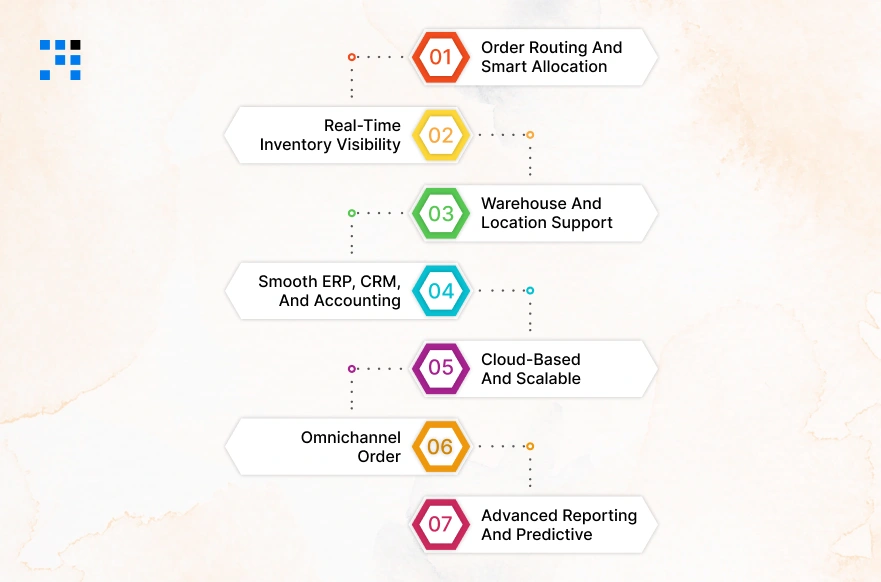
A growth-ready order management system must be automated, integrated, cloud-based, and built to scale without
breaking under pressure.
If your order management software cannot handle higher order volumes, multiple sales channels, and real-time data
syncing, it will limit your business growth.
Here are the must-have features.
1. Automated Order Routing and Smart Allocation
Your order processing system should automatically decide:
- Which warehouse will fulfill the order?
- Which courier to assign?
- How to split orders if items are in different locations?
Why this matters: Manual routing causes delays and errors.
An automated order fulfillment software reduces human mistakes and speeds up shipping. Automation is a basic
infrastructure.
2. Real-Time Inventory Visibility Across All Channels
A modern order management program must show:
- Live stock levels.
- Inventory across multiple warehouses.
- Stock availability across Amazon, Shopify, website, and B2B portal.
Without real-time syncing:
- Customers order out-of-stock products.
- Orders get cancelled.
- Refunds increase.
This directly affects customer trust and revenue. A strong order management system prevents overselling and stock
confusion.
3. Multi-Warehouse and Multi-Location Support
If your business is growing, you will likely:
- Open new warehouses.
- Use third-party logistics (3PL).
- Expand internationally.
Your order fulfillment software must support:
- Auto warehouse selection.
- Region-based order allocation.
- Smart shipping cost optimization.
A basic order processing system cannot handle this complexity. A scalable one can.
4. Smooth ERP, CRM, and Accounting Integration
Your order management software should integrate smoothly with:
- ERP systems.
- CRM platforms.
- Accounting tools.
- Payment gateways.
- Shipping providers.
Why is this important? Disconnected systems cause:
- Duplicate data entry.
- Inventory mismatch.
- Delayed invoicing.
- Reporting errors.
A connected order management system creates one source of truth. This improves decision-making and operational
speed.
5. Cloud-Based and Scalable Architecture
Your order management program must be cloud-based.
Why? Because growth is unpredictable. Cloud-based order management software allows:
- Handling traffic spikes during sales.
- Scaling without server crashes.
- Remote access for teams.
- Faster updates and upgrades.
If your order processing system struggles during festive sales or peak traffic, it is not future-ready.
6. Omnichannel Order Synchronization
Modern businesses sell on:
- Website.
- Mobile app.
- Marketplaces.
- Social commerce.
- B2B portals.
Your order management system must sync orders from all channels into one dashboard. Without omnichannel support:
- Orders get lost.
- Inventory conflicts happen.
- Reporting becomes inaccurate.
The best order fulfillment software treats all channels as one unified system.
7. Advanced Reporting and Predictive Analytics
A growth-ready order management software should provide:
- Sales trends.
- Fulfillment speed reports.
- Error tracking.
- Inventory forecasting.
- Return rate analysis.
This helps you:
- Identify bottlenecks.
- Predict demand.
- Reduce stockouts.
- Improve margins.
A smart order processing system does not just process orders; it gives insights.
Learn more about Headless
B2B Commerce.
Why Do Businesses Wait Too Long to Upgrade Their Order Management Program?
Because growth hides inefficiency temporarily. What are the common excuses:
- We’ll fix it after this quarter.
- Let’s wait until revenue stabilizes.
- Our current order management software works fine.
But “fine” at 1,000 orders/day becomes chaos at 5,000. Operational debt compounds. Meanwhile, competitors invest
in:
- Automated order fulfillment software.
- Integrated ERP systems.
- Intelligent order processing systems.
And they move faster.
How We Built an Order Management System for a Client?
Client Problem:
- 3 warehouses.
- Manual routing.
- 6% order error rate.
- Slow dispatch cycles.
Our Solution:
- Cloud-based order management program.
- Automated allocation logic.
- Unified inventory sync.
- Integrated logistics APIs.
Results:
- 32% faster order processing.
- 21% reduction in errors.
- 18% increase in repeat purchases.
- 40% operational efficiency improvement.
How to Know If Your Order Management System Is Growth-Ready? (Quick Self Audit)
- Can it handle 3x order volume?
- Does it auto-route orders?
- Is inventory synced in real time?
- Is it integrated with ERP and CRM?
- Does it reduce manual work by at least 40%?
- Can it support multi-location fulfillment?
If you said “No” more than 2 times, then you need to reevaluate your Order Management System.
What Should You Do Next?

Upgrade before inefficiency becomes revenue loss. A modern order management system is not a cost center.
It is a growth multiplier. We help businesses to solve:
- Operational chaos: Structured automation.
- Manual dependency: Intelligent systems.
- Limited scalability: Predictable expansion.
FAQs
- An order management system is software that tracks, processes, and fulfills customer orders across all sales channels.
- It is important because it improves order accuracy, reduces delays, syncs inventory in real time, and supports business growth.
- Without a reliable order management system, scaling becomes chaotic and costly.
- Modern order fulfillment software improves delivery speed, reduces incorrect shipments, prevents stockouts, & ensures accurate tracking updates.
- When customers receive the right product on time, trust increases.
- A strong order management system directly impacts repeat purchases and brand loyalty.
- A modern order management system connects directly with ERP and CRM platforms through APIs.
- This ensures synchronized customer data, accurate inventory tracking, automated invoicing, and better reporting.
- Integration eliminates manual data entry and reduces operational errors.
- You should upgrade your order processing system when order volume increases, errors rise, warehouses expand, or manual intervention becomes frequent.
- Waiting too long can slow growth. A scalable order management software prevents operational bottlenecks before they affect revenue.