Most startups move to the cloud believing one simple idea: Cloud is cheaper, scalable, and safe.
But it’s incomplete. Earlier cloud services felt like a blessing. You spin up servers in minutes, deploy faster, and pay only for what you use.
There’s no upfront infrastructure cost, no hardware headache, and everything just works. For a while, startup cloud costs stay low, predictable, and manageable.
Then something strange happens. But suddenly, the cloud bill keeps going up every month.
- No alerts.
- No warnings.
- No visible failures.
Just silent money leakage.
This is where most startups start overpaying for cloud services without realizing it. The cloud doesn’t shout when you waste money.
It quietly charges you in the background. A forgotten server, an oversized database there, idle resources running all night, all of this adds up to massive cloud billing waste.
Founders usually notice the problem only when:
- The burn rate jumps unexpectedly.
- The runway shortens faster than planned.
- Finance starts asking uncomfortable questions.
This is why cloud cost management is necessary. Here in this blog, you will learn about cloud cost management & some of the best cloud cost control strategies.
Why Startups Are Failing at Cloud Cost Management Every Single Month?
We work closely with startups that are scaling fast, from early-stage teams to growth-stage companies handling real production traffic.
It doesn’t matter whether the startup is using AWS, Azure, or GCP. The patterns are identical.
Cloud infrastructure grows quickly, but cloud cost optimization never grows with it. Teams focus on shipping features, improving performance, & avoiding downtime.
But cloud cost governance is usually nobody’s priority until the bill becomes painful.
With the right cloud cost management practices, startups can save a huge percentage of their cloud spend without slowing development or hurting performance.
What Causes Poor Cloud Cost Management in High-Growth Startups?
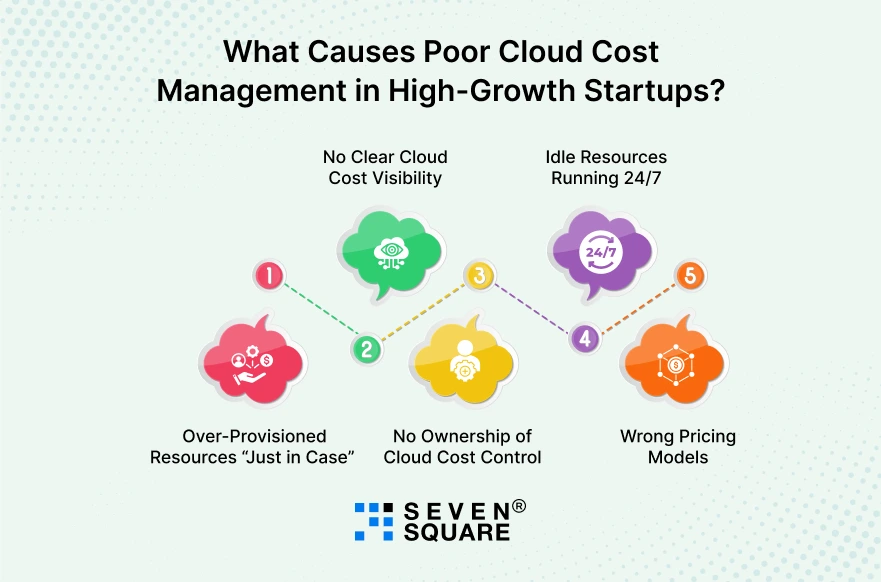
Startups overspend because cloud systems grow faster than cost awareness. Here are the most common cloud cost management mistakes we see.
1. Over-Provisioned Resources “Just in Case”
- Teams often provision larger instances than needed to avoid performance risks. Over time, this becomes the default setup.
- Without proper cloud resource rightsizing, startups end up paying for capacity they rarely use.
2. No Clear Cloud Cost Visibility
- Most teams don’t have a clear view of who is spending what and why.
- When cloud costs aren’t mapped to features, environments, or teams, optimization becomes guesswork instead of data-driven decisions.
3. Idle Resources Running 24/7
- Unused servers, staging environments, old databases, and background services often run continuously.
- This silent idle cloud resource cost can consume a shocking portion of monthly cloud bills.
4. Wrong Pricing Models
- Many startups stay on on-demand pricing long after workloads stabilize.
- Not using reserved instances or savings plans leads to unnecessary overspending, especially for predictable usage.
5. No Ownership of Cloud Cost Control
- When everyone uses the cloud, but no one owns the cost, optimization never happens.
- Cloud cost management needs accountability.
What Startups & Individuals Are Discussing About High Cloud Costs?
Here’s a Google Cloud user who shares how they believed they had disabled an expensive managed Redis instance, only to find out later that charges were still increasing even though the instance didn’t show up in the console or CLI anymore.
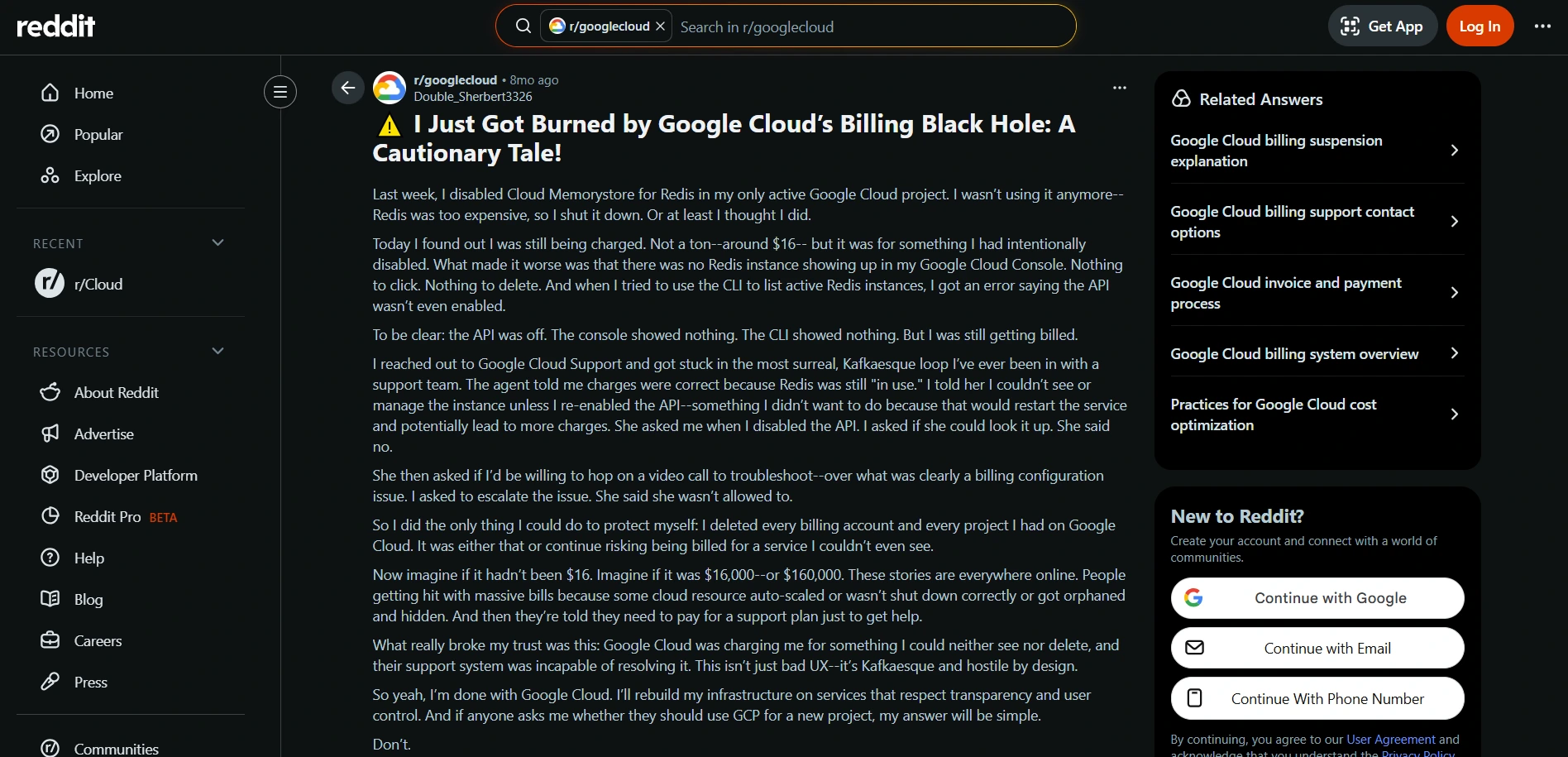
Source: Reddit
What You Should Understand From It?
- No visible usage ≠ no cost, cloud bills can continue to climb even when you think you’ve turned everything off.
- Cloud billing alerts are helpful but not sufficient; they often notify after the fact.
- Without cloud cost management practices in place, this kind of invisible waste can drain cash fast, especially for startups running on tight budgets.
Why Most Startups Don’t Realize They’re Overpaying for Cloud Services?
Cloud overspending rarely feels like a mistake. That’s why it goes unnoticed for so long. In most startups, engineers focus on performance and uptime, not cost.
Finance teams see a large cloud invoice but don’t understand what’s driving it. Founders assume that if the app is running fine, the cloud setup must also be fine.
That assumption is expensive.
Cloud platforms are designed to scale fast, not to stop you from overspending.
There’s no clear signal telling you, “Hey, this server is unnecessary” or “You’re paying double for this workload.” Without proper cloud cost visibility, startups miss:
- Which services are actually needed?
- Which resources are idle?
- Which teams are driving most of the cloud spend?
This is why poor cloud cost management stays invisible until the burn rate increases. By the time founders react, months of cloud billing waste have already happened.
Explore Cloud Migration Mistakes.
How Did We Reduce Cloud Costs Without Hurting Performance?
One of our startup clients came to us with a simple concern: “Our cloud bill keeps increasing, but our growth isn’t according to it.”
They were running a production application on AWS, scaling steadily, but their monthly cloud cost had increased by over 45% in six months.
What did we find?
- Over-provisioned compute instances running at low utilization.
- Multiple idle environments running 24/7.
- No clear ownership of cloud cost control.
- On-demand pricing is used for predictable workloads.
What We Delivered?
- 42% reduction in monthly cloud costs.
- No performance degradation.
- Better cost visibility for the founder.
- Longer runway without slowing product development.
This is what effective cloud cost optimization for startups looks like: Practical, measurable, and sustainable.
What’s Our Proven Approach to Fix Cloud Cost Management Issues?
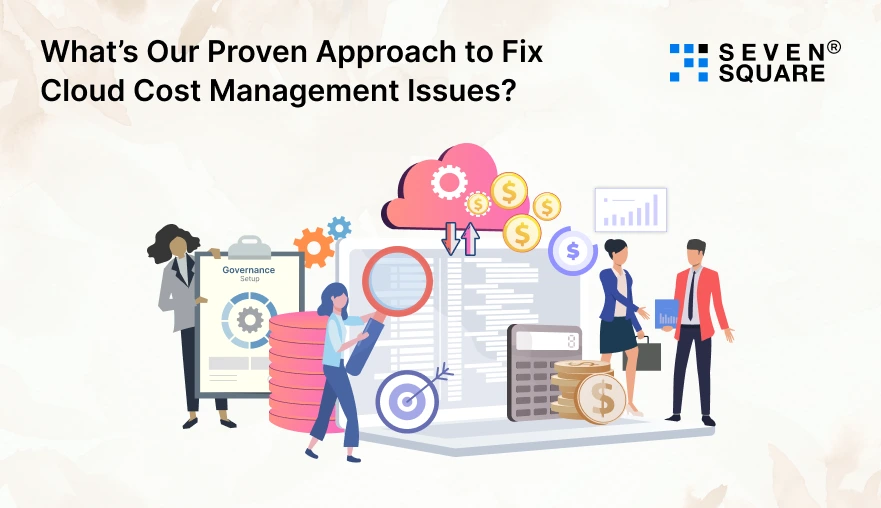
We don’t believe in one-time cost-cutting. We focus on long-term cloud cost management that grows with your startup. Our approach is simple:
- Cloud Cost Visibility: We map cloud spend to services, environments, and teams so costs finally make sense.
- Resource Rightsizing: We match infrastructure size to real usage, not assumptions.
- Pricing Optimization: We help choose the right pricing models for stable vs dynamic workloads.
- Cost Governance Setup: Budgets, alerts, and ownership so cloud cost control doesn’t disappear again.
- Ongoing Optimization: Cloud changes daily. Cost management should, too.
Want to Get Cloud Management Services? Contact Us Today!
How to Stop Overpaying for Cloud Services?
You don’t need to rebuild everything to regain control. Start with:
- Understanding your cloud spend.
- Identifying obvious waste.
- Fixing the highest-impact issues first.
If you want expert help, we can review your setup, highlight cost leaks, and help you fix them without slowing your team.
FAQs
- Cloud platforms don’t stop you from overspending, and most startups lack cost visibility and ownership.
- Cloud cost management is the practice of monitoring, controlling, & optimizing cloud spending to reduce waste and improve efficiency.
- At least monthly. Fast-scaling startups should review costs continuously.
- Yes. We work across major cloud platforms and focus on startup-specific needs.