A senior care app typically costs between $18,000 and $300,000+, depending on how deep the platform goes. An MVP usually takes 8–12 weeks, a mid-level product takes 3–5 months, and a full ecosystem can take 6–9 months or more.
Do seniors really adopt platforms first,
or do they simply need something reliable they can trust?

Your father had an answer for everything when you were growing up.
Your mom once ran a household of six without missing a step.
But today, he pauses in front of his phone, trying to understand where the app moved his medicine reminder.
She notices the screen looks different again, but instead of asking, she quietly puts the phone away.
Not because they cannot learn.
But because every update, every notification, every casual “just Google it” feels like a small reminder that the world moved forward without waiting for them.
And the hardest part is this:
Most of the time, nobody notices.
We call it technological progress. 😔
For them, it often feels like being left behind.
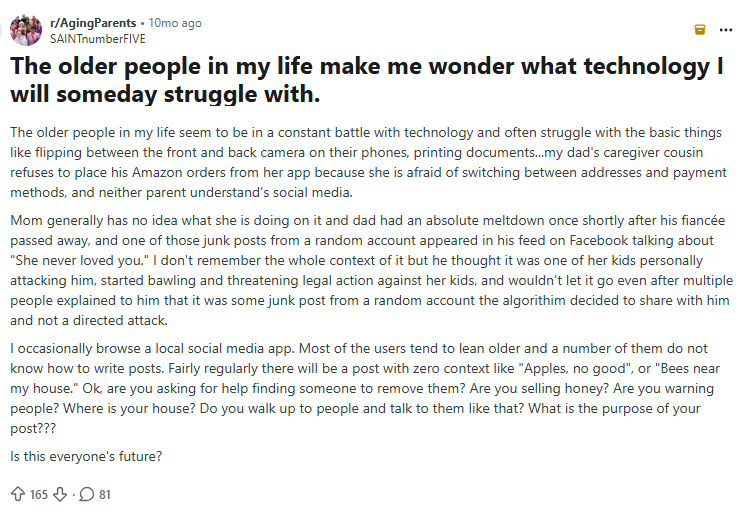
Behind most of Reddit thread every worried son, every late-night Google search about aging parents, there is the same silent question:
How do we help the people who once helped us with everything?
This is no longer just a family problem.
In Europe, nearly 1 in 5 people is over 65 years old today, and that number is expected to rise to almost 1 in 3 by 2050.
The United States is also on a similar path, with its senior population expected to double from 45 million to 90 million in the coming decades.
India, which is often thought of as a young country, is slowly entering the same phase. It already has over 100 million seniors, with that number expected to reach almost 194 million by 2031.
Every year, more families are trying to figure out how to care for their aging parents, but the products meant to support them are falling short.
That gap is where something meaningful can be built.
The B2B Opportunity: Why Build for AgeTech Now?

The AgeTech market isn’t a trend.
It’s being forced into existence by demographics that no policy will reverse.
1. Aging Is Outpacing Care Systems
- In OECD countries, 18.5% of the population is already aged 65+, today there are 33 seniors for every 100 working-age people.
- By the late 2070s, older adults will outnumber children worldwide.
2. Caregiving Is Becoming a Global Family Problem
- Families are becoming smaller, children are moving to different cities, and elderly parents are often managing daily life with less direct support than before.
- Governments and health systems are already warning about loneliness, neglect, and caregiving gaps as serious long-term issues.
3. AgeTech Is Creating a 50+ Economy
- The global 60+ population is projected to exceed 2.1 billion by 2050.
- This aging population is fueling what people call the “silver economy.” A market that covers healthcare, wellness, everyday support, and financial services.
Why “Regular Apps” Don’t Work for Senior Care
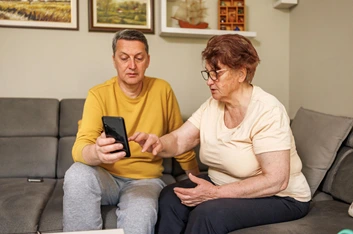
We have seen that most senior care apps do not fail because of missing features or weak technology. They fail because they are built for product thinking, not for human behavior.
3 Weak Spots Blocking User Adoption
1. Confidence Gap, Not Just UX
When navigation feels confusing, buttons feel unclear, or basic actions take too many steps, seniors lose confidence before they experience value. In our experience, usability is not a design improvement, it is the foundation of adoption. If the experience feels difficult, users do not try harder, they simply leave.
2. Trust Gap, Not Just Security
In elder care, trust decides usage more than features ever will. If an app feels unfamiliar, unsafe, or emotionally disconnected, adoption stops immediately. We always build for simplicity, transparency, and predictability first, because trust is something products must earn, not assume.
3. Relationship Gap, Not Just Coordination
Senior care is never managed by one person alone. Families, caregivers, doctors, and service providers all shape the same journey. Any product built only for the senior user misses the real ecosystem. We believe the strongest senior care apps are not single-user products, they are trust systems for everyone involved.
This is where the real opportunity exists.
The companies that solve confidence, trust, and relationships at scale will define the future of elder care.
Types of Senior Care Apps in the Market Today
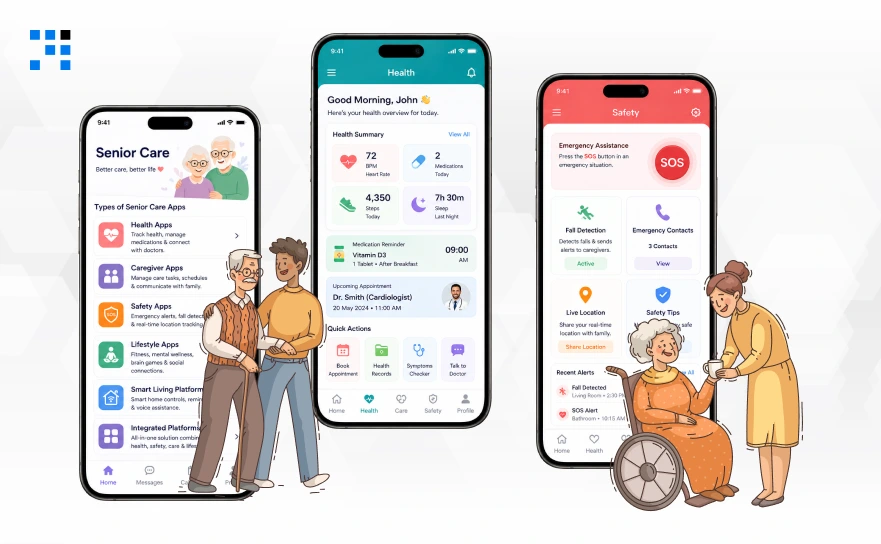
Before starting development, it’s worth understanding how the market is actually structured because most apps in this space are built to solve one specific problem, not the whole picture.
| Type | What They Solve | Key Gap |
|---|---|---|
| Health Apps | Medication tracking, health management | Low daily engagement |
| Caregiver Apps | On-demand assistance | Difficult to scale |
| Safety Apps | SOS alerts, emergency response | Purely reactive |
| Lifestyle Apps | Social engagement | Low retention |
| Smart Living Platforms | IoT and smart home integration | High cost, complex setup |
| Integrated Platforms | All-in-one ecosystem | Complex to build |
Most apps solve isolated problems, and the real opportunity lies in building something that connects all of those pieces.
Senior citizens often need help at home with everyday tasks, especially when they’re alone or at odd times, and that’s where home services platforms come in.
Explore how to build a home services app like Urban Company.
Feature Priorities: What to Build First and What to Scale Later
Most founders plan for a full platform. Seniors only need one trusted habit first.
To make that practical, here is how we usually define feature priorities, starting with what creates daily trust and only then expanding into advanced experiences.
| Layer | What Builds Trust First | What Scales Later |
|---|---|---|
| UI | Large-text, high-contrast, simplified interface | Personalized dashboards per user type |
| Safety | One-tap SOS emergency alert | AI-driven fall detection via wearables |
| Health | Daily medication reminders and alerts | Predictive health alerts, behavioral pattern detection |
| Caregiving | Basic caregiver and family dashboard | Real-time coordination, task assignment, activity feed |
| Engagement | Events feed, basic notifications | Gamification, coin rewards, daily habit loops |
| Access | Online only | Offline accessibility with SMS fallbacks |
| Care | In-app communication | Embedded telemedicine and remote care |
| Payments | Basic in-app payments | Full-service marketplace with subscription tiers |
| Data | Simple admin analytics | AI-powered usage insights and care pattern tracking |
Building features is not the difficult part.
Making them work for seniors across trust levels, devices, internet speeds, and daily routines is where real product thinking begins.
The Tech Stack & Compliance Non-Negotiables
Most senior care app failures don’t start with a bad idea. They start with the wrong technical foundation and compliance decisions that were left for later.
If you want your app to work in the real world, you have to get both right from day one.
| Layer | Technology | Compliance Consideration |
|---|---|---|
| Frontend | React Native or Flutter | WCAG 2.1 AA accessibility standards required |
| Backend | Node.js | Role-based access controls and audit logging |
| Database | PostgreSQL or MongoDB | Encrypted at rest, HIPAA and GDPR compliant storage |
| Cloud | AWS or equivalent | Data residency rules per market (US, EU, India) |
| Payments | Razorpay | PCI-DSS compliant transaction processing |
| Health Integration | Apple HealthKit, Wearables APIs | Patient data handling under HIPAA guidelines |
| Real-time | WebSockets, Firebase | Encrypted data transmission end-to-end |
| Authentication | Biometric, 2FA, session controls | Designed for seniors, secure but never lockout-prone |
Three compliance frameworks govern this space:
- HIPAA (US) – Sets the rules for how patient health data is stored, shared, and protected.
- GDPR (EU) – Covers personal data collection, consent, and the right to deletion.
- DPDP Act (IN) – Regulates digital personal data processing and protection obligations.
Getting compliance right from the start is far cheaper than fixing it after something breaks.
Security basics aren’t optional, since seniors are more vulnerable to fraud.
How Much Does It Cost to Build a Senior Care App?
The cost of building a senior care app depends on the level of product you’re aiming for. Here’s a breakdown of what it typically costs at each stage.
| Stage | Timeline | Estimated Cost (USD) | What You Get |
|---|---|---|---|
| MVP | 8–12 Weeks | $18,000 – $45,000 | A simple, senior-friendly app with SOS alerts, medication reminders, and a basic caregiver view to test with real users. |
| Mid-Level | 3–5 Months | $45,000 – $120,000 | Better coordination tools, health tracking, shared access for family, and features ready for regular use. |
| Advanced Platform | 6–9 Months | $120,000 – $300,000+ | A complete ecosystem with smart health tracking, device integration, stronger workflows, and high-level security. |
These numbers show how much more complex a full platform is compared to an MVP. The better approach is to start small, see what actually works, and build from there.
Trying to do everything at once often wastes time and money. In senior care, what matters most is building something people can rely on every day.
Why Seniors Don’t Stop Using Apps Because of Age, But Because of Design
1. Large Fonts and High Contrast – Use bigger text and strong contrast so everything is easy to read and act on.
2. Simple Navigation – Keep flows short and obvious. If it takes more than two taps, it’s too complex.
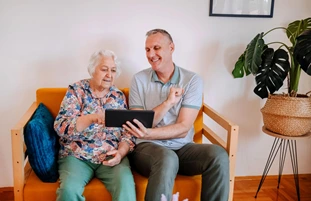
3. Touch-friendly UI – Use large buttons, avoid hidden gestures, and keep everything easy to see and tap.
4. Reduce Cognitive Load – Show only what matters on each screen. Make it simple and uncluttered.
5. Real-User Testing with Seniors – The fastest way to improve is to watch senior users use the app and fix where they struggle.
6. WCAG Accessibility Standards – Make sure things like contrast, navigation, and screen support work before launch, not after.
It’s rarely the technology that causes senior care apps to fail. It’s the experience. If senior citizens struggle to navigate the app, they simply won’t use it.
How Khyaal Built Trust Before It Built Revenue
Khyaal did not start by selling services.
They started by solving embarrassment.
Founder Hemanshu Jain noticed his father kept calling for small digital help like OTT renewals, mobile recharges, and simple app tasks. These were not technical problems, they were dignity problems.
That became the real insight.
Seniors were not asking for more technology.
They were asking for confidence.
So instead of building features first, Khyaal built trust first.
Their Growth Followed This Simple Sequence
| Step | What They Did | What it Created |
|---|---|---|
| Step 1 | Started with WhatsApp groups | Real user validation |
| Step 2 | Built community events | Daily engagement habits |
| Step 3 | Added services and commerce | Natural monetization |
| Step 4 | Introduced fintech products | Higher lifetime value |
Why Their Retention Worked
Khyaal Coins were not just rewards.
Every action inside the app created a reason to return.
This turned the platform from a useful tool into a daily habit.
That is the real difference between downloads and retention.
The Real Lesson
Most founders try to build revenue first.
Khyaal proved the opposite works better:
Trust first. Revenue later.
Because in senior care, people do not pay for features.
They pay for reliability they already trust.
Invest 30 Minutes Before You Invest 6 Months
Building a senior care app is not just a technology decision, it is a business decision that affects adoption, compliance, retention, and long-term revenue.
1. We Start With Business Strategy, Not Just Development
Before any wireframe or code, we help define the real problem worth solving. A strong MVP is not about building more features, it is about identifying the one daily behavior that creates trust and adoption. This protects your investment from becoming expensive assumptions.
2. Our Process Is Built Around Product-Market Fit
We follow a clear sequence: validate early, launch lean, learn from real users, and scale only after trust is earned. This reduces wasted development cycles and helps you move toward revenue with confidence instead of guesswork.
3. Experience That Reduces Expensive Mistakes
With 20+ years of building digital products, we understand where founders usually lose time and money. Our focus is not only technical delivery, but strategic decision-making that helps your product succeed commercially, not just function technically.
4. Cross-Industry Experience Where Trust Matters Most
Senior care products require the same discipline seen in healthcare, fintech, and community-led platforms, where compliance, retention, and credibility decide growth. We bring proven frameworks from these industries to help your product scale with stronger fundamentals.
5. We Think Like Partners, Not Vendors
We do not simply execute requirements. We challenge unnecessary complexity, question risky assumptions, and help prioritize the right features in the right order. Strong products are built through better decisions, not bigger feature lists.
6. Clarity Before Commitment
This discovery call is not a sales conversation. It is a working session where we discuss your senior care app vision, identify technical and compliance roadblocks, and map a realistic MVP scope, timeline, and budget. You leave with clarity, whether you build with us or not.
In senior care, trust is the product.
Everything else is just software.
Let’s make sure you build the right product before you build the bigger one.
Schedule Your Meeting with us, now.
FAQs
We have seen that most senior care apps fail not because of weak technology, but because they are built with a technology-first mindset instead of a trust-first approach. Seniors do not leave apps because they dislike digital tools, they leave when the experience feels confusing, unsafe, or disconnected from their daily routine. We always believe adoption starts with confidence, which is why the right product begins with simple navigation, one-tap emergency access, medication reminders, and clear family visibility, because in elder care, trust matters more than features.
We believe senior care apps are no longer limited to healthcare startups alone. Hospitals, insurance providers, home care agencies, assisted living businesses, wellness brands, and even community-led startups all need stronger digital systems to support aging adults at scale. If care still depends on manual follow-ups, scattered communication, and disconnected services, the opportunity is already there. The real business is not just care, it is coordinated care.
We have learned that the features seniors trust most are usually the simplest ones. They are not looking for complexity, they are looking for clarity, safety, and predictability. A large-text accessibility-first interface, a one-tap SOS emergency alert, and a shared caregiver dashboard for family visibility create the foundation of daily trust. Innovation can come later, but usability must come first because trust grows from comfort, not from advanced features.
We usually see an MVP take around 8–12 weeks, a mid-level product around 3–5 months, and a full senior care ecosystem anywhere between 6–9 months or more. But we always remind founders that speed should never be the first goal. Building fast is easy, building something seniors actually trust is harder. The smartest products start small, validate early, and scale only after people begin relying on them every day.
We often see founders overspend because they try to build a full ecosystem before proving even one daily habit. An MVP may start between $18,000 and $45,000, while advanced platforms can go far beyond $300,000, but the real mistake is rarely the budget itself. It is spending too much before understanding what seniors will truly use. In senior care, small trust loops create bigger long-term value than large feature lists ever can.
We strongly believe revenue comes after trust, never before it. The most successful senior care apps grow through subscription plans, service marketplace commissions, premium caregiver dashboards, reward systems, and partnerships with healthcare providers or insurance companies. People do not pay for features, they pay for reliability that becomes part of daily life. That is why retention matters far more than launch.
We never treat HIPAA compliance as a final checklist because by then, it is already too late. It has to be part of the product architecture from day one. That means end-to-end encryption, role-based access controls, secure audit logs, protected cloud storage, and regular third-party security reviews must be built into the foundation itself. In healthcare, security is not an extra feature, it is the product’s credibility.