Today, almost every business wants a mobile presence.
Maybe you’re planning an app for your customers, or you want to digitize your services. But there’s one big question that stops most businesses right at the start:
“Should we build a PWA or go for Native App Development?”
This is a very important decision, especially when development costs, timelines, and mobile performance matter more than ever.
With mobile usage growing fast and users expecting smooth, fast, and easy app experiences, businesses want to make sure they invest in the right platform.
We help startups, enterprises, and growing businesses make smart technical choices.
Here in this blog, we will compare PWA vs Native App Development.
Based on this comparison, you can decide the best choice for your business according to your goals & budget.
What Is a Progressive Web Application (PWA)?

A PWA (Progressive Web App) is a type of web application that works like a mobile app, but does not need to be downloaded from the Play Store or App Store.
You can simply open it in a browser and even add it to your home screen like a real app. PWAs work across all major browsers like Chrome, Safari, and Firefox.
They are lightweight, fast, and easy to access, which means no heavy installation and no storage issues.
Key Benefits of PWAs for Businesses:
- No installation required, just open and use instantly.
- Works offline (using a technology called Service Workers).
- Loads faster than many regular websites.
- Costs less to develop and maintain compared to native apps.
- Runs on all devices as one build works everywhere.
So if your goal is to reach more users at lower development cost, a PWA can be a very smart choice, especially for startups, eCommerce businesses, & service platforms.
What Is a Native App and How Does It Work?
A Native App is the traditional type of mobile app that you download from the Google Play Store or Apple App Store. It is built separately for Android and iOS, using different programming languages.
Native apps are known for their high performance, smooth animations, and deep access to device features like camera, GPS, microphone, fingerprint sensors, Bluetooth, etc.
This is why apps like banking apps, gaming apps, and social media apps are usually native apps; they need more speed, security, and system-level features.
Where Native Apps Work Best?
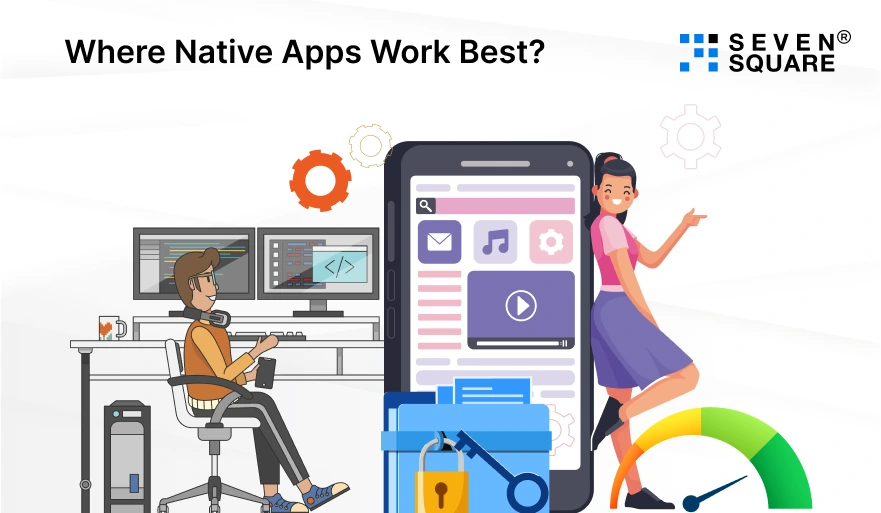
- Excellent speed and performance.
- Advanced animations and smooth transitions.
- Full hardware access (camera, sensors, storage, etc.).
- Best choice for large-scale or high-feature apps.
Native app development usually costs more because you need to build & maintain two separate apps (iOS + Android), which means more development time & higher budget.
PWA vs Native App: Quick Comparison
Here is a quick and simple comparison of PWA vs Native App Development to help you understand what works best for your business needs.
| Feature | PWA (Progressive Web App) | Native App (iOS & Android) |
| Performance | Good performance for most business apps | Excellent performance, smooth animations, faster processing |
| Development Cost | Lower cost (one build works everywhere) | Higher cost (separate app development for iOS and Android) |
| Offline Access | Works offline to some extent (using cache / service workers) | Full offline support and deeper device integration |
| Installation | No app store needed, open in browser or “Add to Home Screen” | Must be downloaded from App Store / Play Store |
| Best For | Startups, MVPs, SMEs, eCommerce, service-based platforms | Large-scale, performance-heavy, feature-rich applications |
- If your priority is lower budget + Faster Launch, then you should choose PWA.
- If your priority is high performance + Advanced features, then you should choose the Native app.
Which One Feels Faster to Users?
When we talk about PWA vs Native performance, the real question is:
“Which one feels smoother and faster when users interact with it?”
Native Apps are known for excellent performance because they are built specifically for iOS or Android.
- They can use device hardware directly, which makes animations, scrolling, camera access, and processing very smooth.
On the other hand, PWAs offer good performance, and for many business applications, the speed difference is barely noticeable.
- Modern PWAs load quickly, respond fast, and can even work offline.
When Performance Difference Matters?
Performance becomes important when your app includes:
- Heavy animations.
- Real-time data processing.
- Gaming or graphics-based interactions.
- High-security transactions.
If your app is simple, like eCommerce, booking, learning, service apps, or directories, the PWA performance is more than enough.
We suggest:
- PWA: For speed, cost savings, and quick launch.
- Native App: For complex, high-performance digital products.
Is PWA Cheaper than Native App Development?
Yes, PWA development is generally cheaper than native app development.
This is because a PWA is built once and works on all devices and operating systems.
But Native Apps need two separate builds (iOS + Android), which means double development and maintenance costs.
| Cost Area | PWA | Native App |
| Development | Lower (one build for all) | Higher (separate Android + iOS apps) |
| Updates | Quick updates, no app store approvals | Updates require store submissions & separate builds |
| Maintenance | Lower long-term cost | Higher maintenance cost due to dual codebases |
User Experience & Engagement: Which One Wins on Retention?
User experience decides whether users stay or leave.
PWAs offer:
- Add a Home Screen button (looks like a real app).
- Push Notifications (in most browsers).
- Fast loading and smooth browsing.
These help improve user engagement and retention, especially if your goal is convenience.
Native Apps offer:
- Stronger animation control.
- More polished UI interactions.
- Consistent device-level performance.
So if your app’s visual experience and animations are important, native apps provide a slight advantage.
But if your main goal is easy access + repeat usage, a PWA works great at a lower cost.
Offline Functionality: Can PWAs Work Like Native Apps?
A common question businesses ask is: Do PWAs work offline like native apps?
Yes, but with limits. PWAs use Service Workers to cache data. This means users can still view pages and use some features without the internet.
Native apps offer full offline functionality, especially for features like:
- Saving data locally.
- Offline forms.
- Offline media access.
So:
- PWA: Partial offline access.
- Native App: Full offline experience.
Why Trust Us for PWA & Native App Development?
Whether you choose PWA development or Native App development, our team ensures that your app is fast, user-friendly, scalable, and cost-efficient.
- We guide you clearly on when to choose a PWA instead of a Native app, and when a Native app is the smarter investment.
- Our team designs apps that load fast, feel smooth, and keep users engaged and coming back.
- From planning to UI/UX, development, testing, deployment, and long-term maintenance, we handle everything.
- Our code is clean, secure, scalable, and ready for future updates without heavy rework.
- Whether it’s Android, iOS, Web, or PWA, we ensure your product works everywhere your users are.
Want a PWA or Native Application? Contact Us Now!
Which Is Smarter for Your Business?
Use this simple decision framework:
| Priority | Smart Choice |
| Low budget + Fast launch | PWA |
| High performance + Hardware features | Native App |
| Testing a new idea / MVP | PWA |
| Scaling a mature product | Native App |
We recommend what fits your business requirements.
Let’s Build an App That Users Love
Both PWAs and Native Apps are powerful, but the smartest choice depends on your budget, features, and business goals.
PWAs are cost-effective, faster to launch, and great for reach, while Native Apps offer top performance and deeper device integration.
FAQs
- Yes, for many business use cases, but not for advanced performance-heavy apps.
- Yes, because you only build it once for all platforms.
- PWA is great for eCommerce due to fast loading and easy access.
- Yes, most modern PWAs support push notifications.
- Yes, PWAs offer partial offline support through caching.