A real estate software is built around the buyer decision and typically costs between $15,000 and $150,000+, depending on how much scope the product covers. An MVP takes 8 to 12 weeks. A mid-level product takes 14 to 20 weeks. A full platform can take 8 months or more.
Do your developers have visibility into buyer preferences
or are they still guessing what buyers want?
Here is something nobody in this space says out loud.
One real estate executive reviewed hundreds of real estate platforms over two years.
His conclusion was blunt:
“A lot of them are very redundant.
People doing the same exact thing or doing a fraction of one thing.”
That is the real problem in 2026.
Real estate developers are still sending hundreds of images to flat buyers with
No categories, no structure, no way to shortlist.
Architects are still chasing client feedback through email threads that go cold.
Interior design startups are still juggling Pinterest, spreadsheets, and calls.
The builders who win in this space are not building more features.
They are building the right workflow end-to-end for the first time.
Why 2026 Is the Defining Year for Real Estate Market

1. The Market Is Forcing It
The global real estate market is expected to grow from $4.9 trillion in 2026 to $7.3 trillion by 2033.
That growth is not coming from enterprise software.
It is being driven by real estate businesses realizing their systems cannot scale.
2. Weak Real Estate Software Is Getting Eliminated
2025 created a clear divide in the real estate software adoption.
The opportunity right now is not to build another feature.
It is to own a real decision-making system before someone else does.
3. Manual Workflows Are Already Costing Millions
Mid-sized firms lose nearly $1.8 million each year to operational inefficiencies.
At the same time, most still use less than 20% of their available data.
Every week without a structured system delays decisions and impacts revenue.
Why Real Estate Teams Abandon Most Platforms

Majority of platforms are built around features.
But real estate decisions are built around people, conversations, and workflows that have existed for decades.
1. Solutions Dressed Up as Platforms
Most products still confuse features with the actual process.
A wishlist feature is not a platform.
A gallery is not a selection process.
A share button is not collaboration.
If users still switch tools, the decision process was never solved.
2. Building Everything Before Proving Anything
Startups must prove their value early before raising capital.
The founders who survive build one core system first.
They get real users on it and watch where the process breaks.
Then they build the next layer.
Trying to launch a full platform on day one is the most expensive mistake in this space.
3. Treating Adoption as Someone Else’s Problem
Systems only work when it fits how real estate teams already operate.
Technology without operational understanding rarely gets adopted.
If the product requires 10 onboarding calls to explain, it will never stick.
The Right Way to Build Real Estate Software
A platform like this should not start with features.
It should start with how choices naturally move from exploration to final action.
| Stage | User Problem | Product Layer | Value Delivered |
|---|---|---|---|
| 1. Discovery Layer | How buyers explore before committing | Structured browsing by category, style, and intent | Shapes attention early, weak discovery breaks everything | 2. Decision Layer | How interest becomes a preference | Context-based saving | Turns browsing into active selection |
| 3. Sharing Layer | How decisions move across stakeholders | Shareable links with live updates | Removes reliance on fragmented communication tools |
| 4. Feedback Layer | How input is collected quickly | Inline reactions and comments | Keeps decisions inside the system |
| 5. Control Layer | How teams track progress | Central view of selections and activity | Replaces assumptions with visibility |
| 6. Optimization Layer | How decisions improve over time | Preference tracking and usage signals | Converts behavior into actionable insight |
Every layer is a decision point that your buyers move through.
Which is why custom software development is the only approach that actually fits.
How Much Does It Cost to Build Real Estate Software in 2026
The cost depends on how much real estate work the platform covers.
More scope means more complexity and longer timelines.
| Platform Tier | What Is Included | Cost Range | Timeline |
|---|---|---|---|
| MVP | Gallery, filters, wishlist, one-link sharing, basic profiles | $15,000 – $30,000 | 8 – 12 weeks |
| Mid-Level | Collaboration, feedback, developer dashboard, analytics | $35,000 – $75,000 | 14 – 20 weeks |
| Full Product | AR preview, AI recommendations, buyer tracking, multi-developer support | $80,000 – $150,000 | 5 – 8 months |
How MOH Improved Buyer Conversion Rate by 20%
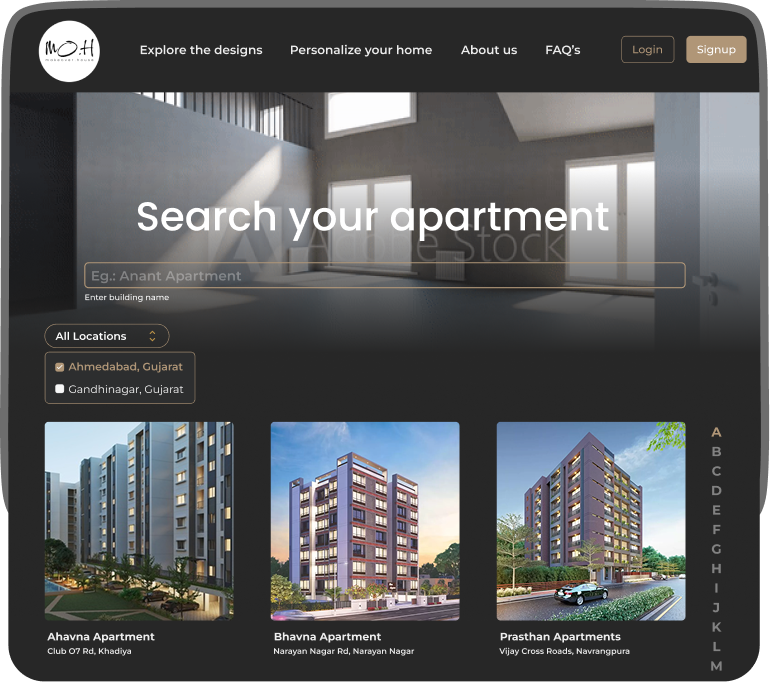
MakeOverHouse was built to fix a broken interior design selection flow.
In real estate projects where:
- Homebuyers were scattered across 5 different apps.
- Architects had no professional collaboration tool.
- Developers had zero visibility into what was being selected and why.
What We Built Inside the Platform
We unified the entire selection journey into one structured flow.
From discovery → shortlist → share → feedback → final decision.
Each stage was converted into a controlled digital layer with visibility for all stakeholders.
Operational Impact After Launch
| Metric | Result |
|---|---|
| Buyer Conversion Rate | 20% improvement |
| Decision Closure Speed | 3x faster approvals |
| Physical Site Visits | 30% reduction |
| Preference Visibility | First-time structured insight into buyer choices |
| Communication Dependency | Major reduction in WhatsApp-based coordination |
This isn’t just about system improvement.
These are the results that come from building the right workflowinstead of just adding a list of features.
Want to see how we mapped the buyer journey?
If You’re Serious About Fixing Buyer Decisions, We’re the Team.
1. We Audit Where Your Process Is Losing Buyers
This is not a surface-level consultation.
We map exactly where your buyers drop off.
Where follow-ups pile up.
Where your team is manually filling gaps that a platform should handle.
That audit becomes the blueprint for everything we build.
2. We Cut the Scope to What Drives Results First
The focus stays on the 3 to 4 features that impact buyer decisions most.
Everything else moves to version two.
You see real outcomes before the full platform is complete.
3. Your Buyers Test It Before a Single Feature Is Finalized
We put working prototypes in front of your actual stakeholders.
Not to show them what we built.
To find every point where the flow breaks before development begins.
One friction point caught here saves 2 to 3 weeks of rework after launch.
4. You Go Live With Zero Decision Friction
Every flow is already configured before the first user logs in.
Roles | Access | Selection logic | Sharing flow.
Your team does not adapt to the platform.
The platform adapts to them.

Delayed buyer decisions result in delayed revenue.
The right build removes every reason for a buyer to pause.
FAQ
Most platforms fail with non-technical buyers because they were never designed for them. We build every interaction around simplicity. One link, zero logins, nothing to download. If a buyer can open a WhatsApp message, they can use what we build.
Pinterest and Google Drive help you collect and store ideas, but isn’t built to manage a real estate selection workflow. We build the platform that takes a buyer from inspiration to a confirmed selection without switching tools or losing context.
A focused MVP takes 8 to 12 weeks from a clear brief to a working product. We spend the first two weeks auditing your workflow before designing a single screen. That one step protects the entire timeline.
Not immediately, but the architecture needs to support it from day one. A platform built without that foundation requires a full rebuild later. We plan for your complete roadmap from the start, so future features are additions, not expensive changes.
We built MakeOverHouse on this exact problem. Decision time dropped from 5 weeks to 10 days, conversions improved by 20%, and that happened because the platform replaced the exact steps where decisions were getting stuck. We build for decisions, not just usage.